Tuesday, January 15, 2008

Growing up with the Newbery


I once read a Shirley Jackson story that had the most perfect ending.

No, not that story.

This was Jackson writing in her jolly-housewife mode (LIFE AMONG THE SAVAGES; RAISING DEMONS), recounting her experiences raising four children in a Vermont college town. The story concerned the countdown to Christmas -- the gift-buying, the tree-getting, the present-hiding -- and ends with two of Jackson's children speaking simultaneously. The youngest boy says, "Next Christmas--" while his older sister says, "Last Christmas--"

I thought that moment perfectly captured the holiday spirit, with the youngest and most innocent part of ourselves already looking forward to future Christmases, while our older, wiser selves grow nostalgic for holidays past. I know I feel that way on Christmas.

I even feel that way on "Newbery Day." I always take the day off work, then get up early and sit anxiously in front of computer and telephone, waiting for the big news. Then, when it arrives, I often need to run out ("run" being the operative word, as if a thousand other book collectors and Newbery enthusiasts are snapping at my heels as we rush to locate books we could have bought last April or May if only we'd known, if only we'd known....) I remember one year in particular when I went racing out to find a copy of THE WHIPPING BOY in the middle of a blinding blizzard, car tires skidding, then having to climb through three-foot snow drifts, only to find the bookstore closing early due to the storm. But I pounded on the wooden door with ice-numbed hands and begged to be let in. The storeowner obliged and the copy of THE WHIPPING BOY I found that day still sits on my shelf. It was one of my finest (and most dramatic) moments in book-collecting.

By the end of Newbery Day, all the drama is over. I sit and think about the winning titles, dwelling on what good or bad choices they were. And I'm like those kids in Shirley Jackson's story, already thinking about "Next Newbery Day" and nostalgically remembering "Last Newbery Day."

At this point in my life, there are a LOT of Last Newbery Days to look back on. I'm not sure when the Newbery Award first drew my attention, though I do remember seeing that shiny gold seal on copies of SHADOW OF A BULL, I, JUAN DE PAREJA, and UP A ROAD SLOWLY in my grade school library...but they all looked...boring. (Years later I read them all and learned that two of them actually weren't boring.) Then came the day the school librarian held up FROM THE MIXED-UP FILES OF MRS. BASIL E. FRANKWEILER and her booktalk of the latest Newbery winner was so appealing that every kid in the class was literally sitting on the edge of their seat, waiting to run and grab the book. When the librarian told us we could get up to select a book, thirty kids all ran toward the K shelf (maybe that's where the feeling of others snapping at my heels first started) but of course someone got there before me. What a bummer. But I did have one secret weapon at my disposal: I was a frequent user of the public library. So that day after school I walked to the public library in the rain, checked out their copy of THE MIXED-UP FILES and have continued to read and love every subsquent Konigsburg book -- and every Newbery book! -- since then.

My favorite Newbery years were the early 1970s. A lot of people today believe that the selection of the award has always been a very secret, cloistered process, with no one outside the committee having any idea what books are being considered. This was not always true. For about four years in the early 1970s, the American Library Association decided to try an experiment, publishing lists of all the books "nominated" for the Newbery and Caldecott awards. Don't believe me? Go look at old issues of School Library Journal and Horn Book from about 1972 through 1975. You'll find the lists there.

I can't tell you how exciting it was to pore over these lists every year, trying to track down as many titles as I could. I'd call the Main Library downtown (which got new books months before the branch libraries) and ask them to send certain books to my local library. (After a while the librarians at the Main Library would sigh, "Hello Peter," as soon as they heard my voice on the phone.) My world kept getting bigger and bigger, as I'd get on my bike and ride to other library branches two or three miles farther away than I'd ever gone before. Or I'd ask my parents to drive me to suburban libraries and get a guest card so I could check out other "Newbery nominees."

The world of books got bigger for me as well. The titles on these lists ranged from picture books (ever heard of HENRIETTA, THE WILD WOMAN OF BORNEO?) to nonfiction (can you imagine a book called FROGS, TOADS, SALAMANDERS, AND HOW THEY REPRODUCE wearing a gold sticker on the cover? It was nominated.) to adult books with young protagonists (LIFE IS A LONELY PLACE; IN A BLUEBIRD'S EYE.) Many of the books on these lists are long forgotten (except, perhaps, by me) while others are still read and loved today. The lists of "Newbery nominees" introduced me to authors such as Ellen Raskin, William Sleator, and M.E. Kerr (who instantly became my favorite author and, many books and many years later, became my friend.)

I guess the American Library Association decided that this "experiment" didn't work because, after the mid-seventies, they quit printing lists of Newbery nominees. It might not have worked for them, but it was a total success for me -- instilling an even deeper love of books and expanding my horizons in many ways. I wish the ALA would repeat this experiment in this new century. I can see classes getting involved in reading all the nominated titles, developing their critical reading skills and becoming enthused about books. I can see discussion groups on the internet debating the merits of the nominations. I can see increased book sales and library circulation. I really see no downside to such an experiment.

These are my memories about past Newbery Days and my hope for future Newbery Days.

Sunday, January 13, 2008

Collectability : THE WILD GIRLS


As I type this entry there is a battle of the books going on at the American Library Association’s Midwinter Convention in Philadelphia, where members of the Newbery, Caldecott, Printz, and Siebert committees are locked away making their selections.

Conventional wisdom (or at least Midwinter Convention-al wisdom) would have us believe that Gary D. Schmidt’s THE WEDNESDAY WARS and Christopher Paul Curtis’s ELIJAH OF BUXTON are facing off for the gold medal this weekend. But if there’s one thing I’ve learned in a lifetime of studying the Newbery it’s...expect the unexpected.

It wouldn’t surprised in the least if, when all is said and done, NEITHER of these titles makes the final list and the winner is something I’ve never even considered. It’s happened before.

Right now my bookstore friend and I are trying to send out “positive energy” about our favorite book, hoping it will float from the midwest to Philly and subconsciously influence the Newbery voters. While I’m at it, I think I’m going to send out some positive vibes for THE WILD GIRLS by Pat Murphy (Viking, 2007) in hopes that it can pick up a Newbery Honor. Even without that silver seal, I think this book may find a devoted audience.

Set in 1972, THE WILD GIRLS is narrated by twelve-year-old Joan, newly transplanted from Connecticut to California, where she meets an offbeat girl named Sarah, who prefers to be known as “Fox.” The story gets off to a slightly slow start (ever since Harry Potter, every children’s book seems to be about 50 pages too long and every young adult novel about 100 pages too long) but hits its stride when the two girls win a writing contest and present their story in front of an audience (“We are the wild girls who live in the woods. You are afraid of us. You are afraid because you don’t know what we might do.”) wearing empowering war paint to enhance their courage.

Self-empowerment is one of the themes of this novel. Both girls find their own strength (and support each other) in facing up to parental challenges (Joan’s parents are on the verge of splitting up and Sarah’s mother returns several years after abandoning her) and in taking a summer writing class for kids at the University of California. One of the most appealing aspects of the novel is seeing how the girls apply the lessons they learn in writing class ("Ask questions." "Listen to what people are saying, but figure out what they aren't saying.") to their real-life situations to gain insight and understanding of themeselves and their families.

Why THE WILD GIRLS may become collectable:

It’s the breakthrough children’s book by a noted adult science fiction writer.

Books about writing and storytelling are big with book collectors.

The dustjacket is decidedly different than the now-standard "stock-photo on glossy paper" sported by most books. This one features an arresting color illustration by Gina Triplett on rough paper that gives the book a “classic” appearance.

First printing points:

The" first printing is indicated by the number “1” appearing in this configuration on the copyright page:

1 3 5 7 9 10 8 6 4 2

Difficulty in finding first editions:

At this point there should be no problem at all finding a first edition in bookstores. That could change if the book picks up an award or develops a cult following among aspiring young writers. Also, books of this type often end up selling their first printings mostly to libraries, so the number of copies available to individual customers can become limited. (This is why first editions of books such as A SINGLE SHARD or KIRA-KIRA are so hard to find these days; most of their first printings ended up in libraries.) So why not pick up a copy now just to be on the safe side?

Cha-cha-cha-changes


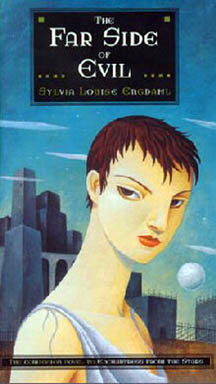
The picture on top shows the first edition of THE FAR SIDE OF EVIL, which was written by Sylvia Louise Engdahl and published by Atheneum in 1971. The illustration below is a later edition of the same novel, published by Walker in 2003. One of my favorite books, this penetrating and thought-provoking novel experienced more than just cosmetic dustjacket changes in the three decades between editions. On her website, Ms. Engdahl discusses the 2003 Walker publication: "This edition has been revised to update its statements about the Critical Stage, the stage of evolution at which a species is ready to begin expanding into space. It is much more timely and convincing than the original 1971 edition, although the action of the story hasn't been changed--so old copies should be discarded."

Discard old copies? Not on your life, Ms. Engdahl!

Most book collectors will want to have both copies in their library in order to document the changes that occured between editions. We want to see how the author's thinking has developed over the years, and will examine it page by page and word by word to see if these alterations have had a positive or negative affect on the novel.

In an earlier blog entry, I wrote about Maia Wojciechowska's anger that her editor added the word "companionable" on the last page of her Newbery winner SHADOW OF A BULL. In fact, Wojciechowska was known for erasing or crossing the word out every time she happened upon a copy of her novel. Finally, after many years and many complaints, as well as the threat of a lawsuit, the publisher removed that word from later editions of the book.

Unless an author labels a book "updated," as Engdahl does, or publicly complains about the situation a lot, as Wojciechowska did, it's unlikely that most of us would be aware of the many minor and major changes that can occur between printings of a book. I have stumbled on a handful myself over the years.

In E.L. Konisburg's wonderful first book, JENNIFER, HECATE, MACBETH, WILLIAM MCKINLEY, AND ME, ELIZABETH, the protagonist appears in a school production and recognizes her friend's mom in the audience because "she was the only Negro mother there." That's what the book said upon publication in 1967. A few years later I came across a later printing and the wording had beeen changed to "she was the only black mother there." I haven't seen a recent copy, but I wonder if it's now been changed from "black" to "African American." (Incidentally, other than the illustrations, which clearly show Jennifer to black, the book's altered line is the only instance in the book where Jennifer's race is mentioned.)

Published in 1969, Konigsburg's humorous baseball-team novel, ABOUT THE B'NAI BAGELS, features an adolescent boy who has an interest in Playgirl Magazine. Clearly, Konigsburg is parodying Hugh Hefner's famous "Entertainment for Men" publication, though she gives it a different name. However, a few years later a magazine called Playgirl did come into being and this one called itself "Entertainment for Women." Obviously this would change the intentions of Konigsburg's protagonist, so in later editions of ABOUT THE B'NAI BAGELS, the name of the magazine was changed to Playboy.

In 1996, Cheryl Ware published an amusing epistolary novel called SEA MONKEY SUMMER. When her book FLEA CIRCUS SUMMER was released the following year, I assumed it was a sequel..but it turned out to be the same book under a new title. I later heard that all the copies published under the original title were withdrawn from the market, and can only assume that perhaps the term "sea monkeys" is trademarked or copyrighted and can't be used by just anyone.

Over the years, many well-known children's books have undergone alterations because they are no longer deemed politically correct. In Hugh Lofting's Dr. Dolittle books, Polynesia, the talking parrot who probably seemed quite charming in the 1920s is now recognized as a dirty bird who freely uses racial epithets -- and Lofting's ilustrations of black characters are grotesque caricatures. These components have been changed in later editions of the books. I have also heard (though I cannot document this one personally) that some of the original illustrations in Maud and Miska Petersham's Caldecott winning picture book, THE ROOSTER CROWS, have been called racially insensitive and were replaced in later editions. Changing a book's text or illustrations to reflect modern sensibilities is a double-edged sword. If emendations are made to represent modern values, the book may stray too far from the author's original intent and vision. Yet if these changes are not made, the book might not be allowed in libraries or sold in bookstores.

Of course there are also times that a book is changed not because it's wrong-headed, but just because it's simply WRONG. Genevieve Foster was one of the twentieth century's premiere writers of children's histories. She garnered four Newbery Honors throughout her career, starting with GEORGE WASHINGTON'S WORLD:


However, just a few pages into that mammoth volume, she made a rather significant error on this page. Click on the image below to get a better view:


Did you figure it out? This page was immediately corrected and the mistake did not occur in later editions.

What changes have you noticed or heard about in children's books over the years? Feel free to share them here!