Today’s Sunday Brunch includes the usual mix of fact and opinion on children’s books and includes the complete list of Dorothy Canfield Fisher Award winners from HOLES and BUD, NOT BUDDY to a few titles I never even
heard of before.
A WHIFF OF NOSTALGIA
There are all kinds of reasons for reading a book -- most of them excellent.
But I just read a book for a rather silly reason.
I liked the way it smelled.
Actually, I first pulled the book from our library shelves because of its strange title, NOTHING EVER HAPPENS AND HOW IT DOES.
When I noticed that one of the co-authors was Dorothy Canfield Fisher (the other was Sarah N. Cleghorne), I was even more intrigued. Ms. Fisher’s reputation as a children’s author pretty much rests on a single book, UNDERSTOOD BETSY (1917), though I’ve recently discovered that two of her adult novels, THE DEEPENING STREAM (1930) and SEASONED TIMBER (1939) were serious contenders for the Pulitzer Prize.
NOTHING EVER HAPPENS is a volume of purposeful stories, written expressly to get young readers discussing a variety of moral situations. A girl realizes a classmate is taking advantage of her.

A boy acts out and later apologizes to his family. In one of the strongest tales, the citizens of a town refuse to financially assist a poor, shiftless family, yet turn out en masse to help find the family’s youngest daughter when she goes missing. While I agree that these stories might lead to some fascinating philosophical debates for young readers, many adults would find the volume preachy and fairly basic. I know I did. Yet I couldn’t put the book down till I finished it because, well...because it
smelled so good!
When I held this book open, it gave off a strong aroma of furniture polish. I guess we all have specific scents that take us back to a certain time and place in our lives -- and this was indeed a very specific fragrance for me. It came from the days before spray polish, back when furniture polish came in cans and was rubbed into tabletops and chairs with a dustrag. (If I shut my eyes I can picture the square metal container; I can’t quite recall the name, but I remember the can was decorated with stripes.) And of course the reason I remember this smell was because I always associate it with happy occasions.
Back when I was a kid, my family would invite relatives over for Sunday dinner every couple months. The day before these events, our parents would toss us out of the house and spend hours scrubbing, dusting, vacuuming, and cooking. I still remember returning home those twilights, with the setting sun slanting through the front windows. The kitchen floor would be so slick you could practically skate across it, the furniture so shiny you could see your reflection in it. There was usually a cake or pie in the oven (tomorrow’s dessert) and the anticipatory feeling of “Company coming, company coming!” Plus the smell of that old-fashioned furniture polish in the air.
So when I opened NOTHING EVER HAPPENS and sniffed the exact same aroma on every page, I was immediately taken back to my childhood. I even got kind of excited, thinking, “Company coming!” though no guests were expected this weekend. Incidentally, the book was published in 1940 and, according to the bookplate inside, our copy was owned by a married couple for nearly fifty years before it was donated to the library. I assume it sat on a wooden shelf (I like to imagine the previous owners had a den or study or even a “home library”) and that the shelf was polished every now and then with the exact same product my family used. The book soaked up that aroma...which remains there today...taking me back to a time when everything seemed shiny and exciting.
A MISUNDERSTOOD TITLE
Very few people remember NOTHING EVER HAPPENS these days, but the author’s first book, UNDERSTOOD BETSY, continues to be read and enjoyed. I know at least a couple people who still call it their all-time favorite book. The novel concerns a coddled nine-year-old girl who is sent away from home to live with a loving, no-nonsense Vermont farm family. UNDERSTOOD BETSY provides both an old-fashioned view of New England life in an earlier era and -- as "Elizabeth" transforms into "Betsy" -- a still-timely message about self-sufficiency and personal growth.
Canfield's novel remains in print today (hey, you can even get it on Kindle!) although, strangely, the title is often misquoted as “MISUNDERSTOOD BETSY.” Just this week I saw the incorrect title used in a Jean Stafford short story. And Google led me to a lecture in which Robert Frost also discussed the book “MISUNDERSTOOD BETSY.”
AN AWARD
Incidentally, are you familiar with the Dorothy Canfield Fisher Children’s Book Award? It doesn’t get much press, even though it’s been around for more than half a century.
This award -- for books appropriate for grades four through eight -- is selected by the children of Vermont. These days we have many (perhaps too many?) children’s choice book prizes, but it’s important to remember that the Dorothy Canfield Fisher Award, begun in 1956, was only the second such award established in this country.
Here is the list of winning titles:
2009 DIARY OF A WIMPY KID / Jeff Kinney
2008 RULES / Cynthia Lord
2007 FLUSH / Carl Hiassen
2006 THE OLD WILLIS PLACE / Mary Downing Hahn

2005 THE TALE OF DESPEREAUX / Kate DiCamillo
2004 LOSER / Jerry Spinelli
2006 LOVE THAT DOG / Sharon Creech
2002 BECAUSE OF WINN DIXIE / Kate DiCamillo
2001 BUD, NOT BUDDY / Christopher Paul Curtis
2000 HOLES / Louis Sachar
1999 ELLA ENCHANTED / Gail Carson Levine
1998 SMALL STEPS: THE YEAR I GOT POLIO / Peg Kehret
1997 MICK HARTE WAS HERE / Barbara Park
1996 TIME FOR ANDREW / Mary Downing Hahn
1995 THE BOGGART / Susan Cooper
1994 JENNIFER MURDLEY'S TOAD / Bruce Coville
1993 SHILOH / Phyllis Reynolds Naylor
1992 MANIAC MAGEE / Jerry Spinelli
1991 NUMBER THE STARS / Lois Lowry
1990 WHERE IT STOPS, NOBODY KNOWS / Amy Ehrlich
1989 HATCHET / Gary Paulsen
1988 WAIT TILL HELEN COMES / Mary Downing Hahn
1987 THE CASTLE IN THE ATTIC / Elizabeth Winthrop
1986 THE WAR WITH GRANDPA / Robert Smith
1985 DEAR MR. HENSHAW / Beverly Cleary
1984 A BUNDLE OF STICKS / Pat Rhoades Mauser
1983 TIGER EYES / Judy Blume

1982 THE HAND-ME-DOWN KID / Francine Pascal
1981 BUNNICULA / James Howe
1980 BONES ON BLACK SPRUCE MOUNTAIN / David Budbill
1979 KID POWER / Susan Beth Pfeffer
1978 SUMMER OF FEAR / Lois Duncan
1977 A SMART KID LIKE YOU / Stella Pevsner
1976 THE TOOTHPASTE MILLIONAIRE / Jan Merrill
1975 THE EIGHTEENTH EMERGENCY / Betsy Byars
1974 CATCH A KILLER / George Woods
1973 NEVER STEAL A MAGIC CAT / Donald E. Caufield
1972 FLIGHT OF THE WHITE WOLF / Melvin Ellis
1971 GO TO THE ROOM OF THE EYES / Betty K. Erwin
1970 KAVIK THE WOLF DOG / Walt Morey
1969 TWO IN THE WILDERNESS / M. W. Thompson
1968 THE TASTE OF SPRUCE GUM / Jacqueline Jackson
1967 THE SUMMER I WAS LOST / Phillip Viereck
1966 RIBSY / Beverly Cleary
1965 RASCAL / Sterling North
1964 THE BRISTLE FACE / Zachary Bell
1963 THE INCREDIBLE JOURNEY / Sheila Burnford

1962 CITY UNDER THE BACK STEPS / Evelyn Sibley Lampman
1961 CAPTAIN GHOST / Thelma Bell
1960 DOUBLE OR NOTHING / Phoebe Erickson
1959 COMANCHE OF THE SEVENTH / Margaret Leighton
1958 FIFTEEN / Beverly Cleary
1957 OLD BONES, THE WONDER HORSE / Mildred Pace
THAT LIST!
I must admit that I’m quite fascinated by the titles that have won the Fisher Award. Of course one expects to find some Newbery winners (NUMBER THE STARS; HOLES) and Honors (ELLA ENCHANTED; BECAUSE OF WINN-DIXIE), a couple classics (INCREDIBLE JOURNEY), as well as books by perpetually-favorite authors (Beverly Cleary) and titles that are more popular than literary (WIMPY KID.) But I’m intrigued by the wide range of books represented, from youngish (RIBSY) to YA (TO CATCH A KILLER; SUMMER OF FEAR.) I’m surprised that Mary Downing Hahn has won three different times. And, most of all, I’m shocked that a few books made this list that I’d never heard of before. Okay, OLD BONES THE WONDER HORSE was published before I was even born...but where was I in 1980 that I never even heard of BONES ON BLACK SPRUCE MOUNTAIN?
ANOTHER TITLE I DIDN’T KNOW
Out of curiosity, I decided to look up one of the books I didn’t know, the intriguingly-titled GO TO THE ROOM OF THE EYES by Betty K. Erwin, which won the award in 1971. From what I’ve read, the story concerns a treasure hunt in a large mansion and includes such then-timely topics as the plight of returning Vietnam veterans. Author Betty K. Erwin published a handful of novels between 1965 and 1973, including AGGIE, MAGGIE, AND TISH; THE SUMMER SLEIGH RIDE, and BEHIND THE MAGIC LINE. She wrote both fantasy and “problem novels” with an emphasis on civil rights. Her papers are archived at the famous de Grummond Children’s Literature Collection at the University of Southern Mississippi. I can’t stop thinking of her online bio at the de Grummond Collection's website -- specifically, the last two lines:
Erwin failed to publish anything after Who Is Victoria? in 1973, despite writing several children's novels, short stories, and a romance novel. She died of lung cancer in 1989.Although I’m unfamiliar with her work (I plan to get hold of GO TO THE ROOM OF THE EYES very soon) I hate thinking about Ms. Erwin writing away for most of the seventies and eighties and not getting published. Clearly her Dorothy Canfield Fisher Award proved she knew how to write books that kids enjoyed. Were her later books somehow inferior? Had the publishing world passed her by? I’d sure like to read those unpublished manuscripts and see if they could find their way into print today. Even if there wasn’t enough interest to justify large printings from big publishing houses, perhaps Print-on-demand and Kindle formats could fill the bill.
QUESTION FOR THE DAY
Considering that every item in today’s blog seems to be concerned, in one way or the other, with Dorothy Canfield Fisher, I thought I’d throw in something completely unrelated:
When is a CHILDREN’S BOOK not a children’s book?
When it’s written by A.S. Byatt. Her forthcoming novel is titled THE CHILDREN’S BOOK, but it’s not written for kids. It’s an adult novel that spans many years, featuring a character named Olive Wellwood, an author who writes fairy tales. According to a recent interview, Byatt says, “E. Nesbit was a key point of ignition, though Olive Wellwood is not ‘based’ on Nesbit.”
Though not a book
for young readers, it certainly sounds like a title that will interest fans of children’s books.
COMPANY COMING
I started today’s blog by mentioning how the book NOTHING EVER HAPPENS took me back decades to a world of gleaming, hand-polished furniture, cakes in the oven, and the excitement of “company coming.”
Well, would you believe that almost as soon as I finished reading the book, company CAME?
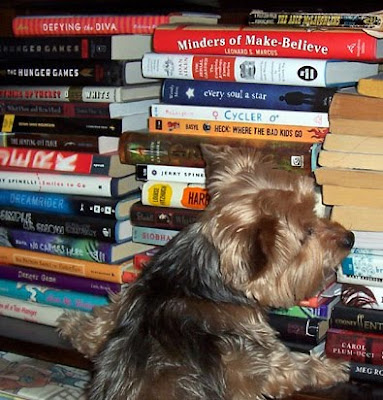
My brother made a surprise visit from Chicago, along with The Most Entertaining Dog in the World, Elgin:

And Elgin is always anxious to see what’s on my shelves.
Nearly sixty years have passed since NOTHING EVER HAPPENS was published. Now we use Pledge spray-polish on the furniture. Cakes are bought, not baked. All those relatives who used to come to our house on Sunday afternoons? They’re gone.
Yet the Canfield book was able to take me back many decades to an earlier era PLUS conjure up a weekend guest! Pretty good for a volume titled NOTHING EVER HAPPENS!
Thanks for visiting Collecting Children’s Books. Hope you’ll be back.


