Saturday, November 12, 2011

November 13 Sunday Brunch

This morning is gray and cold. The wind is whistling down the chimney. I just went out on the deck and watched four honking geese come in for a splash-landing in the pond. Meanwhile, a squirrel was chasing up and down the limbs of a bare tree, as if trying to find his way out of a maze. It's a "coming of winter" morning, as Truman Capote would say -- which is the reason I'm starting off today's blog with Capote's "A Christmas Story." I know, it's a little early in the season, but I didn't want to start with my Joe Paterno entry. That comes later -- along with other random stuff about children's books old and new.


IT'S FRUITCAKE WEATHER

Imagine a morning in late November. A coming of winter morning more than twenty years ago. Consider the kitchen of a spreading old house in a country town. A great black stove is its main feature; but there is also a big round table and a fireplace with two rocking chairs placed in front of it. Just today the fireplace commenced its seasonal roar.

A woman with shorn white hair is standing at the kitchen window. She is wearing tennis shoes and a shapeless gray sweater over a summery calico dress. She is small and sprightly, like a bantam hen; but, due to a long youthful illness, her shoulders are pitifully hunched. Her face is remarkable—not unlike Lincoln’s, craggy like that, and tinted by sun and wind; but it is delicate too, finely boned, and her eyes are sherry-colored and timid. “Oh my,” she exclaims, her breath smoking the windowpane, “it’s fruitcake weather!”


Yeah, I know Truman Capote's "A Christmas Memory" isn't technically a work for children. In fact, its mix of nostalgia and poignancy is probably best appreciated by adults. But it does feature a child protagonist, and every kid in the United States probably reads it in a school textbook before they're twelve-years-old. And, in 2006, fifty years after its original publication in an adult magazine, the story made its debut as a children's book:


It's one of my all-time favorites and if the above passage made you want to read it again or (where have you been?) read it for the first time, you can even read it on the internet, here or here. I'm not sure who posted the story and I'm sure it's all kinds of illegal, but it's out there so you might as well read.

If you're around my age, you may remember the wonderful (and wonderfully faithful) 1960s TV special made from this story. Geraldine Page won an Emmy for her performance. If you want to revisit the movie, or see it for the first time, it's available in six parts on Youtube:


I must admit I was a bit put off by one of the first viewer comments is from a kid who says, "im watching this cause my homework nd i dont like 2 read."

If you think it's still too early for Christmas memories, you might prefer Capote's other holiday classic, "A Thanksgiving Visitor." This story was also originally published for adults, but was co-opted for kids with this 1996 illustrated edition:


It was also made into a TV movie, for which Geraldine Page won her second Emmy. And it's also available on Youtube in five parts, starting here:


FROM THE SUBLIME TO THE RIDICULOUS

If you've been following the shocking and shameful events at Penn State this past week, you may have had an experience similar to mine.

Reading Joe Paterno's biography on the Wikipedia, I noticed the different "categories" were Paterno's name is included:

Penn State Nittany Lions football coaches
1926 births
people of Italian descent
American children's book writers

Children's book writers?

Though it's undoubtedly strange to see him listed there between Dillwyn Parrish and Katherine Paterson, he made the list by virtue of this 2007 children's book he wrote with his wife Sue:


He was also the subject of a 1974 children's book SIX DAYS TO SATURDAY by Jack Newcombe:


Jerry Sandusky, the criminal at the center of this case (oh, I shouldn't say that because he's "innocent until found guilty"? Sue me for slander) also wrote a book, although thankfully it's not a children's book.

The title?

TOUCHED.

Talk about flaunting it.

Talk about hiding in plain sight.

When I first looked this book up on Amazon.com last weekend there were only a couple customer reviews.

Now there are over one hundred.

Few, if any, of those reviews are from people who have actually read the book. Most are just using the space to comment on the Penn State case. I find this fascinating. I've bemoaned the fact that when bookstores close, folks can't find a place to share their thoughts and opinions with like-minded people -- "book people." It looks like they have found a way now...by visiting online bookstores.


BIL KEANE

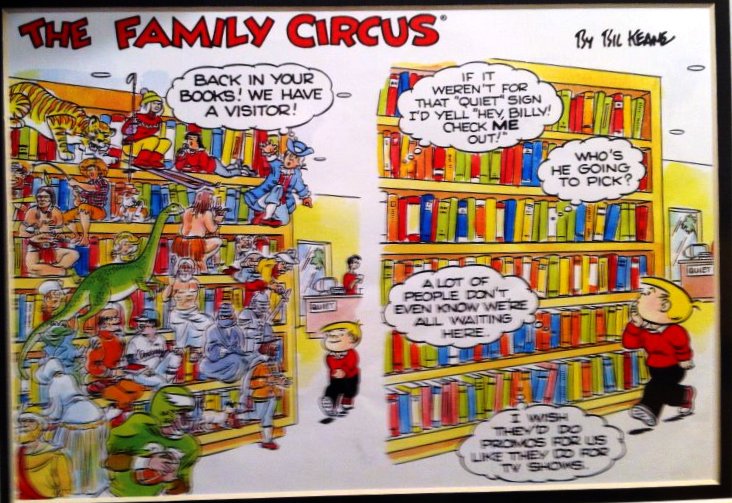
I was sorry to hear about the death of Family Circus creator earlier this week. Although he never illustrated a children's book, his newspaper comic usually provided either laughs or smiles of recognition in its depictions of how kids think and feel. (Though he did run to those "Ida Know" and "Not Me" into the ground, didn't he?)

He also produced some cartoons that advocated literacy. My co-writer Julie Walker Danielson shared this one with me:


and now here is one I'm sharing with Julie -- and you:


R.I.P., Mr. Keane.


HEAVY MEDAL SHORTLIST

Over at the Heavy Medal blog , Jonathan Hunt and Nina Lindsay have announced their Newbery shortlist. The titles are:

THE ADVENTURES OF SIR GAWAIN THE TRUE by Gerald Morris

AMELIA LOST by Candice Fleming

HEART & SOUL by Kadir Nelson

I BROKE MY TRUNK by Mo Willems

THE MONEY WE’LL SAVE by Brock Cole

A MONSTER CALLS by Patrick Ness

OKAY FOR NOW by Gary Schmidt

PENDERWICKS AT POINT MOUETTE by Jeanne Birdsall

THE TROUBLE WITH MAY AMELIA by Jennifer Holm

WONDERSTRUCK by Brian Selznick

I'm 7/10.

How'd you do?

I was tickled to read Jonathan's later comments about three titles that almost made the cut:

PIE by Sarah Weeks

MO WREN, LOST AND FOUND by Tricia Springstubb

NEVER FORGOTTEN by Patricia McKissack

It was like hearing rumors about which titles almost, but not quite, become Honor Books for the Newbery.


SEUSS BY WHO?

Last night on ANTIQUES ROADSHOW an original drawing by Dr. Seuess was valued at $6000. The appraiser went on to mention that there are a number of fakes on the market. Checking the ROADSHOW's website, I found this article which states that as many as 80% of the "Seuss" drawings in circulation are fakes. The article gives some tips on separating the real stuff from the phony.


CULT CLASSICS

Blog reader and bookseller Pamela Grath from Dog Ear Books in Northport, Michigan recently wrote a blog entry about two of her favorite childhood books, BEYOND THE PAWPAW TREES and its sequel, THE SILVER NUTMEG, both written and illustrated by Palmer Brown.


After reading her enthusiastic comments, I wanted to get my hands on these books myself. Fortunately, my library had both titles in stock.

Published in 1954, BEYOND THE PAWPAW TREES is the story of Anna Lavinia, a young girl with a wandering father and a mother who stays home all cooking pawpaws. Torn between her mother's motto, "Never believe what you see," and her father's rule, "Only believe what you see," Anna Lavinia lives a strange claustrophic life, never attending school, never even leaving her family's property. Then comes the strange "lavender blue" day when Anna's mother sends her daughter off to visit an aunt in a remote location. The girl's adventures traveling on a train and through a desert by camel are nonsense of the first order. I must admit that I am not a fan of nonsense fiction at all. I'm far too literal minded. In fact, reading the book, I wondered if a brief reference to Anna Lavinia being locked in a broom closet by her mother as a punishment was the key to the story; could her fanciful adventures be nothing but the dreams of a captive child? Whatever the case, BEYOND THE PAW PAW
TREES is nonetheless distingusihed by its lyrical language, songs and poems (the book is full of them) and precise line drawings. If you do a search around the internet, you will see that many, many people love this book. First editions cost hundreds or even thousands of dollars. Its 1956 sequel, THE SILVER NUTMEG, also has a cult following. This one is more a fantasy than a nonsense story, as Anna Lavinia discovers another world on the other side of the Dew Pond, where she makes a new friend and solves a romantic mystery. Once again, the language shines, as in this passage describing the tingling feeling of life on the other side of the water:

It was something like the touch of clean cool sheets after a bath on a hot susmmer night, or the smell of the first burning leaves in atuumn. It was like the taste of the first wild strawberry in springtime, or the sound of a train's whistle far off at midnight in winter. It was a little, too, like the tickle before a sneeze, or the thrill that comes when the knot in the ribbon of a gift just begins to loosen. It was like all these things rolled together, ony it was even better.

If you have a taste for whimsical stories, filled with beautiful imagery (a hedgehog floating into a yard on a windy day) and precise, exquisite drawings, these books are for you. The good news is that you don't even need to track them down in unweeded library collections or spend hundreds for a used copy. The New York Review of Books recently reissued PAWPAWS and NUTMEG will be re-released next spring.


PALMER BROWN

Since reading the two Anna Lavinia books, I have been trying to track down information about author-illustrator Palmer Brown.

Strangely, there is almost nothing out there.

So far I've learned that he was born in 1919, educated at Swarthmore College and got a Master's from the University of Pennsylvania, and served four years in the military during WWII. No word about a family, hobbies, avocations.

One source said that he didn't begin drawing until he wrote PAWPAWS and decided to illustrate the book. Another source included this quote about his first book, "“If it has any moral at all, it is hoped that it will always be a deep secret between the author and those of his readers who still know that believing is seeing.”

Although his Contemporary Authors bio lists his career as "Illustrator and author of children's books," and adds that he contributed to WOMAN'S DAY and GOURMET magazines, is it really possible to make a lifetime living from just five middle-selling books (in addition to the two above, he also wrote three stories about mice: CHEERFUL (1957), SOMETHING FOR CHRISTMAS (1958) and HICKORY (1978.) What to make of the twenty year gap between the last two books? Why didn't he ever illustrate books for other authors? How come he never published a collection of poetry and verse since his novels contain so much of it?

These are some of the questions I'd love to ask this now-92 year-old author.


THANKS

Thanks for visiting Collecting Children's Books. Hope you'll be back soon!

Sunday, November 6, 2011

A Sunday Brunch with Geese and Goops

Among other topics, today's Sunday Brunch introduces Mother Goose's family, reveals the sad fate of a famous book dedicatee, and asks if anyone has ever called you a "goop." (They have???)


IF IT HADN'T BEEN HALLOWEEN

Working with children's books, I probably cross paths with Mother Goose several times a week. This past Monday I was moving some volumes around at work and came across this one:


If it hadn't been Halloween that day, I probably wouldn't have thought a thing about it...but it WAS Halloween. And my immediate thought was: "You know, Mother Goose sure looks like a witch!"

I then pulled a few more Ma Goose books from the shelf and they also supported my theory. Hey, substitute a broomstick for that goose she's flying and you could be looking at a Halloween decoration:


This got me wondering about the real identity of Ms. Goose -- and why she's often pictured as an old crone with black peaked hat and billowing shawl. From a little bit of internet research, it appears that the origins of this character are shrouded in mystery. Some trace her back to the first millennium as "Bertha the goose-footed," the wife of King Robert II of France, who was said to enthrall children with her stories. Others say she was a seventeenth-century Bostonian, though that legend has been dismissed by most experts. We probably never will know the truth.

But back to her appearance.

Can anyone explain why this character, meant to represent a kindly children's storyteller, looks like a witch?

I'm assuming that her image was developed over the years by a number of different illustrators until it finally settled into the general "look" it has today. But was the intent to make her look like a witch (right down to those striped "Wicked Witch of the East Socks" in the last picture?) or were the illustrators merely utilizing the then-current "little old lady" fashions of their own historical era?

Anyone know?


AS FAR AS THAT GOES....

We call her "Mother" Goose, but what ever happened to her kids? And where was her husband?

Actually, some of those answers can be found in children's books.

Though I doubt it was the first-ever reference to "Father Goose" in the panetheon of literature, the best-known character by this name was created by L. Frank Baum, who also originated the Wizard of Oz.

Baum was forty-one years old when he published his first book. MOTHER GOOSE IN PROSE (1897) contained short stories based on a number of familiar nursery rhymes, including "Old King Cole," "Humpty Dumpty" and "Little Miss Muffett." It was also the first book illustrated by Maxfield Parrish.

The following year, Mr. Baum published BY THE CANDELABRA'S GLARE, a biography of Liberace. Just kidding. BY THE CANDELABRA'S GLARE was actually a collection of poetry, with the last section of the book devoted to children's verse.

A year later, Baum released FATHER GOOSE : HIS BOOK, a volume containing nothing but nonsense verse for kids. The introduction states:

There is a fascination in the combination of jingling verse and bright pictures that always appeals strongly to children. The ancient “Mother Goose Book” had these qualities, and for nearly two centuries the cadences of its rhymes have lingered in the memories of men and women who learned them in childhood. The author and illustrator of “Father Goose” have had no intent to imitate or parody the famous verse and pictures of “Mother Goose.” They own to having followed, in modern fashion, the plan of the book that pleased children ages ago—and still pleases them. These are newer jingles and pictures for children of to-day, and intended solely to supplement the nursery rhymes of our ancestors.

and is followed by this explanatory poem:

Old Mother Goose became quite new,
And joined a Women's Club,
She left poor Father Goose at home
To care for Sis and Bub.
They called for stories by the score,
And laughed and cried to hear
All of the queer and merry songs
That in this book appear.
When Mother Goose at last returned
For her there was no use;
The goslings much preferred to hear
The tales of FATHER GOOSE.


FATHER GOOSE : HIS BOOK became the top-selling children's book of 1899, selling over 75,000 copies. Some credit much of this success to the illustrations of W.W. Denslow.

In 1900, Baum and Denslow published THE SONGS OF FATHER GOOSE, which set some of the previous volume's verses to music.


1900 was also the year that THE WONDERFUL WIZARD OF OZ was published. Baum and Denslow spent many more years writing the "Oz" series, only revisiting Father Goose once -- with a book of nonsense poetry for adults (FATHER GOOSE'S YEAR BOOK : QUAINT QUACKS AND FEATHERED SHAFTS FOR MATURE CHILDREN) in 1907.


DID MOTHER AND FATHER GOOSE HAVE ANY GOSLINGS?

According to Leonard Weisgard they did.

Three years after winning the 1948 Caldecott Medal for illustrating Margaret Wise Brown's THE LITTLE ISLAND, Harper published THE FAMILY MOTHER GOOSE, a collection of three small volumes (MOTHER GOOSE, FATHER GOOSE, and LITTLE GOOSE) that presents Mother Goose in her second most-famous visual incarnation. Instead of being being shown as an old woman; she's depicted as an actual goose in a dustcap.


Weisgard's three volumes were presented in a boxed set. A die-cut hole allowed one of the family members (here "Little Goose") to be seen, based on which book was first in the box.

The FATHER GOOSE volume (notice the fifties' style dad-hat on Father G) contains rhymes mostly featuring males, such as "Jack Sprat," "Three Men in a Tub,", "Old King Cole," and "Solomon Grundy."


LITTLE GOOSE features "Little Tommy Tucker," "Mary Had a Little Lamb," "Jack and Jill" and other kid-centric rhymes, while MOTHER GOOSE offers "Old Mother Hubbard," "Ladybug, Ladybug," and others.


Although the three volumes of THE FAMILY MOTHER GOOSE are easy enough to find individually in used bookstores, it's near impossible to find them together in their original fragile cardboard box.


...And so, like so many modern real-life families, the members of this book "family" have become separated over the years and are rarely seen together.


FROM GOOSE TO GOOPS

So you want to find information on Mother Goose in the online catalog, make a little typo, and what do you end up with?

Goops!

I have to admit I was unfamiliar with the books GOOPS AND HOW TO BE THEM and MORE GOOPS AND HOW NOT TO BE THEM until I stumbled across them in our catalog.


Goops, whose heads can be drawn by anyone with a compass and protractor, were the creation of Gelett Burgess. The introduction to the first book, explains what they are:

Let me introduce a Race
Void of Beauty and of Grace,
Extraordinary Creatures
With a Pauciety of Features.
Though their Forms are fashioned ill,
They have Manners stranger still,
For in Rudeness, they're Precocious,
They're Atrocious, they're Ferocious!
Yet you'll learn, if you are Bright,
Politeness from the Impolite.
When you've finished with the Book,
At your Conduct take a Look;
Ask yourself, upon the Spot,
Are you Goop, or are you Not?
For, although it's Fun to See them
It is TERRIBLE to be them!


Subtitled "A Manual of Manners for Polite Infants Inculcating many Juvenile Virtues Both by Precept and Example with Ninety Drawings," GOOPS AND HOW TO BE THEM is filled with rhymes (some of which appeared in St. Nicholas Magazine) about misbehaving kids.

Here's one about table manners:

The Goops they lick their fingers,
And the Goops they like their knives;
They spill their broth on the tablecloth--
Oh, they lead disgusting lives!
The Goops they talk while eating.
And loud and fast they chew;
And that is why I'm glad that I
Am not a Goop -- are you?


and another titled "Picking and Stealing":

When you are fetching bread, I trust
You never nibble at the crust.

When in the kitchen, do you linger
And pinch with your finger?

Or do you peck the frosted cake?
Don't do it, please, for Mother's sake!


Originally published in 1900 and 1903, these volumes taught etiquette by letting kids laugh at (and probably recognize in themselves) exaggerated bad behavior.


So popular were THE GOOPS that by the time the first volume was republished in 1928, the dustjacket informed us:

"Don't be a goop," children still cry to one another, though the book first came out so long ago its first readers are long since grown up.

So that's where that word came from.

I was also surprised to learn that the original Goops books are still in print today.

There is also a small company called Goops Unlimited which sells modern Goops books and merchandise. It was created by a seventy-year-old grandmother and atwenty-year-old young man and has been in business for a decade.


RACHEL, RACHEL

Last Sunday I wrote a blog entry about Rachel Field, best known in children's book circles for writing HITTY : HER FIRST HUNDRED YEARS. I ended my piece with this:

And I am still left wondering if we've ever had another creator with such wide-ranging talent: plays, poetry, children's fiction, adult novels, a Newbery, a Newbery Honor, a Caldecott text, two Pulitzer contenders -- plus she illustrated many of her own books!

I'm also wondering if anyone can answer three questions I have about this author:

Does anyone know where the original Hitty doll is? Is she owned by a library or museum?

Does anyone know what happened to her daughter Hannah?

Finally, I've read that Ms. Field was well-loved by her friends for designing personalized Christmas cards, and for giving them copies of her own books which, originally printed in black-and-white, she had hand illustrated with oolor paints. Has any collector ever come across any of these cards or books? Wouldn't it be a coup to find one?


I'm happy to say that I now have answers to these questions.

Blog reader Wendy informed me that Hitty now resides in the Stockbridge Library in Massachusetts. This sent me to the internet to find a picture of the real doll. If you Google "Hitty" with "Stockbridge," you will find quite a few...but they are all protected by so many copyright notices and warnings not to reproduce, that I dared not poach one for my blog today. However, I can provide links for you to see the original Hitty doll here and here.

I also did a little internet research and came across a wonderful article that Robin Clifford Wood wrote for the Bangor Daily News.

Get this: Robin Woods lives in Rachel Field's old house on Maine's Sutton Island.

Even better than that, Ms. Wood says in her article, "Relics and papers from her time in the house remained on shelves, in drawers and stored away in the attic."

Can you think of anything better than moving into a home once owned by a favorite writer -- and finding bits of their work still in residence?

Although usually too shy to contact writers, I sent Ms. Wood an e-mail. It turns out she is the midst of writing a book about Rachel Field, and has done a lot of research on the author's life.

I'll be first in line to buy that book!

Meanwhile, Robin was able to answer some of the questions I had.

I was very curious to learn how Rachel Field's relics and writings could be left in her Maine home for so many decades.

Robin explained, "The reason why Rachel's island house was so unchanged is twofold: First, there are no roads, and the house is a mile walk from the town pier, so when people move out they tend to leave things behind - especially furnishings, kitchenware, etc. Many of the contents actually pre-date Rachel. The second reason is that people generally go for only a few weeks a year, and the last decade or so before we bought it, it was virtually unused. No one was ever there long enough to care about cleaning out the attic!"

She also discussed the greeting cards and hand-illustrated books I asked about: "There are still in existence many original hand-painted cards, notes, and books made by Rachel for friends. Most of them, at this point, are no longer in private collections. Several college and university collections have Rachel Field stuff, plus many smaller institutions and libraries. I've been to archives all over the country - including in Hollywood. It's amazing what you find once you begin to dig, and I've been working on this for several years. She was a wonderfully talented woman, with an amazing spirit."

During my research this week, I had come across an obituary for Hannah Pederson, the adopted daughter of Rachel Field and her husband Arthur Pederson. According to findagrave.com, "Hannah married Gerald L. Tildsely on 30 January 1960" when she was barely twenty. They were divorced long before she died on the Fourth of July 1965. She was only twenty-five at the time.

I asked Robin Wood what happened.

It's a sad story.


WHAT HAPPENED TO HANNAH

It's one of the more indelible images in picture books.

The dedication page from PRAYER FOR A CHILD, written by Rachel Field and illustrated by Elizabeth Orton Jones, reprints the book's cover illustration of a little blonde girl kneeling in prayer and simply says, "For Hannah."


Rachel Field wrote the poem "Prayer for a Child" for Hannah in 1941, just a year before her own death from cancer surgery complications.

At the time, Hannah was only two years old.

The poem, which begins,

Bless this milk and bless this bread.
Bless this soft and waiting bed
Where I presently shall be
Wrapped in sweet security....


is a comforting list of items for which a young child would be grateful: her toys, her shoes, her "little painted chair."

The poem was published as a picture book in 1944, beautifully illustrated by Elizabeth Orton Jones. It would go on to win the Caldecott Award and remains in print nearly seventy years later.

One wonders if young Hannah read this book as she was growing up. Did it bring back happy memories for her


or did some rhymes -- such "Bless my Father and my Mother / And keep us close to one another" -- seem cruel in light of her mother's early death?


In answer to my question about Hannah's own early death, Robin Wood replied, "Although Rachel's husband, Arthur, tried to do his best for their daughter, he struggled with some depression himself. Hannah was cared for, but not tended to with any kind of rigorous direction. She married young, received an enormous inheritance, and went a bit wild. Her marriage ended after a year and she died of alcohol poisoning. Very sad."

Very sad indeed.

Rightly or wrongly, now whenever I look at the dedication page of PRAYER FOR A CHILD, I won't see the back of a girl snug in her pajamas and kneeling in gratitude but, instead, a sad young girl already turning away, turning away from life....


HOW TO IDENTIFY A FIRST EDITION OF PRAYER FOR A CHILD

If you are a picture book or Caldecott collector, you may be curious about how to identify a first edition of PRAYER FOR A CHILD.

Here is the front of the dustjacket. It may or may not have a Caldecott seal on the front. The presence of this sticker does not necessarily mean your copy is not a first edition; it may be a first edition that was still in the warehouse at the time the award was received and the sticker was added before shipping to stores. However, the price on the front flap of the dustjacket must be $1.50, as that was the original price of the book.


Removing the jacket, the binding must be beige with blue-inked illustrations that look exactly like this:


The front and back endpapers must also be blue.

The title page must look exactly like this, with "1944" in the lower right-hand corner. If the date is missing or changed, it is not a first edition.


Finally, the copyright page must match this image. Do not worry about the "1941" copyright date; that refers to the date the poem itself was written and copyrighted. The top date of "1944" is the important one here And there must be no other dates (months or years) or printings listed on this page. If there are, this is not a first edition.


If your book matches all the above qualifications it may be worth $250-$300. If the dustjacket is missing, yet the book itself remains in very good condition, it should be somewhere between $50-$100. Add on $50-$100 if it's signed by illustrator Elizabeth Orton Jones. Walk away if it's signed by Rachel Field, as that would mean the book is a phony. Remember, she died in 1942, over two years before this book was published.

I wonder if there are any copies out there signed by Hannah Pederson herself....


FYI : TK

Speaking of book collecting, if there's one thing we book collectors like it's ARCs!

ARCs are paperbound "advance reading copies" (AKA uncorrected proofs, galleys, pre-pubs) of books sent out to reviewers, bookstore owners, and others in the months before the actual book is published.

Sometimes these volumes are identical to the eventual published books.

Other times they are fairly different, and may include typos, printing errors, and even changes in the text.

Sometimes they are incomplete.

Often the dedication is not filled in yet:

Sometimes not all of the art is finished:

Someone recently asked me why the initials "TK" are used on these occasions. It seems fairly obvious that "TK" means "to come," yet we never see "TC" in such situations.

I did a little searching on the subject this week and learned the following from Wikipedia:

To Come is a printing and journalism reference abbreviated "TK." It is used to signify that additional material will be added at a later date.

TK is a combination of letters designed to catch the eye (it is also likely to be caught by computer spell-check programs, though the use of TK long predates the use of computers.) It may originally have come into use because very few words feature the letter combination of "t" followed by "k". The phrase "to come," by contrast, could very easily be mistaken as a deliberate part of the text, especially if read by an overworked editor late at night while on deadline.


So now we know the answer to TK, OK?


NEW YORK TIMES BEST ILLUSTRATED CHILDREN'S BOOKS, 2011

Earlier this week the New York Times released its list of the "Best Illustrated Children's Books of 2011."

The honored titles:

ALONG A LONG ROAD / Frank Viva
A BALL FOR DAISY / Chris Raschka
BROTHER SUN, SISTER MOON : SAINT FRANCIS OF ASSISI'S CANTICLE OF THE CREATURES / illustrated by Pamela Dalton ; text by Katherine Paterson
GRANDPA GREEN / Lane Smith
ICE / Arthur Geisert
I WANT MY HAT BACK / Jon Klassen
ME...JANE / Patrick McDonnell
MIGRANT / illustrated by Isabelle Arsenault ; text by Maxine Trottier
A NATION'S HOPE : THE STORY OF BOXING LEGEND JOE LOUIS / illustrated by Kadir Nelson ; text by Matt de le Pena
A NEW YEAR'S REUNION / illustrated by Zhu Cheng-Liang ; text by Yu Li-Qiong.

What do you think? Any major books missing (the new Sendak? Kadir Nelson's other book, HEART AND SOUL)? Any books that really shouldn't be there?


NYT VS. CALDECOTT

I imagine there are a few illustrators out there thinking, "My book didn't make the New York Times list...so I guess I'm not going to win the Caldecott either!"

Fear not!

The NYT has been publishing their list for fifty-nine years now...yet only TWENTY of the titles on their lists have gone on to win the Caldecott Award.

That's pretty amazing when you consider that the TIMES usually honors ten illustrated books per year (some of the early years listed fewer than ten.)

Yet TWO THIRDS of the time, the Caldecott winner did not even find a place on the NYT's list of TEN BOOKS.

This either says a lot about the differences in criticism and evaluation between separate award committees or proves what a bounty of wonderful picture books are released each year.

In case you are wondering, these are the twenty Caldecott winners cited as NYT Best Illustrated Children's Books:

1954 / MADELINE’S RESCUSE / Ludwig Bemelmans
1961 / BABOUSHKA AND THE THREE KINGS / illustrated by Nicolas Sidjakov; text by Ruth Robbins
1962 / ONCE A MOUSE... / Marcia Brown
1964 / WHERE THE WILD THINGS ARE / Maurice Sendak
1977 ASHANTI TO ZULU: AFRICAN TRADITIONS / illustrated by Leo and Diane Dillon ; text by Margaret Musgrove
1978 / NOAH'S ARK / Peter Spier
1980 / OX-CART MAN illustrated by Barbara Cooney ; text by Donald Hall
1982 / JUMANJI by Chris Van Allsburg
1985 / SAINT GEORGE AND THE DRAGON / illustrated by Trina Schart Hyman; text by Margaret Hodges
1986 / THE POLAR EXPRESS / Chris Van Allsburg
1993 / MIRETTE ON THE HIGH WIRE / Emily Arnold McCully
1994 / GRANDFATHER'S JOURNEY / Allen Say
1997 / GOLEM / David Wisniewski
2004 / THE MAN WHO WALKED BETWEEN THE TOWERS / Mordicai Gerstein
2005 / KITTEN’S FIRST FULL MOON / Kevin Henkes
2006 / THE HELLO, GOODBYE WINDOW / illustrated by Chris Raschka; text by Norton Juster
2007 / FLOTSAM / David Wiesner
2008 / THE INVENTION OF HUGO CABRET / Brian Selznick
2010 / THE LION & THE MOUSE / Jerry Pinkney
2011 A SICK DAY FOR AMOS McGEE / illustrated by Erin E. Stead; text by Philip C. Stead

Just a few of the titles that the NYT didn't cite:

TIME OF WONDER by Robert McCloskey
THE SNOWY DAY by Ezra Jack Keats
SYLVESTER AND THE MAGIC PEBBLE by William Steig
...and David Wiesner's first two Caldecott winners

It's interesting to note, however, that in recent years they seem to have included the future Caldecott winner every year except for THE HOUSE IN THE NIGHT by Beth Krommes, the 2009 awardee.


ALMOST LOST THIS ONE

They've been weeding children's books again at work and one of my jobs involves withdrawing the records from our online catalog.

One book that crossed my desk was an early Andre Norton title, SWORDS ARE DRAWN. Published in 1944, it's a World War II action story that pre-dates Norton's reign as Queen of Science Fiction.


Opening up the book, I discovered that it was a first edition. It was also our only copy of this title. So I snagged it for our library's collection of rare and notable children's titles.

SWORDS ARE DRAWN was the first of three books Ms. Norton wrote about Lorens Van Norreys. It was followed by SWORD IN SHEATH (1949) and AT SWORDS' POINTS (1954.) I know these books are highly-valued by collectors, and fairly hard to find. And expensive.

But looking at this first book, I was struck by two things.

The introduction talks about the Cleveland Press World Friends Club, a penpal organization sponsored by that newspaper which was, during the time SWORDS ARE DRAWN was published, on hiatus because of World War II. The introduction states that Andre Norton first came to know the novel's Dutch protagonist, Lorens Van Norreys, because he was a member of the Cleveland Press World Friends Club.

I find this odd. The book does not state that "she based her fictional character Lorens on a real boy" but specifically seems to say that the protagonist of her book, Lorens Van Norreys, is a real person. Yet I've seen no other documentation that supports this.

Does anyone know?

Secondly, I was somewhat surprised by the book's adult, rather risque illustrations by an artist named Duncan Coburn. This one seemed like something you'd see in a "physique magazine" they might sell "under the counter" back in the forties:


Does anyone know anything about this artist? The only thing I could find was that he illustrated one other children's book -- COME, JACK : THE STORY OF A DOG by Robert W. McCulloch -- around the same time. After that, I see no references to him. Was he a casualty of the war? Did he move into another career? Did he start anonymously illustrating 1950s porn?

It's amazing what you find in books almost lost in weeding projects.

Like I always say, "It's better to read 'em than weed 'em."


THANKS

Thanks for visiting Collecting Children's Books. More TK so I hope you'll be back -- even if you are a Goop!


I know I am!

Sunday, October 30, 2011

Sunday Brunch with Watercolors, Rachel Field, Tickletown, Halloween, and Teenage Girls Trying to Keep Their Heads Above the Water

I guess this blog entry requires no introduction; the title tells you everything you need to know.


FROM TEST PIES TO TEST PAINTINGS

Does anyone remember INTERIORS, Woody Allen's extremely serious 1978 movie -- regarded by many as an homage to Ingmar Bergman?

Most audience members left the theater feeling like they wanted to jump off a tall building or stick their head in the nearest oven.

I left thinking, "Gee, I really identify with the character of Joey."

I'd like to report that the character of "Joey" was an intelligent, wealthy, and debonair man-about-town, beloved by all.

In actuality, "Joey" was a mousy middle-aged woman played by the bespetacled Mary Beth Hurt. She was depressed and looked-down-upon because she had a creative spirit, but absolutely no artistic talent.

I can relate.

I've tried all kinds of things: writing, playwriting, gluing together felt Santa Claus figures...I've never been much good at any of it, despite having a creative spirit that impels me to keep trying such things.

It would be bad enough if I confined these creative endeavors to some little basement studio -- but no! I always have to put them out there for everyone to see. So everyone saw the one-star (one out of four) review my play got when it was reviewed in the local newspaper. And everyone sees my felt-and-yarn Santa Claus when I hang it on the wall every Christmas. ("Oh, that's...er...cute. Did you make that in kindergarten?" "Actually, I was nineteen years old.")

My Facebook friends (feel free to "friend" me at "Peter Sieruta" on Facebook) heard about -- and sometimes saw photographs of -- the succession of test pies I made this past summer. That story had a happy ending when Sarah Weeks -- author of the new middle-grade novel PIE -- praised my lattice-topped sour cherry pie at a booksigning. This made me realize that, while practice doesn't necessarily "make perfect," it does make things better.

So now I've embarked on another creative endeavor. When I moved into this house, I thought, "Oh, I'll just paint my own pictures to put on the walls." Never mind that I'd never painted any pictures before -- it looked easy! So I went out and bought a wooden watercolor kit that had little drawers and latches and even a fold-out easel. A year passed and the walls are still bare. So about a month ago, I finally cracked open the kit and every weekend since I've painted a "test picture" -- just like all summer I baked "test pies" -- in preparation for the day that I'm finally ready to do a big painting to put over the fireplace. At the rate I'm going, I think I'll be ready in a hundred and twenty-three years.

This was my first painting:


Someone on Facebook asked if the crossing guard was suicidal and getting ready to jump from a ledge.

I used a photo of two childhood friends to inspire my second painting:


Can't tell you how glad I am that these friends are not on Facebook.

Used another old photo for Test Pic #3, which I titled "Borrowed Cat":


Friends suggested I either try drawing it upside down or get a copy of the book DRAWING WITH THE LEFT SIDE OF YOUR BRAIN. I haven't tracked down the book yet, but I did try it again, using the upside-down technique, which seemed to help:


Yesterday, I painted this one, inspired by my brother's memory of baking potatoes in curbside bonfires when we were kids -- back before ecology was an issue and burning autumn leaves was banned:


The first person I showed it to didn't "get" the whole baked potato thing and suggested I write "POTATO" in the middle of the painting and then draw arrows pointing to each of the kids' hands. Obviously, this same person would have told Whistler to write "MOTHER" in the center of his painting and then draw an arrow pointing to the old lady in the rocker!

Anyway, what's the point of this whole "art exhibit," since it has nothing to do with children's books?

Nothing, really, except I know that when many of us re-read childhood favorites, we're taken back to the world of our youth. I've found that painting these pictures from my own childhood (however badly!) also takes me back to those days. I remembered "borrowing" that cat from a neighbor to take the porch photograph forty years ago. When painting the bonfire picture, I remembered how the leaves smelled in the fire and how charred our potatoes would get in the fire. I remembered how black the smoke was and how it hurt to breathe. So many people I know -- my contemporaries! -- tell me they can't remember going to kindergarten, or can't remember the names of childhood friends. I guess I'm trying to "save" mine now, on paper, before I start forgetting too.

I don't just collect children's books...I also collect memories.


HALLOWEEN ISSUE

Last year at this time I shared the cover image of the October 1934 issue of CHILD LIFE magazine. I found it in a book of vintage Halloween art and was surprised to see that this one issue alone had work from at least three Caldecott winners (Dorothy Lathrop and Berta and Elmer Hader) as well as two Newbery winners, Rachel Field and Dorothy Lathrop:


Since then I have acquired a copy of the magazine itself. It's considerably more dogearred and tattered than the one pictured above, but it's still a lot of fun to look at -- especially at Hallween time.

The cooking column was written by Clara Ingram Judson, who is listed as "a well-known expert on home economics," who would later be better known as three-time Newbery Honor biographer. In this issue she provides a fruit salad recipe that contains "equal parts of whipped cream and mayonnaise."

Ah, so we finally know who to blame for our long midwestern nightmare -- that potluck, office party, church social staple: ambrosia salad!

Who knew a children's book author was behind it?

The other thing that surprised me about Ms. Judson's column is that it doesn't contain all the usual warnings that would have been found in our kid-cautious era. It's full of instructions to "light the stove," "dice fruit," and pour things into "boiling hot liquid."

Can you imagine this column today? "Ask an adult to turn on the stove," "have mom cut up the fruit for you," "stay away from boiling liquids!"

I was also tickled by Tickletown -- a monthly two-page comic strip by Lois Lenski. In this edition, the children of Tickletown celebrate Cabbage Night (their version of Devil's Night) by putting Deacon Dandelion's garden bench on Old Lady Bluenose's porch roof. On Halloween, Peter Prunepit has a party where "the boys ducked for apples and ate pumpkin pie." Walking home they see a ghost, which turns to be Farmer Sauerkraut's white horse."

Beneath the comic strip we are told in teeny-tiny print:

"Moral note: The Tickletown sisters, the Tickletown brothers
Deserve to be scared, for they scare others!"


The ads are also intriguing. I was particularly struck by this one, pitching Remington Typewriters for elementary grade children. I've never seen typewriters suggested for kids that young. When I was in school, we learned to print in firs grade, learned cursive in fourth grade, and didn't see a typewriter until ninth grade at the earliest.


Nowadays, of course, keyboarding actually is taught in elemenatary schools -- though on computers, and typewriters -- while cursive has been done away with completely.


LADY OF LETTERS

Although much of CHILD LIFE seems dated today, a two-page drawing by Dorothy Lathrop which frames Rachel Field's poem "Something Told the Geese," still holds up well toay.


Thinking about Rachel Field's (1894-1942) contributions to literature today, I'm convinced she was one of the most gifted and wide-ranging writers of the twentieth-century. This is especially impressive when you consider she didn't even learn to read until she was ten years old. Except for reading and writing, she was an unimpressive pupil and was only allowed to enter Radcliffe College as a "special student," studying writing but not allowed in a degree program. She was also permitted to spend two years in a playwriting program at Harvard. Most of her plays were written for children and she earned enough from drama royalties to buy a cottage (which she named "Playhouse") on the coast of Maine.

Her output was extraordinary. She published plays, poetry, and novels for children -- ofen as many as four volumes a year. Some she illustrated herself. She is best known today for HITTY: HER FIRST HUNDRED YEARS, a story told from the perspective of a wooden doll. She and illustrator Dorothy Lathrop first noticed the doll in the window of an antique shop and pooled their money to purchase it. The book they created about Hitty was acknowledged as an instant classic. It was the first book by a female writer to win the Newbery Medal; some sources also say it was the first book with American themes to win that award. (Personally, I think that honor goes to Will James' SMOKY, published three years earlier.) Among her other famed chilren's book are the Newbery Honor CALICO BUSH (1931) and the lesser-known but no less brilliant circus novel HEPATICA HAWKS (1932.) She also wrote the poem "Prayer for a Child" which, published as a stand-alone volume, won the 1945 Caldecott Medal for illustrator Elizabeth Orton Jones.

Ms. Field did not marry until she was past forty. She and her husband would later adopt a daughter named Hannah. Although she continued to write for children, the author switched focus to adult novels at this point, publishing TIME OUT OF MIND (1935), ALL THIS, AND HEAVEN TOO (1938), and AND NOW TOMORROW (1942.) All three were made into movies (ALL THIS, AND HEAVEN TOO, with Bette Davis is especially great...and, speaking of Halloween, has a nice little "All Hallow's Eve" sequence) and the later two books were considered strong contenders for the Pulitzer Prize.

Rachel Field died of pneumonia after cancer surgery in 1942. She was only 47 and we can only imagine how many other brilliant works she might have written had she lived another few decades. Maybe that's just greedy thinking, though, since she left us wih so many lasting works.

And I am still left wondering if we've ever had another creator with such wide-ranging talent: plays, poetry, children's fiction, adult novels, a Newbery, a Newbery Honor, a Caldecott text, two Pulitzer contenders -- plus she illustrated many of her own books!

I'm also wondering if anyone can answer three questions I have about this author:

Does anyone know where the original Hitty doll is? Is she owned by a library or museum?

Does anyone know what happened to her daughter Hannah?

Finally, I've read that Ms. Field was well-loved by her friends for designing personalized Christmas cards, and for giving them copies of her own books which, originally printed in black-and-white, she had hand illustrated with oolor paints. Has any collector ever come across any of these cards or books? Wouldn't it be a coup to find one?


BLAST FROM THE PAST

Some authors seem to disappear into thin air.

Such was the case with Dale Carlson, an author who published her first children's book in 1964 and released books fairly consistently through the next couple decades.

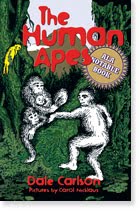
I was particularly fond of the offbeat books she published with Atheneum in the 1970s, including THE MOUNTAIN OF TRUTH (1972), about a camp for young people in the mountains of Tibet, THE HUMAN APES (1973), about a group of humans disguising themselves as apes, and BABY NEEDS SHOES (1974), which revolved around the subject of gambling. THE MOUNTAIN OF TRUTH was considered particularly daring, as I recall, because one of the young characters was labelled "a practicing homosexual" -- probably the first time that phrase was ever used in a mainstream novel for kids. Although Ms. Carlson continued to publish into the 1980s, she eventually disappeared from the scene.


The other day I was roaming around the web and found her!

Since 1993, Dale Carlson Bick has been running the Bick Publishing House.

According to the company's website:

The mission of Bick Publishing House for Teens/Young Adults is to relate modern science and its ethics, communications arts, philosophy, psychology to the teenager's world, so they can make their own responsible decisions about their own lives and future. The Life Sciences books in the series are presented with accessible texts, with glossary of terms, illustrations, index, resources, bibliography,websites.

The mission of Bick Publishing House for Adults is to bring professional information to the general audience in mental illness and recovery, addictions and recovery, in the art of living with disabilities, and in wildlife rehabilitation.


I was intrigued to see that Bick has re-issued many of Dale Carlson's earlier books. Yes, the cover illustrations aren't up to standard:


but I'm sure the novels are still as odd and intriging as they were in the seventies.

If you have fond memories of this author and her books, you might want to track them down too.


GIRLS UNDER TROUBLED WATERS

Looking through a stack of recent YA novels, I noticed a strange trend in cover illustations:


Stay out of the water, girls. Even bathtubs are dangerous places in the world of YA fiction:


A THOUGHT

Earlier this week friend sent me this link to a Publishers Weekly article about the large rise in sales for e-books.

But I was most struck by this ent by Karen Chase, who has apparenty published her own novel as an e-book:

My belief is the publishing cycle will reverse from what it has been. Authors and publishers will put out an e-book, then paperback, then hardcover or special editions. It makes more sense to launch books softly, gain the following, and then invest when readers cry for more.

I never thought of that before. Do you think Karen Chase is right that publishing may turn things around, first releasing e-books and only publishing special edition hard covers if the market demands?

I'd hate for that to happen.

But in this topsy-turvey new world of publishing, anything is possible....

Thanks for visiting Collecting Children's Books. Hope you'll be back soon. And I hope Halloween brings you a cup of cider, a bag of candy corn, and a nice bright candle for reading ghost stories in the dead of night!