Sunday, April 29, 2012

April 29 Sunday Brunch

Information and opinions on children's books old and new, delivered Sunday Brunch style.


I'M OKAY, MY BOOKS ARE OKAY

A few years ago, soon after the publication of Gary Schmidt's THE WEDNESDAY WARS (his second Newbery Honor, after LIZZIE BRIGHT AND THE BUCKMINSTER BOY) the Michigan-based author had a speaking engagement/booksigning at a local library. As I've frequently mentioned on this blog, I am in awe of all my favorite writers -- and very much starstruck. Couple this with my natural shyness and you are not going to see me asking questions from the audience or making smalltalk with an author while my books are being signed. I can't do those things! However, when I attended that event (which was wonderful) I had a question I was just dying to ask Gary Schmidt. So I did what any other shy person would do in that situation: I begged my friend to ask the question for me!

Here was the question my friend asked: "Mickey Mantle appears in your novel but comes across as an awful person. Was the scene based on something that happened in real life? If not, weren't you concerned about depicting a real person so negatively in your novel?"

Gary Schmidt said that the scene in the book was completely fictional, but since stories of Mantle's cruel streak were legendary, he had no qualms about depicting the famous Yankee player in such a bad light. Later, someone who worked on the book sent Mr. Schmidt a note saying that scene rang true because they had once witnessed Mickey Mantle's bad behavior in person.

In the years since THE WEDNESDAY WARS, Gary D. Schmidt has continued publishing outstanding novels such as TROUBLE and last year's OKAY FOR NOW, which was nominated for the National Book Award and recently won School Library Journal's Battle of the Books.

This past week, Gary Schmidt was in town again for a presentation/signing. Because this event was sponsored by a school system and a big turnout was expected, I did not attend. (Plus, if I had gone, I would have had to leave work early. Besides, I was even more in awe of his talent since reading OKAY FOR NOW and probably would have made a fool of myself if I were there.) Fortunately, my bookseller buddy was providing books for the event and kindly offered to get my copies of OKAY FOR NOW signed for me.

This past Friday I picked up the books and was thrilled to see the inscriptions.

My first copy is very rare -- a large bound manuscript that was released even before the ARC (advance reading copy):

Here is how he signed it:

You are probably wondering how I've cost Mr. Schmidt a "boatload" of money. Apparently he sometimes reads my blog (pausing here to do a little happy dance) and has gotten tips on older books he wants to add to his collection. The interesting thing is that Mr. Schmidt has cost me some money too. If you look in the upper right hand corner, you will see that that bound manuscript cost me $12. ...But as he said, "It's all worth it." I treasure this unusual copy of his book.

Next is the ARC of OKAY FOR NOW:

and this great inscription:

Again, who knew he read this blog? I was both thrilled and nervous. Thrilled because I'm one of HIS faithful readers. And nervous because, well, he's a college professor who probably cringes at all my grammatical and punctuation errors.

Finally, he signed my hardcover copy of OKAY FOR NOW:

with this nice inscription:

Just when you thought I was about to add these volumes to the shelf with my other Gary Schmidt books and move on to the next blog entry....

...I'll adopt the voice of a TV infomerical pitch man and say, "But wait! There's more!"

A day or two before the signing, my bookstore buddy received this ARC in the mail:
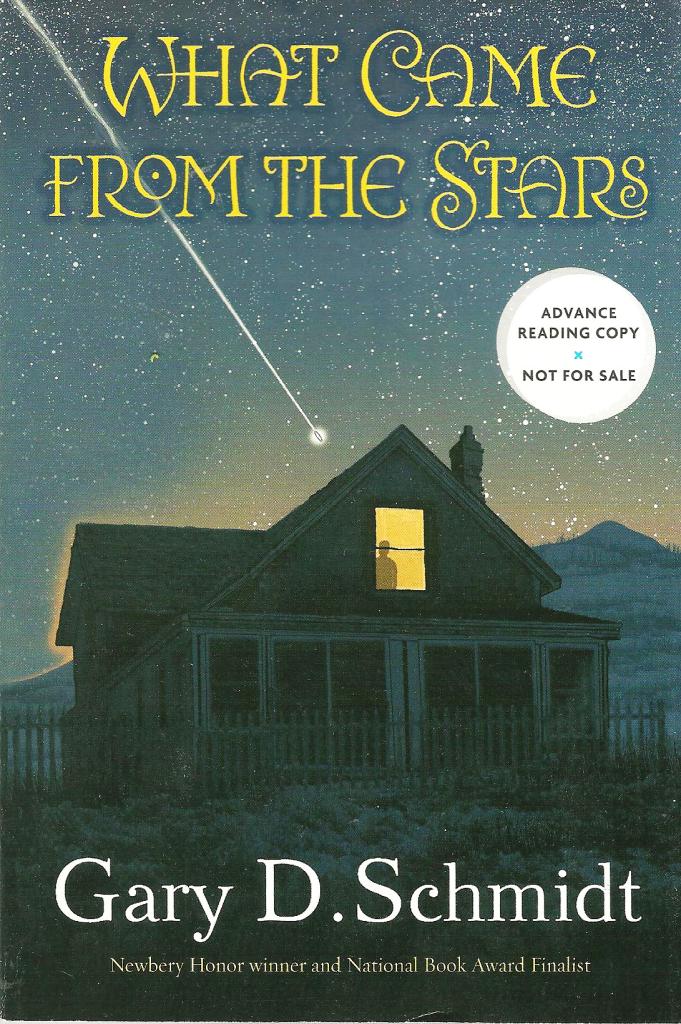
She said that even Mr. Schmidt was surprised to see she had it, since the book won't be published till September. My friend had just started reading it that day, but asked him if he'd sign it to me. Here's the one-in-a-million inscription he wrote inside:

How cool is that? Even if this book goes on to sell a million copies, I've got the very first copy the author ever signed!

I am not, however, the first person to ever read this copy.

My bookstore friend spent the last couple days reading the novel before telling me to drop by the bookstore this morning and pick it up. I asked what she thought of the book, but she did not want to influence my opinion. So she simply said, "You'll have to read it yourself."

And now I can!


A NEW STICKER

Just bought a copy of Walter Dean Myers' latest novel, ALL THE RIGHT STUFF, and noticed a silver sticker on the cover:

Here's a closer look:

This is the first time I've seen this sticker on a book. Was the same seal used on books by former Ambassadors Jon Scieszka and Katherine Paterson?

Is the sticker used only on books published during the author's tenure as Ambassador, or does it go on all of his previous books? It's great to see this honored acknowledged, but do you think this sticker will draw readers to the book? Or, more specifically, draw young readers?


REVIEW : DYING TO KNOW YOU

In the history of young adult fiction, can you remember a narrator ever complaining about his prostate problems? I can't. But then most YA protagonists are somewhere between the ages of thirteen and eighteen...not sixtysomething widowers like the unnamed narrator of Aidan Chambers' new novel, DYING TO KNOW YOU.
Chambers is known for writing lengthy, complex books about big themes: identity, sexuality, death, religion. Though his latest has a less intricate plot than the Printz-winning POSTCARDS FROM NO MAN'S LAND and tighter prose than the doorstop-sized THIS IS ALL, the novel still touches on many of Chambers' familiar themes and offers thought-provoking insights into human behavior, communication, and the artistic impulse. Eighteen-year-old Karl Williamson first approaches the narrator, an elderly author, for help in writing a letter to his literary-minded girlfriend. As usual with Aidan Chambers, style is important as content, with the author employing pages of ping-pong-like dialogue, letters, instant messages, a random footnote, and traditional narrative techniques to show the slowly developing relationship between the younger and older man -- in many ways, two versions of the same self, and both carrying secrets. Smart, mature, and sometimes funny, DYING TO KNOW YOU presents a fascinating portrait of a teenage romance observed through the eyes of an old man while simultaneously exporing a uniquely-memorable intergenerational friendship.


OTHER ADULT NARRATORS

Aidan Chambers is known for breaking with convention in his books for young people. His use of an adult narrator in DYING TO KNOW YOU got me wondering if there are many other books for children and teenagers that employ older narrators. Of course there are many cases where the protagonist is a grown-up looking back on experiences from his or her youth. But I'm thinking of something a little different here. I'm thinking of books FOR and ABOUT young people that are related by an adult who also appears in the story. The only ones that come to mind for me at the moment are two novels by Scott O'Dell. In KATHLEEN, PLEASE COME HOME, at least part of the book is narrated by the mother of a teenage runaway, while CHILD OF FIRE is told by the parole officer working with the book's teenage protagonist. Perhaps FROM THE MIXED-UP FILES OF MRS. BASIL E. FRANKWEILER would also qualify as a book with an adult narrator, although she only speaks in the first person during the framing device at the beginning and end of the novel. Can you think of any other books for kids with adult narrators?


MEET ME AT 84, CHARING CROSS ROAD

Many years ago I happened upon this paperback copy of Helene Hanff's 84, CHARING CROSS ROAD at a local bookstore:

Late that night I picked up the book, planning to read a few pages before bed. Instead I read the entire (short) volume in one fell swoop. The next morning, before even getting out of bed to brush my teeth, I read the entire book again!

THAT's how crazy I am about this epistolary "love story" between a New York writer and a London bookseller. Since then I've read the book dozens of times, won a first edition for $25 at a library auction, went to see the stage production during a blizzard, and have seen the Anne Bancroft/Anthony Hopkins movie both in an empty theatre and at home on video. Throughout those years I have shared the book with many special friends.

I think anybody who loves books would love 84, CHARING CROSS ROAD.

Author Helene Hanff wrote several other books including UNDERFOOT IN SHOW BUSINESS, THE DUCHESS OF BLOOMSBURY STREET, and -- a real favorite -- LETTERS FROM NEW YORK.

In all these books, Helene herself pops off the page: larger-than-life, warm-hearted, gregarious -- the kind of person you would want as a friend. (Indeed, many readers felt so attached to her that they'd visit her in New York and even call her up on the phone.) Despite having such a "presence" on the page, Ms. Hanff was rather mysterious and private and no one seems to know much about her personal life. That's why I was thrilled when I recently came across this "biography" of the author:

I just finished reading it and almost speechless.

HELENE HANFF : A LIFE could well be one of the worst books I've ever read!

I'm assuming this book was self-published -- and points out the importance of those often unsung heroes and heroines of publishing: editors. You don't realize how important they are until you read an unedited book like this one, filled with typographical errors and copy-editing mistakes. On one page Helene is described as attractive, on another she's homely. One minute she hates fiction, the next minute she loves novels. We're told that Helene doesn't drive and then, a little later, she hops into "her small red sedan" to visit someone. An relative listed as MIA in World War II is referred to as both her second cousin and her brother.

But beyond that, the book is poorly-written on every level. The chronology is off. Huge events, such as Helene's romance and engagement are described and then dropped (we see her trying on her wedding gown and packing her bags, then her fiance leaves town on a short trip and -- this romance -- is -- never -- mentioned -- again!) Other scenes -- complete with much dialogue, inner thoughts, and plodding descriptions ("Once in her apartment Helene took a long shower and feeling hungry decided to eat a big piece of pumpkin pie and to drink a glass of milk. She started reading some notes on education while she ate but was soon very sleepy so she went to bed for a short nap") -- are so odd that they feel completely fabricated. For example, I have always understood that, as depicted in 84, CHARING CROSS ROAD, Helene Hanff moved to a new apartment on E. 72nd Street in 1956 and remained there the rest of her life. What to make of this biography's description of a homeless Helene living pretty much as a bag lady until a connected friend gets her a job outside New York City as a postmistress and librarian? I didn't believe much of this book. However, if you are a fan of the author -- hungry for more info on her life -- you'll still be interested in this awful volume for the little glints and glimmers of the author's life that might be true.

And I do admit I liked the appended bibliography that lists all the books in Hanff's famous home library. She even owned a few children's books -- classics by Carroll and Milne, as well as, most intriguingly, a copy of THE DARK IS RISING by Susan Cooper. That last one really surprised me, as Hanff was known for her strong dislike of Tolkien.

In 84, CHARING CROSS ROAD, Ms. Hanff makes reference to writing several children's history books during the 1960s. I've seen a few of them and they are typical of the dreary informational "book report" volumes you frequently saw in libraries back in that era.

This new biography also tells about a young-adult book she was commissioned to write in the 1960s, about the political radicals of the time:

I knew about that one, but must admit I did not know that she also wrote two picture books in the 1960s.

Published by Harper in 1964, TERRIBLE THOMAS is the story of a kid running rampant in a NYC apartment. Shades of Eloise. Kirus Reviews described it as a "tedious tomfoolery."

Then in 1969, Parents Magazine Press released BUTCH ELECTS A MAYOR, which Kirkus called "pretty feeble."

Anyone know it? Many Parents Magazine Books were released through their book club and are remembered very fondly today. Is this book remembered as fondly as other book club titles such as MISS SUZY, JELLYBEANS FOR BREAKFAST, and OLD BLACK WITCH?


PLAQUE BUILD UP

While Helene Hanff's children's books may be long-forgotten, her best-known work, 84, CHARING CROSS ROAD is so beloved that a commemorative plaque has been placed at the former location of Marks & Co., the bookshop that inspired her memoir.

Perhaps even more unusually, Ms. Hanff's former NYC apartment has been renamed "Charing Cross House," with a plaque outside containing a quote from the book.

This got me wondering if there are any building plaques that honor children's books and authors.

I did a quick internet search and found several in Europe. Here's one honoring Erich Kastner, author of EMIL AND THE DETECTIVES, in Germany:

The location of the sweetshop recalled in Roald Dahl's BOY also merited a plaque:

as did a former home of Kate Greenaway:

and this one marks where J.K. Rowling wrote the early part of Harry Potter:

Can you think of any comparable sites here in the United States? Leonard Marcus wrote a book called STORIED CITY, which contains working tours of famous children's book sites in the Big Apple:

Maybe someday we should all take this tour and stop to put up plaques (or at least post-it notes!) at each location.


THANKS

Thanks for visiting Collecting Children's Books. Hope you'll be back!


Sunday, April 22, 2012

A Big Crunchy Sunday Brunch

Today's Sunday brunch focuses on Pete Hautman, Dick Clark, Little Golden Books, and other random children's book info.


THE BIG REVEAL

This was my second and (sad sigh) last year serving as a judge for the Los Angeles Times Book Prize in the category of Young Adult Literature. It was a blast. A couple months ago, fellow judges Cindy Dobrez, Angelina Benedetti, and I spent a spirited Saturday morning narrowing a long list of possible finalists down to five books: BEAUTY QUEENS by Libba Bray; THE BIG CRUNCH by Pete Hautman; A MONSTER CALLS by Patrick Ness; LIFE : AN EXPLODED DIAGRAM by Mal Peet, and THE SCORPIO RACES by Maggie Stiefvater.

This past Friday night, at a star-studded ceremony in California, author Cornelia Funke announced the winning title:

THE BIG CRUNCH by Pete Hautman.

Here is how we described the book in our recommendation:

"An ordinary boy meets an ordinary girl in a novel that is anything but ordinary. Wes and June’s relationship mirrors the magnetic pull of an unfolding universe. Against a backdrop of the four seasons a series of brief, often understated, vignettes alternate between the perspectives of each teenager, highlighting their sometimes shared, sometimes differing, perspectives on young love: the physicality, the confusion, the euphoria, and even the occasional moments of disconnect. It’s rare to discover a love story this elemental in its telling, this balanced in its point of view, and this honest in emotion. Pete Hautman’s The Big Crunch redefines and re-energizes the “teen romance” genre for twenty-first century readers."

Big Congrats to THE BIG CRUNCH and its four extremely worthy fellow nominees!


TEN THINGS YOU MAY OR MAY NOT KNOW ABOUT PETE HAUTMAN

To honor Mr. Hautman's big win, I've compiled a list of ten things you may or may not know about him:

1. SCHOOL DAYS : Pete Hautman attended the same Minnesota grade school as comedian/writer/senator Al Franken and filmdom's Ethan and Joel Cohen.

2. HE WRITES FICTION FOR ADULTS : Hautman entered the field of fiction with several books for adults, including DRAWING DEAD (1993), SHORT MONEY (1995), and THE MORTAL NUTS (1996) and has continued to publish adult novels such as RING GAME, MRS. MILLION, RAG MAN, DOOHICKEY and THE PROP during his career as a young adult author.

3. HE HAS A PSEUDONYM : Under the name "Peter Murray," he has published nearly 100 nonfiction books for children, on topics ranging from dinosaurs and kangaroos to juggling, paper airplanes, and chocolate chip cookies.


4. IT SOMETIMES TAKES HIM A LONG TIME TO WRITE A BOOK : According to his website, the author wrote INVISIBLE in just six weeks, but many books take longer because "I often get stuck when I'm writing. Rather than brood about it, I'll set a book aside for weeks, months, or years and work on something else. I usually have several projects underway." And some books take an entire lifetime to write. For example, GODLESS originated with a conversation Hautman had with some friends as a teenager; decades later he wrote the book and won the National Book Award for it. Of his latest work, "The Klaatu Diskos," Hautman says, "I've been thinking of this trilogy my whole life."

5. SWEETBLOOD AND THE SPOOKY COINCIDENCE : Hautman's vampire novel SWEETBLOOD took twenty-five years to write. He conceived the story in 1978, long before today's vampire craze began, developing the offbeat premise that vampire legends from the middle ages could simply have been cases of undiagnosed diabetes. The book would not be published until 2003. In the interim, Pete Hautman himself had been diagnosed with Type I diabetes.

6. HE'S GOT A CO-AUTHOR : Hautman shares his life with writer Mary Logue, who write poetry, adult mysteries, and children's books (DANCING WITH AN ALIEN.) Together, they've teamed up to write a series of mystery novels for kids including SNATCHED (2006), SKULLDUGGERY (2007), and DOPPELGANGER (2008.) They also started writing Hautman's new book, WHAT BOYS REALLY WANT, together but abandoned the project when Pete became (his word) "pushy." He later finished the book alone, but credits Mary with some of the best lines in the first four chapters of the published book.

7. HE'S A BIBLIOGRAPHER'S WORST NIGHTMARE : Writing across genres, writing solo and with a partner, using a pseudonym...we can deal with that. But having the same book published under three different titles will confuse the best of us:


8. DUSTJACKET DISASTER : Then, to confuse us even more, his publishers made a major goof with the dustjacket of THE BIG CRUNCH. If you've read the book, you know the female protagonist's first name is JUNE. Unfortunately, the dustjacket flap consistently refers to her as
9. HE'S MAKES FILMS : Pete Hautman has also been known to make "trailers" to promote his books on Youtube. Here is the one he made for THE BIG CRUNCH.

10. HE'S GOT TWO BOOKS COMING OUT THIS SPRING : It's pretty rare for an author to have two books released in the same publishing season, but Pete Hautman has accomplished that this spring. His romantic comedy WHAT BOYS REALLY WANT was published a few months back by Scholastic and Candlewick just released THE OBSIDIAN BLADE, the first volume in the "Klaatu Diskos" trilogy. And we've got reviews of both book below!


TWO NEW NOVELS BY PETE HAUTMAN

One of the most engaging aspects of THE BIG CRUNCH is its exceptionally evenhanded exploration of boy/girl relationships. That balanced view of love and romance is also on display in WHAT BOYS REALLY WANT, a novel told in the alternating voices of high schooler Lita
and her best friend Adam. Lita is a wannabe writer who is working on a novel and writes an anonymous blog about relationships, but it's not-reading, business-minded Adam who actually sits down and writes WHAT BOYS WANT, a book that tells "the truth about what real boys are thinking, saying, and doing when it comes to sex, love, and romance!" Though neither shallow, oblivious Adam or snarky busybody Lita are particularly likable characters, their humorous dialogue is often laugh-out-loud funny. While the text could have been tightened by a third, the breezy story will likely have both male and female readers nodding in recognition at Adam and Lita's insights into what boys and girls really want from each other when it comes to romance and love.

THE OBSIDIAN BLADE is the first volume in a new science fiction/fantasy series titled "The Klaatu Diskos." An enigmatic opening relates how a "discorporal Klaatu artist" from far in the future created a series of portals that opened into important historical locations.
The story then moves into the present as thirteen-year-old Tucker's father, fixing a loose shingle on the roof, tumbles through one of those portals -- or diskos -- and returns some time later with a little girl ("She is from...Bulgaria"...yeah, like the Coneheads were from France!) and a complete loss of religous faith -- particularly troubling since Tucker's dad is a minister. In the months to come, Tucker's mother has a breakdown and then both his parents disappear, leaving the teenager in the care of a hip uncle he's never before met. Soon Tucker himself is traveling through the mirage-like diskos floating in the air -- finding himself atop the World Trade Center on 9/11 and viewing the crucifixion of Jesus. Though filled with stunning moments, the novel becomes increasingly abstruse as it continues. By the final chapters -- in which Tucker has mysteriously aged, his mother has returned home years younger, married to another man, and not recognizing her son, and Dad is now an aged, evil religious leader -- many readers may be as confused as I am. I'm not sure what to make of the "Klaatu Diskos" at this point, but will trust that Hautman knows what he's doing and that the disjointed and confusing plotlines will seamlessly converge and make total sense in future volumes.


A LITTLE HELP FROM MY FRIENDS

I've often said that my book collection, not to mention this book-collecting blog, would be pretty dull if I didn't get a lot of help from friends.

That was proven again this week, when two east coast friends went out of their way on my behalf.

First, my New York friend, who planned to attend the annual Newbery/Caldecott event at Books of Wonder, volunteered to take my first editions and Advance Readings Copies of winner DEAD END IN NORVELT and Honor Book BREAKING STALIN'S NOSE to the store to have them signed by Jack Gantos:


and Eugene Yelchin:


Meanwhile, my Connecticut friend recently told me expect a package in the mail. It didn't arrive and, instead, took a little trip back and forth across the country, until it finally arrived in my mailbox this week.

It was an ARC of one of this season's most talked-about children's books:

personally inscribed with a meaningful statement by author Barbara Wright:

That particular friend is currently out of the country on vacation, so I have not written her personally to thank her for the wonderful surprise. Maybe she'll see it here first. In fact, maybe both of my friends will see this posting and know how grateful I am. Thank you, guys!


"I GIVE IT A 90 FOR THE PICTURES, BUT ONLY A 50 FOR THE WRITING"

Dick Clark died this week at age 82. It's a sign of his longevity in the entertainment business that every generation remembers him a different way.

Today's young people probably know him best from "New Year's Rockin' Eve" and the American Music Awards.

People of my generation knew him from hosting game shows. On our first trip to New York, in 1979, my brother and I watched a taping of THE $20,000 PYRAMID hosted by Dick and starring Joanne Worley and, of all people, David Letterman. (Children's book connection: THE $20,000 PYRAMID also plays a role in the Newbery-winning WHEN YOU REACH ME by Rebecca Stead, a novel set in 1979!)

And of course people from an earlier generation new Dick Clark best from AMERICAN BANDSTAND, the show which earned him the title "America's Oldest Teenager."

Did you know that Dick Clark also wrote a few books for teenagers?

There was YOUR HAPPIEST YEARS, which was published both in hardcover:

and in paperback:

Then there was TO GOOF OR NOT TO GOOF, also in hardcover:

and paperback:

He also wrote a few books for adults. I am somewhat skeptical whenever an entertainment personality is credited with writing a book. I know there are times when the famous individual really does write the volume, but there are other times when their only contribution is allowing their name to appear on the front cover. I don't know which was the case with the above YA books by Mr. Clark, but I assume this oddity -- apparently passed out as a bowling lane freebie -- is an example of just lending his name and image to a publishing package:

I think the following novel may be my favorite memorial to Dick Clark. Published in 1959, TV BANDSTAND is the story of a teenage girl who gets a make-over and joins the cast of "TV Bandstand, the popular, daily record hop at the television station." According to the dustjacket, "Here's a story as fast and irrepressible as rock 'n' roll itself. All teen-agers, especially those who enjoy 'American Bandstand,' will acclaim it true to life and one of the most exciting books they've read."

Published when the author was only twenty-eight, TV BANDSTAND has been long out of print, but it's apparently quite well-remembered by former teens. It's in demand among book collectors and, the few times a copy turns up, it often sells for between $100 and $200.


CHILD CHOOSERS

There are just a few more days for kids to vote for their favorites in the fifth annual Children's Choice Book Awards.

According to a recent article in School Library Journal, over half a million kids participated last year and this year's goal is one million.

This year's finalists -- selected by the Children's Book Council -- are:


Kindergarten to Second Grade Book of the Year

BAILEY by Harry Bliss
DOT by Patricia Intriago
PIRATES DON'T TAKE BATHS by John Segal
THREE HENS AND A PEACOCK by Lester L. Laminack, illustrated by Henry Cole
ZOMBIE IN LOVE by Kelly DiPucchio, illustrated by Scott Campbell

Third Grade to Fourth Grade Book of the Year

BAD KITTY MEETS THE BABY by Nick Bruel
A FUNERAL IN THE BATHROOM AND OTHER SCHOOL BATHROOM POEMS by Kalli Dakos, illustrated by Mark Beech
THE MONSTROUS BOOK OF MONSTERS by Libby Hamilton, illustrated by Jonny Duddle and Aleksei Bitskoff
SIDEKICK by Dan Santat
SQUISH #1, SUPER AMOEBA by Jennifer L. Holm and Matthew Holm

Fifth Grade to Sixth Grade Book of the Year

BAD ISLAND by Doug Ten Napel
HOW TO SURVIVE ANYTHING by Rachel Buchholz,illustrated by Chris Philpot
LOST & FOUND by Shaun Tan
OKAY FOR NOW by Gary D. Schmidt
RACING IN THE RAIN : MY LIFE AS A DOG by Garth Stein

Teen Book of the Year

CLOCKWORK PRINCE by Cassandra Clare
DAUGHTER OF SMOKE AND BONE by Laini Taylor
DIVERGENT by Veronica Roth
PASSION by Lauren Kate
PERFECT by Ellen Hopkins

Author of the Year

Jeff Kinney for DIARY OF A WIMPY KID 6: CABIN FEVER
Christopher Paolini for INHERITANCE
James Patterson for MIDDLE SCHOOL : THE WORST YEARS OF MY LIFE
Rick Riordan for THE SON OF NEPTUNE
Rachel Renee Russell for DORK DIARIES 3 : TALES FROM A NOT-SO-TALENTED POP STAR

Illustrator of the Year

Felicia Bond for IF YOU GIVE A DOG A DOUGHNUT
Eric Carle for THE ARTIST WHO PAINTED A BLUE HORSE
Anna Dewdney for LLAMA LLAMA HOME WITH MAMA
Victoria Kann for SILVERLICIOUS
Brian Selznick for WONDERSTRUCK

Kids (and, hey, no cheating!) can cast their votes here!


THOSE BOOKS WITH THE GOLDEN SPINE

I imagine that it's now been beaten out by boy wizards and teenage vampires but, as recently as 2001, THE POKY LITTLE PUPPY headed Publishers Weekly's list of "All-time Bestselling Children's Book."

This modest little volume by Janette Sebring Lowrey was one of the first twelve volumes published by Little Golden Books in 1942.

Today, Janette Sebring Lowrey remains virtually forgotten (to see how Ursula Nordstrom tried to nurture her talent over decades, get a hold of DEAR GENIUS, edited by Leonarad Marcus) but Golden Books are still going strong.

Here's an interesting article about the Little Golden Books that just appeared on ABEbooks site. Just seeing the pictures of those old book covers brought back a flood of memories, plus I enjoyed the comments from readers recalling their own favorite Little Golden Books from the past.

If you have an interest in Little Golden Books, the best place to start is with GOLDEN LEGACY, a history by Leonard Marcus:

You might also be interested in this bibliography of all the Little Golden Books published between 1942 and 1985, compiled by Delores B. Jones:

And book collectors will appreciate these identification and price guides by Steve Santi:


Though once criticized as cheap, commmercial "supermarket" books, the Little Golden Books frequently feature prose and art from creators who would later become famous in the world of children's books. And no one can deny the impact these books have had on the childhoods of millions.


WHICH ANDRE NORTON BOOK SHOULD I READ?

Considering her huge output of children's and young adult books, it's somewhat surprising that I only have one book by Andre Norton on my library shelves. It's a paperback copy of her 1947 book ROGUE REYNARD, which was re-issued as a sixty-five cent Dell Yearling paperback in 1972.


I probably never would have bought it, except I was collecting Yearling Books at that time. However, I ended up loving it -- which is why I still own this volume while most of my other Yearling books have been lost, given away, or upgraded-to-hardcover over the past forty years.

Strangely, my love of this book did not make me an Andre Norton fan. The public library had dozens of her science fiction novels, and every now and then I'd check one out...but never made it past the first chapter or two. Science fiction just wasn't my thing, and I could never get past all those impossible-to-pronounce names of characters and planets. Later in life I did read and enjoy a couple of Ms. Norton's fantasies such as LAVENDER-GREEN MAGIC (I'm not a big fantasy reader either, but those stories were grounded enough in the "real world" to keep me interested) and at least one of her science fiction epics, THE JARGOON PARD (see what I mean about funny names? What's a "jargoon"? What's a "pard"???)

However, I've recently decided that -- as someone who writes about historical children's books -- I really do need to read at least a couple of Andre Norton's science fiction novels, just so I can have some perspective on the matter.

I asked one Norton fan what book would be a good starting place -- a readable title that will keep me interested and isn't overwhelmed with characters named Pker and Hslan living on the planet Xtrobilia.

This fan recommended Norton's SOLAR QUEEN.

Unfortunately, our copy is checked out of the library at present. While I wait for its return, can anyone recommend other favorite Andre Norton titles that might turn me into a fan?


BACK TO THE LA TIMES...

This weekends LA Times Book Prize Awards were presented as part of the Los Angeles Times Festival of Books, a weekend celebration full of speeches, discussions, events, booksignings and other fun. I particularly liked this huge banner that public was invited to sign:

Wouldn't it be great if every city had one of these hanging for the public to sign. What a great way to advertise books and show that reading is fun!


THANKS

Thanks for visiting Collecting Children's Books. Hope you'll be back!


Sunday, April 15, 2012

Changing Libraries, Changing Books, and Other Topics for Sunday Brunch

Are libraries about to start "thinking locally"? Has a beloved children's book figure regressed in time? Is that furniture-sized appliance with spools of tape actually a computer? And what new and forthcoming books are starting to get "buzz"? We consider all of these questions in today's Sunday Brunch.


OPPORTUNITIES FOR LIBRARIES

The Chinese word for "crisis" is composed of two characters. One stands for "danger" and the other represents "opportunity." I first read that over thirty years ago in THE SON OF SOMEONE FAMOUS by M.E. Kerr, an author who has continued teaching and entertaining me ever since.

Anyway, it seems to me that our libraries are about to face a crisis. Due to the popularity of e-books, the good old-fashioned BOOK (the kind with pages and a cover) appears to be going the way of the dinosaur. At least that's the case at the library where I work. On Friday I learned that, while the number of patrons coming into our library is increasing, the number of books being circulated is getting smaller and smaller. Ten years ago we circulated over 500,000 books per year. Last year we were down to 100,000 circulations. The experts say that we will eventually level off at 20,000 books circulating per year.

When I heard that, a siren and flashing neon light went off in my head ("Danger, Will Robinson!") and I pictured libraries following in the footsteps of the record stores and bookstores decimated by modern technology.

But remember the line about "danger AND opportunity..."?

The experts now tell us that one of the things that will save libraries is a switch in focus. Libraries will now find new life in archiving LOCAL history and events. My own library is already taking steps in this direction and I've heard that many others are following suit.

Strangely, just after attending a meeting about this future role for libraries, I returned to my office and found this book on my desk:


Published by the Marguerite de Angeli Library in Lapeer, Michigan, MICHIGAN'S MARGUERITE DE ANGELI includes biographical material, an interview/conversation from the author's 90th birthday celebration, family photographs, paintings, and material written for, but not included in, her novel COPPER-TOED BOOTS. It also contains a complete bibliography of de Angeli's work, noting where the original manuscripts for many of these books can be found.

I thought this was an excellent example of a library focusing on local resources. Let's face it, except for a few major figures, monographs about children's authors don't have much of a market. Marguerite de Angeli may have been one of the most notable children's writers of the twentieth century, but she's not particularly well-known these days except for her Newbery-winner, THE DOOR IN THE WALL, and perhaps two or three other titles. Yet researchers, writers, teachers, and critics will always have an interest in this author -- and who better to continue her legacy than the library in her hometown of Lapeer, Michigan? This may be one role that libraries will fill in coming years -- creating books, online exhibits, and historical archives about local children's authors who may otherwise be lost to history.


SPEAKING OF LOCAL HISTORY....

The other day I received an e-mail from a woman who had read my recent blog entry on author Palmer Brown. Cindy Z. said:

I don’t know much about him but he did live down the street from me when I was growing up. He gave my sister and I some of his books. He wrote inside the cover of each of the books, personalizing each of them for my sister and I, and drew beautiful unique watercolor artwork and signed them. I have three first edition books. Unfortunately the matching paper book jackets were damaged by smoke in a house fire that we had in 1999. But the books themselves survived and are in otherwise excellent condition.

Palmer Brown lived with his mother in a white stone house covered with ivy in the tiny little town of Oregon, Pennsylvania. [...] Long ago the town was called “Catfish”. Palmer Brown’s home was by the Oregon Hotel, which in later years has become Reflections Restaurant.

I think he gave us the books as a Christmas present because my mom told him how much we loved to read. I remember trick or treating at his house one year. He was very quiet and you never saw much of him or his mother. But they were very nice people, very pleasant and sweet.


Thank you, Cindy, for sharing these memories about the author of HICKORY and BEYOND THE PAW PAW TREES!

Cindy's note got me wondering if anyone else had a famous children's author as a neighbor. If so, did you get to know them? Did you read their books?

As a kid, I was so awed by authors that I could never imagine them living in regular neighorhoods...driving cars...going grocery shopping....

Although I now realize that yes, many writers live in regular neighborhoods and buy milk at the grocery store, I still tend to place them on pedestals.

Many years ago I had a pair of friends in this area. Over the years, I occasionally accompanied them as they visited the wife's childhood home where her parents still lived. One day someone mentioned the neighbor, Mrs. Blos. I said, "There's a children's writer named Joan Blos."

My friend said, "Yes, that's her. We grew up with her children. She won the Caldecott Award for one of her books."

(She meant the Newbery -- and the book was A GATHERING OF DAYS.)

I was so shocked to think that someone I knew grew up just across the street from a Newbery-winning writer! My friend said, "Some day I'll take you across the street to meet her." Alas, my friends soon moved to Chicago and evetnually got a divorce, so I never did have a personal meeting with this famous author.

Have you ever lived across the street or on the other side of the fence from a famous writer?


THE WASP WOMAN AND WEETZIE BAT

Speaking of literary connections: Last Sunday I wrote about actress Susan Cabot whose real-life experiences rivaled any of the B-movies she made in the 1950s. She dated King Hussein until he realized she was Jewish...she gave birth to a dwarf...she dabbled in drugs and even took her son's growth hormone medication...she became a recluse...and eventually the dwarf killed her with a barbell. The reason I wrote about her is that she once illustrated children's books, though I have been unable to find any of specific titles.

I still haven't been able to identify those books, but this week I did note an unusual literary coincidence.

Francesca Lia Block's latest book, PINK SMOG : BECOMING WEETZIE BAT features the eponymous character who made her debut in Block's 1989 debut novel and several subsequent books. In those stories Weetzie grows from a teenager to an adult. However in PINK SMOG we move back in time, meeting Weetzie when she was thirteen-year-old Louise. Reading this book I became intrigued by the character of Weetzie's father, who works in the field of B-movies. Knowing that some elements of these novels mirror Block's own life, I paid a visit to the imdb.com and discovered that Francesca's father, Irving Block, really did work in the field of B-movies.

In fact, he wrote the original stories for two movies starring Susan Cabot -- WAR OF THE SATELLITES and 1957's THE SAGA OF THE VIKING WOMEN AND THEIR VOYAGE TO THE WATERS OF THE GREAT SEA SERPENT.


ANOTHER CHARACTER GETS YOUNG

PINK SMOG works fairly well as a "prequel" to the "Weetzie Bat" series. However, I was recently unnerved when I discovered that another beloved children's book figure has also stepped back into time.

You have probably already heard this news, since it's been going on since 2009...but I knew nothing about it until this past week when I saw a reference to this book:


That's Amelia Bedelia? A kid getting off a school bus?

I thought Amelia Bedelia was a middle-aged maid, who looked like this:


Apparently she is both.

Amelia Bedelia was created by Peggy Parish, who based the character on a maid she once knew who always took comments literally. Introduced in 1963, this character starred in a dozen easy readers, sketching pictures of drapes when her employers told her to "draw the drapes" and sticking lightbulbs in the dirt when instructed to plant bulbs in the garden.

Peggy Parish died in 1988, but her nephew continued the series beginning with 1995's GOOD DRIVING, AMELIA BEDELIA.

However, in 2009 a major change took place in the series.

Instead of easy readers, the volumes are now often (though not always) presented in a picture book format...and, instead of being an adult maid, Amelia Bedelias is now a little girl.

The idea is that we're now reading about Amelia's childhood -- an idea that doesn't quite work since the stories don't appear to revisit an earlier time period and Amelia is dressed in very contemporary fashions.

It would be interesting to learn what kids think of this change in Amelia. Do they like her better as a kid? Can they relate to her more easily now?

I guess I'm old school.

There was something especially funny about seeing such a literal-minded adult...and it was comforting to see that, despite her "issues," Amelia Bedelia was so warmly regarded by her employers and friends. Now she seems just like just anohter silly, annoying kid and not nearly as individualized as she was in the adult volumes.

What do you think about this change in Amelia Bedelia?


SERIOUSLY, NOW....

It took many decades for the character of Amelia Bedelia to change.

It took less than a year before GO THE F*** TO SLEEP changed.


Of course you remember 2011's most scandalous d-- a lullabye book that contained such as verses as:

The cats nestle close to their kittens now.
The lambs have laid down with the sheep.
You’re cozy and warm in your bed, my dear
Please go the (bleep) to sleep.

The book has just been released in a new edition called SERIOUSLY, JUST GO TO SLEEP:


The illustrations have been slightly altered, and so has the text.

Here is the new version of the verse above:

The cats nestle close to their kittens,
The lambs have lain down with the sheep.
You're cozy and warm in your bed, my deaar.
Please, just this once, go to sleep.

Same intent, same overall meaning...but this time G-rated.

Though this version unlikely to get the same gut-level (often smirking and nodding) response from adults that the original edition did, this book can at least be brought into nurseries without the threat of a visit from Child Protective Services.


A GOREY COLLECTION

Do you collect books by Edward Gorey?

Last night I was watching ANTIQUES ROADSHOW and saw an appraisal for a colletion of Gorey books and stuffed figures that would make many children's book collector drool. Did you miss it? You can still catch it here.


BUT THAT'S NOTHING...

The $5000 value of that Gorey collection seems like peanuts when compared to the recent ROADSHOW appraisal of a signed first edition of J.R.R. Tolkien's THE HOBBIT, which was valued at between $80,000 and $120,000. You can watch that video here.

Many people forget that THE HOBBIT was originally published as a children's book.


OLD SCHOOL COMPUTERS

Wandering through the library stacks this week, I came across an oldie by William D. Hayes -- HOLD THAT COMPUTER! Although I remember a few of the author's other books with fondness (PROJECT: GENIUS and PROJECT SCOOP), I had never read this title before. HOLD THAT COMPUTER! turned out to be a rather pedestrian effort -- a tired plot, flat dialogue, interchangable characters -- so it's hard to believe it was published by Jean Karl at Atheneum during the era of E.L. Konigsburg, Zilpha Keatley Snyder, and so many other luminaries. Of course at the time of publication, many kids were likely drawn to this title because of the topic, as baseball players Hank and his friends use the new school computer to figure out why they can't beat a rival team. The subject -- so new in 1968 -- is what really dates the book today, as the boys input info into a machine as big as a kitchen appliance hung with spools of tape. Predictably, it eventually blows up when facing off with another computer during the book's climax.

Although this book is almost forgettable (how forgettable? I had to go back and look up the name of the protagonist even though I just finished reading the book yesterday) it is rather notable as an early story about computers. Can anyone think of any other children's books from 1968 or earlier that dealt with computers? Of course there were a few nonfiction volumes, plus references to computers in science ficton novels, but I'm hard-pressed to think of any other realistic novels that touch on the topic. I did find one, OLLIE'S TEAM AND THE BASKETBALL COMPUTER by Clem Philbrook, published a year later by Hastings House. Funny that two of earlist children's books to feature computers also focused on sports. Nowadays kids seem to play all their games ON the computer, rather than using computers to help them play better on the field or the court.


AFTER EASTER SPECIAL

Well, it took a week of lunches to finish up all my Easter egg-salad. But the holiday is still not quite over. That's because blog-reader ChrisinNY reminded me of my failed promise to read THE WICKED ENCHANTMENT by Margot Benary-Isbert. During a previous Easter blog I mentioned that many books are set in the days and weeks leading up to Christmas -- and sometimes even leading up to holidays such as Thanksgiving and Halloween. But I could think of very few books set during the Easter season. At the time, Chris suggested the Benary-Isbert novel as a good example, but the seasons passed and I never got around to reading it. This past week Chris wrote to say, "Last year you asked if anyone knew of books that centered on Holy Week and I suggested this title. I actually reread it every year in the weeks approaching Easter, and wondered if you had ever tracked it down and read it? It has a real sense of taking place in another country/culture/time, but has a lot of humor and fun too. If you ever get a chance, try it." Well, I don't have to be told twice (actually, I DID have to told twice!), so this week I finally found a copy. I'll report back with my thoughts when I finish it, but at this point I'm really enjoying it. I believe this is the only fantasy that Margot Benary-Isbert wrote. She was mostly noted for writing realistic fiction about Germany during and after World War II. In fact, her best-known novel DIE ARCHE NOAH (published in the United States as THE ARK) was one of the first children's novels published in Germany after WWII. The book concerns a refugee family who turn an abandoned railway car into a home for themselves. The book was well-received by American critics though, from today's perspective, one wonders how any book about Germany and World War II could avoid mention of Nazis or the Holocaust...and the railway car seems a strange device considering how such cars were utilized during the war. Later books by Margot Benary-Isbert, such as DANGEROUS SPRING were much more unflinching in their portrayals of Nazism and the Hitler Youth. The author had experienced all these things first hand in Germany. Born in 1889, she was not allowed to publish anything between 1933 and 1945 because she refused to join the Nazi writers organization. In 1953, she and her family immigrated to the United States and became naturalized citizens. Her publishing career continued to flourish, although she continued to write in her native language and have the books tranlsated into English.


WHAT'S THE BUZZ?

Although we are only four months into 2012, I'm curious about what books have been getting a lot of "buzz." I don't necessarily mean great reviews (some haven't even been reviewed yet) but just lots of chatter among colleagues, on message boards, on Facebook, etc. Some of the titles I've been hearing a lot about include:

THE FALSE PRINCE by Jennifer Nielsen (I loved this one!)
STEP GENTLY OUT by Helen Frost and Rick Lieder (ditto! And my bookstore friend can't keep it in stock)
WONDER by R.J. Palacio
CROW by Barbara Wright
THE LIONS OF LITTLE ROCK by Kristin Levine
STARRY RIVER OF THE SKY by Grace Lin
TWELVE KINDS OF ICE by Ellen Obed
SUMMER OF THE GYPSY MOTHS by Sara Pennypacker
KEEPING THE CASTLE by Patrice Kindl
LIAR AND SPY by Rebecca Stead
SEE YOU AT HARRY'S by Jo Knowles (I'm hearing rapturous advance word)
TEMPLE GRANDIN by Sy Montgomery
CODE NAME VERITY by Elizabeth Wein

Which titles are you hearing about?


THANKS

Thanks for visiting Collecting Children's Books. Hope you'll be back soon!