Sunday, March 7, 2010

Sunday Brunch in March

It’s Sunday brunch time at Collecting Children’s Books and here’s a round-up of facts and opinions on children’s books old and new.


A MOVING EXPERIENCE

I’m going to be moving within the next few weeks. After a lifetime of storing books sideways, two and three deep on every shelf, I will finally have a room completely devoted to my book collection. I will actually have my own library! That’s the exciting part. The bad part is having to pack all these volumes away in boxes. The work is exhausting...plus I’m concerned that I won’t be able to get all these boxes over to the new place. A fellow book-collector told me that her moving company flat-out refused to move her books saying it was “too much work.” Since I’m only moving two miles away, I am thinking of avoiding that problem by moving most of these books on my own. If I pack the car with ten boxes a night, it should only take something like...thirty days....

And maybe I’m getting punch-drunk from all this packing, but I’ve begun to notice I have a tendency to anthropomorphize my books. (I know I’m not the only one who ascribes human qualities to inanimate objects. At Thanksgiving a friend of mine was grocery shopping and stopped to move a frozen turkey from the empty end of the display case back to the pile of Butterballs on the other side because “it looked lonely being away from its friends.”) Anyway, as I pack these books into boxes and seal them shut, I’m finding myself feeling sorry for them being shut away in the dark, unread and unappreciated.

I imagine a psychologist would say that I’m really feeling sorry for myself -- not being able to have access to all my beloved books for the next several weeks.

That’s it -- I’m going through separation anxiety!

Can’t wait until I can reopen these boxes, and put these books on the shelves in their -- and my! -- new home.


1965 NEWBERY/CALDECOTT/WILDER PROGRAM

One of the books I’ll be packing away today just arrived in the mail a couple days ago.

It’s a tiny volume that was distributed at the 1965 Newbery/Caldecott/Wilder Dinner, which was held at Cobo Hall in my hometown of Detroit on July 6 of that year.


I love these N/C programs, not only because they commemorate an important annual event in the world of children’s books, but because they evoke a very different era. Who would think that in 1965 women were still known mainly by their husband’s names. For example, the Wilder award was given to Mrs. Albert Durand that year.

Who was she?

Ruth Sawyer.

Another highlight of these programs is that they usually contain some special material created by the year’s Newbery and Caldecott winners.

This book includes “A Greeting from Beni Montresor,” who received the Caldecott for illustrating MAY I BRING A FRIEND:


“Ciao” back atya, Beni! ...Though to my untrained eye Montresor’s art appears very much a product of its era and doesn’t seem to hold up well in the twenty-first century.

There is also “A Fable from Maia Wojciechowska,” who won the Newbery for SHADOW OF A BULL. Since the tale is short, I think I’ll include the whole thing here:

Once upon a time two friends went to Spain and together they saw a bullfight. One was a realist, the other an idealist.

“Why is it,” the realist asked the idealist, “that you did not cry or faint at the bullfight? It made
me sick to see the bull die, and you, who are made ill at the sight of a burned moth and weep for the deer in the dead of winter, why did you not cry for the bull?”

“A moth,” the idealist replied, “does not seek death but light. The deer asks not for the ground to harden nor the snow to fall. But a brave bull makes his choice, almost at birth, and lives to die with it. It need not die from the sword if it chooses a coward’s life. And that is what I did not cry.


Talk about “anthromorphosizing”!

And, Miss Wojciechowska, you have a call on line one: it’s PETA.

A blank page in the back of the program is reserved for autographs. I’d love to say that Beni and Maia and editor Jean Karl signed this book, but it appears to be autographed by lesser known lights. I don’t recognize any of the following names. Do you? Are you one of them?


ARCHIE...ARCHIE ANDREWS...WHERE ARE YOU?

Given my devotion to children’s books, it may surprise you to learn that I also enjoyed reading Archie comics as a kid.

The girl across the street got me hooked.

For weeks and weeks she promised to take me to the grocery store and show me how to buy a comic book out of a machine. I don’t know what intrigued me more -- reading my first comic or actually using a machine to acquire it.

The big day came.

I had twelve cents -- a sum that seemed like a hundred dollars at the time -- to buy my comic and my friend had $5 -- an amount that seemed like a million bucks back then -- to pick up a a few items at the grocery store for her mother.

When we arrived at the grocery, my friend discovered the five dollar bill, which she’d tucked into her mitten on the way to the store, had disappeared.

She became frantic and wanted to retrace our steps and hunt for her money.

I said, “Can’t we get my comic book first?”

“No,” she wailed, and ran home crying.

The comic book machine was about the size and shape of a Coke machine, but the front was made of clear plastic so you could see the selection of Archie comics inside. Each magazine (ARCHIE, PEP, BETTY AND VERONICA) had a handle in front of it. On one side of the handle you’d place a dime and on the other side you’d place your two pennies, then you’d push the handle in and the comic would slide down into a chute below.

At least that was the theory.

Of course being only about eight and not that bright to start with, I put the dime in the penny slot and couldn’t get it back out, then dropped my two pennies under the machine and then I also ran home crying.

Later that night my father drove me back to the grocery store and helped my get my very first comic book out of the machine. It was an issue of ARCHIE AND ME.

I brought it home and soon got my brother addicted. Before long, one of our uncles began buying Archie comic books for us and, every time we visited him, he’d hand us each a thick bag of ARCHIE’S PALS AND GALS, JUGHEAD, LAUGH, ARCHIE’S JOKE BOOK and all the rest. We had a long wooden shelf in the basement where we kept stacks of these magazines, and constantly ran downstairs to refresh and replenish the comics we had in our bedrooms. The difference between my brother and me was that, for me, the comics were just a supplement to all the regular books I was reading. In my brother’s case, they were a substitute to all the regular books he should have been reading. For years, he wrote everything in all caps and only used exclamation points for punctuation, since THAT WAS HOW ALL THE ARCHIE COMICS WERE WRITTEN!

What was it that kept me reading Archie for years and years? Part of it was simply that they were funny and fast-paced nd reader-friendly. And they gave you an advance preview of what it was like to be a teenager. (Never mind that my teenage years -- and probably everybody’s teenage years -- turned out to be a lot less fun than what was promised in Archie comics.) And there was also something very appealing and comforting about the friendship of Archie, Jughead, Betty, Veronica, and the rest. A friend of mine who also grew up reading Archie Comics, said that his favorite thing about the stories was that there was always a nearby wall or bench where the characters could always sit down and talk.

What does all this have to do with children’s books?

Nothing, except I recently read that Archie comics are going to be teaming with Random House to to “exclusively handle worldwide distribution of Archie graphic novels and trade paperbacks.”

I’m not sure if that includes novelizations, but I wish it would. I have never thought about writing fiction about already-conceived characters for an already-extant series, but feel uniquely qualified to write about Archie...and all his friends...who always have a nearby bench or wall where they can sit down and talk.

Archie, if you’re reading this: give me a call!


TWO TITLES, TWO COVERS -- ONE BOOK

Any new book by Kimberly Willis Holt is an event and I’m particularly intrigued by her forthcoming novel called...well, what is it called, anyway?

The original title was apparently THE DOWSER’S SON and here is the cover of the ARC:


However, it now appears the title has been changed to THE WATER SEEKER, and it has a new cover illustration:


It’s not unusual for books to change either their titles or cover art at the last minute like this. From a collecting point of view, however, it’s always nice to have a copy of the ARC with the original title and art. And should the book go on to become famous (and remember, Ms. Holt has received both a Boston Globe Horn Book Honor and a National Book Award) the original title/cover will be even more desirable by collectors.


ANOTHER BOOK TO KNOW

Yesterday I received a surprise in the mail from a friend -- a copy of VIRGINIA HAMILTON : SPEECHES, ESSAYS, CONVERSATIONS, edited by the late author’s husband, Arnold Adoff, and Kacy Cook:
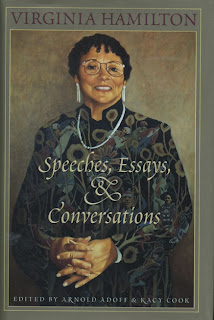

As a special treat, my copy was signed by both the editors!


When I was growing up, Virginia Hamilton was considered one of the top authors of children’s books -- perhaps the top author of all. This remarkable volume collects her speeches (Newbery acceptance, Coretta Scott King Award acceptance) and lectures, and includes powerful memories from family members and colleagues.

It’s a book that every fan of children’s literature will want to own.

Just sampling this book over the weekend has made me eager to return to Ms. Hamilton’s novels such as ZEELY, M.C. HIGGINS THE GREAT and my personal-favorite THE PLANET OF JUNIOR BROWN.

I wish I could figure out which box I stored them in.

After perusing VIRGINIA HAMILTON : SPEECHES, ESSAYS, AND CONVERSATIONS, I really don’t want to wait till I finish moving before I can re-read this author’s timeless treasures!

Thanks for visiting Collecting Children’s Books.

Hope you’ll return!

Sunday, February 28, 2010

Sunday Brunch with Multicolored Medals

What does this image have to do with children’s books?

Plenty, as I’ll explain shortly.

Today’s Sunday Brunch also:

* discusses Caldecotts of a different color

* identifies a Newbery Honor Book that only received two votes

* anticipates life in Sweet Valley for the now-grown twins Jessica and Elizabeth, and

* explains why my eighteenth birthday left me bleary-eyed, muddle-headed, reeking of smoke, and addicted!


THE BLUE CALDECOTT

I recently received this e-mail from blog reader Eric Carpenter:

I was in a used book store the other day and saw a copy of Robert
McCloskey's TIME OF WONDER with two stickers on the cover. One
sticker shows a figure with the words: "For the Most Distinguished
American Picture Book for Children" and the second sticker is the
familiar Caldecott Medal sticker except that the background is blue
instead of gold like the figures. I took a picture with my phone of
the medals:


Eric wondered about the double-sticker -- and why it was blue.

Nowadays, the foil stickers on every Newbery and Caldecott winner are gold, but there was a time when color occasionally appeared on these stickers. Here is the sticker that appeared on the 1943 Newbery winner, ADAM OF THE ROAD by Elizabeth Janet Gray.


Not only did they add color, but they also included the author’s name on the sticker.

In addition to the blue Caldecott seal on TIME OF WONDER, I have seen a green Caldecott on Robert McCloskey’s MAKE WAY FOR DUCKLINGS and am fairly certain I’ve seen red stickers on one or two older Caldecotts.

As for the double, or overlapping, stickers, I have never seen such a thing on a Newbery winner, but I have seen it on a few Caldecotts, though it’s pretty rare.

What do these two stickers represent?

Both sides of the medal.


BOTH SIDES NOW

Yep, the actual bronze Caldecott Medal, which most of us never see, has engravings on both sides.

The front of the medal features a Randolph Caldecott illustration from THE DIVERTING STORY OF JOHN GILPIN which, according to the American Library Association, “is a perfect example of the humor, vitality, and sense of movement found in Caldecott's work. The illustration shows John Gilpin astride a runaway horse, accompanied by squawking geese, braying dogs, and startled onlookers.”


The back of the medal is a scene from SING A SONG OF SIXPENCE and shows a man carrying a pie from which some of the four-and-twenty blackbirds are escaping.

The name of the winning illustrator is inscribed below this illustration.

The Newbery Medal has two sides as well.

The front depicts an open book, with the phrase “For the most distinguished contribution to American literature for children” emblazoned across it.


The back of the medal features a man and two children. According to Irene Smith’s A HISTORY OF THE NEWBERY AND CALDECOTT MEDALS, this illustration represents “the writer giving his imaginative talents to the children.”

For many years the “flip side” of the Newbery wasn’t widely know by readers but, beginning in 1971, that image has been used on the silver foil stickers of Newbery Honor Books:


THE DESIGNER OF THE MEDALS

American sculptor RenĂ© Paul Chambellan was only twenty-nine years old when he designed the Newbery Medal in 1922. Fifteen years later he was asked to create the Caldecott Medal. The founder of the awards, Frederic Melcher, described the creation of the latter award: “I gave the sculptor, Rene Chambellan, a collection of Caldecott’s books, not specifying that the Caldecott designs should be used, but wishing him to understand the spirit of Caldecott and the reasons for his continuing value. Mr. Chambellan became so delighed with Caldecott’s draftsmanship that he immediately said he could do nothing better than put a few of the typical scenes on the medal, and this he has done.”

In addition to the designing these two major book awards, Mr. Chambellan illustrious career included creating archictectural sculpture for the Russell Sage Foundation Building, the Chicago Tribune Building, Rockefeller Center, and many other landmarks.

I was shocked to discover that the designer of Newbery also did the sculpture for this mammoth tower at the Shrine of the Little Flower, which is just a few miles down the street from where I work.


Back in the thirties and forties, controversial Father Charles Coughlin used to broadcast his infamous and anti-Semitic radio program right inside this very tower.

I’ve driven past it thousands of times and never knew this tower had any connection to the world of children’s books.

Looking now at some of Mr. Chambellan’s other creations, I find myself seeing portents of future Caldecott winning books.

These ornaments from the Chicago Tribune Building (also featured at the start of this blog) put me in mind of the 1964 winner, WHERE THE WILD THINGS ARE:


The front entrance of the Trib Building features “Aesop’s Screen” -- a depiction of moments from the famous fables -- had me thinking these tales are so timeless that the most recent winner (Jerry Pinkney’s THE LION AND THE MOUSE) was based on one of them:


This Rockefeller Center statue of Atlas (designed by Lee Lawrie and modeled by Rene Chambellan) made me think of the 2010 Honor Book, ALL THE WORLD.


The back of the statue?


The 2005 winner: KITTEN’S FIRST FULL MOON.


TWO VOTES

Can a book be named a Newbery Honor if it only receives two votes?

That’s what happened when Cornelia Meigs’ WINDY HILL was named a Newbery Honor in 1922.

1922 was the first year of the award and the selection committee was comprised of four officers from the American Library Association, as well as four important librarians including (who else) Anne Carroll Moore.

In preparation for the awards, librarians across the country (not just children’s librarians) were invited to nominate titles.

Only 212 votes were received. (Can you imagine how many thousands they’d get today...especially if the award were publicized on the net?) Of those, 163 went to THE STORY OF MANKIND by Willem Hendrik Van Loon. Twenty-two went to THE GREAT QUEST by Charles Boardman Hawes. CEDRIC THE FORESTER by Bernard Marshall got seven, William Bowen’s OLD TOBACCO SHOP got four, and Padraic Colum’s THE GOLDEN FLEECE got four.

WINDY HILL got two votes, followed by nine other titles which received one vote each.

I’d sure love to see a list of those nine titles.

The members of the award committee apparently did not debate the nominated titles, but simply gave the top vote getter the award and named the remaining titles “runners-up” (now called Honor Books.)

That two-vote getter, WINDY HILL, remains one of the most elusive Newbery titles of all time. I don’t think I’ve ever even seen a copy. Once in a while an ex-library copy in a later printing turns up for sale, but even those are priced at a couple hundred dollars.


MIZPELLED CHILDEN’S BOOK AWADS

One of the reasons the Newbery and Caldecott Awards were created was to bring more attention to children’s books.

They’ve succeed in that regard.

Everyone seems to know the “Newbery” and “Caldecott” today.

...They just can’t spell them!

Doing a Google search this morning, I found the following:

754 hits for Caldicott Medal
1110 Caldecot Award
4550 hits for Caldacott Award
4910 hits for Caldicott Award

189 hits for Newburry Award
20,000 hits for Newbury Award
12,200 hits for Newbury Medal
31,100 hits for Newberry Medal
148,000 hits for Newberry Award


THEY’RE BACK!

Publishers Weekly reports that the twin protagonists of the “Sweet Valley High” series are staging a comeback.

With over 500 titles, the series was hugely popular during the eighties and nineties...before interest lagged and the series got buried down around Fear Street.

But now there’s a film in the works, to be written by Diablo Cody, who won an Oscar for JUNO. And next year St. Martin’s Press will be publishing SWEET VALLEY CONFIDENTIAL, an adult novel that tells what happened to Jessica and Elizabeth when they grew up.


MY EIGHTEENTH BIRTHDAY

Back when I turned eighteen...in the last century...when (gulp) Gerald Ford was president...my cousin gave me an unusual birthday present.

It marked a rite of passage...something that young people weren’t allowed to do before they turned eighteen and became, in the eyes of society and the law, brand-new adults.

My cousin picked me up early that evening and we drove to our destination.

Three hours later, I emerged -- my head swirling and my clothing reeking of cheap perfume and tobacco. I wasn’t sure what had happened...but I wanted to go back.

My cousin had taken me to the local YMCA to play bingo for the first time.

(What were you expecting -- an opium den? A house of ill-repute? This was the midwest, after all, and I was a wholesome kid...well, a wholesome newly-minted adult.)

Back then you were not allowed to enter a bingo hall until you were eighteen years old. Even if it was at the Y.

It was a whole new world for me.

Everyone there was puffing on cigarettes (except for me and my cousin) and clouds of thick gray smoke hung low over the bingo tables like polluted air over an LA freeway.

Every bingo player seemed to have good luck charms and amulets spread across the table in front of them -- and they usually performed elaborate rituals with them (tugging on the blue hair of a troll doll, kissing a school picture of one’s granddaughter) before each game.

The noise in the room was incredible and the mood was intense. All the players seemed hypnotized. And, the few times that the bingo caller stumbled over a number (“The number is B-seve...oh, I’m sorry, that was a B-NINE....”), you could feel the anger of the players and almost thought they were going to rise up as one and tear him from limb to limb. (Or least pelt him with bingo chips.)

My mind was spinning with numbers, numbers, numbers as I smacked the ink dauber aganst my cards, trying to keep up with the caller.

Meanwhile, my normally calm cousin began sobbing hysterically when she realized she needed only one more number to win the “Big X” game. When someone else yelled "Bingo!" before her number was drawn, she ran to the bathroom and threw up.

I think I won $2 that night.

...But that was all it took.

After that I was hooked and we went to play Bingo many nights after that.

That particular obsession only lasted a few months. I got tired of the second-hand smoke, the noise, and the just-below-the-surface anger of the bingo players who, I honestly believed, might kill someone who yelled "Bingo!" before they did.

Besides, I never seemed to win after that first night.

So I quit going.

But I wonder if I’d return to my gaming ways if some local Y offered children’s book bingo. I just discovered a website that allows you to make topical bingo cards on your home computer. The literature series includes bingo games based on Beatrix Potter characters, Beverly Cleary books, as well as Dr. Seuss, Mrs. Piggle-Wiggle and Mother Goose.

I was particularly intrigued by Caldecott Bingo:


and Newbery Bingo:


I think I’ll ask the Y if they’ll quit using numbered Bingo cards and start playing these more literary games.

...But first I’d better bone up on my Newbery and Caldecott titles. Both games include a book called “Free Space” in the middle square and I’ve never even heard of that title!

Thanks for visiting Collecting Children’s Books. Hope you’ll be back.

Thursday, February 25, 2010

Valid Invalids

A recent discussion about winter sports books brought this comment from Laurie of the Six Boxes of Books blog :

For Olympics this week, I re-read White Boots (aka Skating Shoes) by Noel Streatfeild. Great read! A sickly girl (not a character you see much in novels these days, is it?) starts skating to exercise and regain her good health during a London winter.


I recently received a copy of SKATING SHOES, just re-issued in paperback by Yearling, but haven't yet read it. I should probably give it a go before the Olympic flame in Vancouver is doused this weekend.

In the meantime, I've been thinking about Laurie's comments on sick kids in literature.

It's true, in the old days children's books were filled with sickly kids, frail kids, kids who were homebound, or sent away to the country for rest cures.

Colin in THE SECRET GARDEN and Katy in WHAT KATY DID are bedridden.

HEIDI's Clara and the title character in POLLYANNA can't walk.

Tiny Tim: tiny crutch.

Then of course there's Beth in LITTLE WOMEN. She really went overboard with the sick-kid thing.

And it's not as if sickly children disappeared from books at the end of the Victorian era. Glancing at my shelf of Newbery winners and Honor Books, I'm reminded of Robin in Marguerite DeAngeli's THE DOOR IN THE WALL, who loses his ability to walk.

Julie in Irene Hunt's UP A ROAD SLOWLY, starts a new school "still weak from the same illness that had stricken my mother."

Cousin Kate ends up on her uncle's farm in THE GOOD MASTER because she's recently had the measles and remains "delicate."

The whole plot of MRS. FRISBY AND THE RATS ON NIMH hinges on a sick kid...well, a sick mouse.

Come to think of it, Mrs. Frisby's creator, Robert C. O'Brien, was once a pretty frail kid himself.

In fact, once I began researching the topic, I discovered that quite a few children's authors grew up fainting, sniffling, sneezing, barfing, and generally staying off school for weeks or months at a time.

Robert Louis Stevenson is probably the poster child for invalid authors. He once described himself as "a mere complication of cough and bones." Between coughing and bone-rattling, though, he produced TREASURE ISLAND and A CHILD'S GARDEN OF VERSES, so I guess we can't judge him too harshly.

Among twentieth century authors, Arnold Lobel missed a year of school due to ill health.

Ed Young started school a year late for the same reason.

Newbery Honor writer Sorche Nic Leodhas has them both beat, having spent "several years" studying at home due to childhood sickness.

As a child, CAPS FOR SALE creator Esphyr Slobodkina was "confined to bed for lengthy periods."

Meindert DeJong had pneumonia multiple times and was once so ill that his entire Dutch village prayed for his recovery.

Karen Hesse remembers her own days as a sick kid with these words: "Thin and pasty, I looked like I'd drifted in from another world and never quite belonged in this one."

Having grown up in a "You're not that sick. Get dressed for school" kind of family, I'm tempted to call the above authors and illustratos a bunch of slackers and malingerers.

...But then I ask myself if they ever would have become the creators we now admire if they hadn't had that childhood "down-time" to dream, to imagine, and to get an early start on their craft.

In Anita Silvey's CHILDREN'S BOOKS AND THEIR CREATORS, Maurice Sendak recalls, "I was a sickly child and spent a lot of time looking out the window. There was a little girl across the street named Rosie, and I must have forty sketchpads filled with Rosie pictures and Rosie stories."

Imagine. If Maurice Sendak had been a robust, healhy kid, we might not have REALLY ROSIE today.

The aforementioned Esphyr Slobodkina utilized her bedridden days cutting designs in paper.

As a young adult, Will James spent his recuperation period after an accident painting pictures of horses and selling them to magazines; Mary Stolz wrote her first young-adult novel while recovering from an illness.

Finally, Newbery winner Kate DiCamillo gives this explanation on how being a sick kid helped her become a writer:

Now, looking back, I can see all that illness for what it was: a gift that shaped me and made me what I am. I was alone a lot. I learned to rely on my imagination for entertainment. Because I was always on the lookout for the next needle, the next tongue depressor, I learned to watch and listen and gauge the behavior of those around me. I became an imaginative observer.

When I look back on childhood, I remember one moment with great clarity. I was three years old and in the hospital with pneumonia, and my father came to visit me. He arrived in a black overcoat that smelled of the cold outdoors, and he brought me a gift. It was a little, red net bag. Inside it there was a wooden village: wooden church, house, chicken, tree, farmer. It was as if he had flung the net bag out into the bright world and captured the essential elements and shrunk them down and brought them to me.

He opened the bag and said, "Hold out your hands." I held out my hands. "No," he said, "like this. Like you are going to drink from them." I did as he said, and he poured the wooden figures, piece by piece, into my waiting hands. Then he told me a story about the chicken and the farmer and the house and the church. Something opened up inside me. There was the weight of the wooden figures in my hands, the smell of my father's overcoat, the whole great world hiding, waiting in the purple dusk outside my hospital room. And there was the story--the story.

I think of that moment often. It was another gift of my illness. When I write, I sometimes stop and cup my hands, as if I am drinking water. I try, I want desperately to capture the world, to hold it for a moment in my hands.


Did being a "sick kid" make Ms. DiCamillo into a writer? Who knows? But it's probably safe to say that, if Ms. DiCamillo hadn't spent so much of her childhood exploring her imagination, she might never have written about Winn-Dixie or Edward Tulane or a mouse named Despereaux.

If she'd had my "You're-not-that-sick. Get-dressed-for-school" parents, she might still be a writer...but she'd probably be writing mostly school stories.