Sunday, August 9, 2009

Sunday Brunch with Ladybugs and Bees

Today’s Sunday brunch offers up the usual mix of facts and opinions on children’s books. Want to know which Newbery and Caldecott winners were most popular fifty years ago? Want to know how a fictional character from a children’s book figures into NCAA basketball? Want to know why I’m ticked at JACK AND JILL magazine? Read on.

I DREAMT OF AN EGG

The mind is a very strange thing.

Well, let me rephrase that:

My mind is a very strange thing.

What quirk in my brainwaves caused me to wake up this morning thinking about, of all things, HUMPTY DUMPTY MAGAZINE? I haven’t thought of that children’s periodical in decades. I can only assume that I dreamed about it last night...otherwise, why did I wake up thinking about it?

I actually had a subscription to HUMPTY DUMPTY when I was preschooler. What I remember best was how thick each issue was. I also remember fanning out the pages and rubbing them against my cheeks because the paper was so soft. (Gosh, maybe that’s how Lennie from OF MICE AND MEN went off track.) I don’t remember much else about the magazine, except I seem to recall a monthly cartoon called, I think, “Twinkle, the Star That Fell to Earth” and featured a star with a face walking around on two of his points. He looked sort of like this:


So for the last couple hours I’ve been looking online to learn more info about this magazine. The first thing I discovered is that’s actually called HUMPTY DUMPTY’S MAGAZINE, not just HUMPTY DUMPTY and that it is still being published. I also learned that from 1952 through 1965 it was edited by Alvin Tresselt, a major figure in children’s books. Among other titles, he wrote WHITE SNOW, BRIGHT SNOW, which won the Caldecott Medal in 1949.

I can’t find any references to the comic strip character Twinkle, though. Could I have made him up? You have to remember it's been decades since I subscribed. In fact, I’d outgrown the magazine by the time I started kindergarten. For a few years after that, I received JACK AND JILL magazine instead. I don’t know if they had a famous editor and, frankly, I don’t care. Ever since age eight, when they rejected the crayon drawing I sent for their “picture exhibition page,” that magazine has been dead to me!


NEWBERY AND CALDECOTT POPULARITY, FIFTIES STYLE

One reference book that I frequently consult is A HISTORY OF THE NEWBERY AND CALDECOTT AWARDS by Irene Smith. Published by Viking in 1957 (an updated edition was published 1963), this volume provides background on the awards, lists the winners and “runners-up,” places the books in subject categories, and ranks them in popularity. I’ve always been particularly interested in those popularity rankings circa 1957. Are the same books popular today? Have most lost favor over time? Have any become more popular than they used to be?

In ranking the Newbery titles, Ms. Smith states that only two “stand out for their real satisfaction to a majority of children": GINGER PYE by Eleanor Estes (1952) and KING OF THE WIND by Marguerite Henry (1949.)

Five more are “usually found in the upper bracket of favor among children”: JOHNNY TREMAIN by Esther Forbes (1944), RABBIT HILL by Robert Lawson (1945), THE VOYAGES OF DOCTOR DOLITTLE by Hugh Lofting (1923), CADDIE WOODLAWN by Carol Ryrie Brink (1936), and STRAWBERRY GIRL by Lois Lenski (1946.)

The following “occupy the middle ground between actual popularity and a prevailing lack of it":

CALL IT COURAGE by Armstrong Sperry (1941)
THE MATCHLOCK GUN by Walter Edmonds (1942)
SMOKY THE COWHORSE by Will James (1927)
MISS HICKORY by Carolyn Sherwin Bailey (1947)
HITTY, HER FIRST HUNDRED YEARS by Rachel Field (1930)
ROLLER SKATES by Ruth Sawyer (1937)
THIMBLE SUMMER by Elizabeth Enright (1939)
MIRACLES ON MAPLE HILL by Virginia Sorensen (1957)
THE DOOR IN THE WALL by Marguerite de Angeli (1950)
YOUNG FU OF THE UPPER YANGTZE by Elizabeth Foreman Lewis (1933)
THE WHEEL ON THE SCHOOL by Meindert DeJong (1955)

Two books are listed as having “less than average use”:

THE TWENTY-ONE BALLOONS by William Pene DuBois (1948)
TALES FROM SILVER LANDS by Charles Finger (1925)

According to Smith, the Newbery biographies (INVINCIBLE LOUISA by Cornelia Meigs, 1934; DANIEL BOONE by James Daugherty, 1940; AMOS FORTUNE, FREE MAN by Elizabeth Yates, 1951; CARRY ON, MR. BOWDITCH by Jean Lee Latham, 1956) “enjoy a fair and steady popularity” with the remaining nonfiction volume, 1922’s THE STORY OF MANKIND by Hendrik Van Look, somewhat less popular.

The rest of the winning books “compose a group considered lowest in popularity.” They are:

THE DARK FRIGATE by Charles Boardman Hawes (1924)
GAY NECK by Dhan Gopal Mukerji (1928)
ADAM OF THE ROAD by Elizabeth Janet Gray (1943)
DOBRY by Monica Shannon (1935)
THE TRUMPETER OF KRAKOW by Eric P. Kelly (1929)
THE WHITE STAG by Kate Seredy (1938)
THE CAT WHO WENT TO HEAVEN by Elizabeth Coatsworth (1931)
SHEN OF THE SEA by Arthur Chrisman Bowie (1926)
SECRET OF THE ANDES by Ann Nolan Clark (1953)
...AND NOW MIGUEL by Joseph Krumgold (1954)
WATERLESS MOUNTAIN by Laura Adams Armer (1932)

Irene Smith also ranks the Caldecott winners in popularity, circa 1957. She includes just two as “top favorites with children”: THE BIGGEST BEAR by Lynd Ward (1953) and MADELINE’S RESCUE by Ludwig Bemelmans (1954.)

Next in popularity are:

ABRAHAM LINCOLN by Ingri and Edgar d-’Aulaire (1940)
MAKE WAY FOR DUCKLINGS by Robert McCloskey (1942)
FINDERS KEEPERS by Nicolas Mordvinoff (1952)
CINDERELLA by Marcia Brown (1955)
FROG WENT A-COURTIN’ by Feodor Rojankovsky (1956)

Those deemed to have “average” popularity are:

MEI LI by Thomas Handforth (1939)
THE LITTLE HOUSE by Virginia Lee Burton (1943)
MANY MOONS by Louis Slobodkin (1944)
PRAYER FOR A CHILD by Elizabeth Orton Jones (1945)
THE ROOSTER CROWS by Maud and Miska Petersham (1946)
WHITE SNOW, BRIGHT SNOW by Roger Duvoisin (1948)
THE BIG SNOW by Berta and Elmer Hader (1949)

At the bottom of the list are five Caldecott winners “not often sought by children themselves”:

ANIMALS OF THE BIBLE by Dorothy Lathrop (1938)
THEY WERE STRONG AND GOOD by Robert Lawson (1941)
THE LITTLE ISLAND by Leonard Weisgard (1947)
SONG OF THE SWALLOWS by Leo Politi (1950)
THE EGG TREE by Katharine Milhous (1951)

Nowadays, most of Smith’s top-ranked books would be pushed further down the ladder because so many kid-friendly titles (HOLES, WESTING GAME, WRINKLE IN TIME, FROM THE MIXED-UP FILES, etc.) have been published in the intervening years. Still, I think Smith’s relative rankings hold up surprisingly well. Those listed as lowest in popularity in 1957, such as THE WHITE STAG and THE CAT WHO WENT TO HEAVEN, still remain fairly unpopular today.


A GOOD IDEA GONE BAD

Here’s a book that suits the season:


Unfortunately, this is also a book that makes me feel a little sad. When I look at the cover, I think of opportunities lost and stories we probably won’t get to read. And I blame the publisher.

Bonnie Geisert began her writing career with the texts for HAYSTACK, RIVER TOWN, and other volumes illustrated by her husband Arthur Geisert. In 2002, she published PRAIRIE SUMMER, an autobiographical novel about a young girl growing up on a South Dakota farm in the early 1950s.

Now most of us know about nineteenth-century prairie life courtesy of Laura Ingalls Wilder. But here was another historical, though significantly more modern, view of life on the prairie for a whole new audience of kids. Ms. Geisert had written a fine story, peopled with well-individualized characters and strong sense of place. Publisher Houghton Mifflin seemed to be behind the book as well, giving the book a notably classy design. The volume was issued in a larger-than-normal format, with a beautiful wraparound jacket evoking farmlife under a wide prairie sky. Here’s the back panel:


The book contained line drawings by Arthur Geisert and, that rarest of luxuries in a modern children’s books, illustrated endpapers:


In my mind, I imagined this series running for years, continuing the story of Rachel’s life on the prairie as she progressed through grade school...went to high school...grew older and wiser. I could see more and more larger-than-normal-sized volumes joining PRAIRIE SUMMER on the shelf, each with a gorgeous matching dustjacket.

Three years later, Bonnie Geisert wrote LESSONS, another story about Rachel’s life on the prairie and this is what we got:


Gone were the distinctively oversized volume and timeless dustjacket. Gone were the illustrated endpapers and wonderful line drawings throughout the book. Instead, we got a normal trimsize and today’s “typical” -- and typically bland -- stock photo cover illustration. The book had lost its charm and individuality. The narrative was still appealing (though a bit more narrowly focused than its predecessor) but the whole presentation was now just...ordinary. Houghton had had the opportunity to create a special series of books that might have appealed to readers of Wilder, but it appears that they really dropped the ball. LESSONS is now selling for about $5 on Amazon.com and I doubt there will be any more books in this series. Sad. It had the makings of a classic.

UPDATE : ME AND MY BIG MOUTH!

Well, this afternoon I finished this blog entry, braved the 94 degree heat and went out for lunch, then came home and took a nap. When I woke up, I had received an e-mail from a friend of this blog, informing me that a new novel by Bonnie Geisert is going to be be published this fall: PRAIRIE WINTER!

Of course I'm delighted to hear the Bonnie Geisert series will continue, although I feel kind of embarrassed to learn this news two hours after complaining that Houghton had ruined the franchise with their shoddy production of LESSONS!

I just hope that PRAIRIE WINTER is a return to the distinctive bookmaking of PRAIRIE SUMMER and not a slick, ordinary-looking volume like LESSONS. This series deserved better than that.


WANDERING THROUGH THE STACKS

Wandering the stacks this week, I came across a curiosity -- CHINESE MOTHER GOOSE RHYMES by Isaac Taylor Headland of Peking University:


Published by Fleming H. Revell in 1900, this collection of nursery rhymes was collected from two of China's then-eighteen provinces and the editor contends that there "are probably more nursery rhymes in China than can be found in England and America."

Printed on heavy, patterned paper, each verse is accompanied by a black-and-white photograph and -- a surprisingly respectful touch considering the date of publication -- the poem's text written in Chinese.


Which isn’t to say that some images won’t make modern readers cringe, such as this frontispiece titled “Little Orientals”:


Although many of these verses relate to specific Chinese subjects, others are reminiscent of rhymes from our own oral tradition. Listen to “Lady Bug”:

Lady-bug, lady-bug,
Fly away, do,
Fly to the mountain,
And feed upon dew,
Feed upon dew
And sleep on a rug,
And then run away
Like a good little bug.

In the the west we have “five little piggies,” but in the east they apparently have “five little cows”:

This little cow eats grass,
This little cow eats hay,
the little cow drinks water
This little cow runs away,
The little cow does nothing
But just lie down all day;
We'll whip her.

Oh, and if you missed the little toe going “whee-whee-whee all the way home,” here is a Chinese rhyme called “Five Little Fingers”:

A great big brother,
And a little brother, so,
A big bell tower,
And a temple and a show,
And little baby wee wee,
Always wants to go.

And for those who wonder about the gratuitous violence that sometimes pops up in our western children’s rhymes, here are a couple eastern rhymes that prove it’s a global phenomenon:

Cruel Little Glutton

He eat too much,
That second brother,
And when he had eaten,
He beat his mother.

Pat-A-Cake

Pat a cake, pat a cake,
Little girl fair,
There's a priest in the temple
Without any hair.

You take a tile,
And I'll take a brick,
And we'll hit the priest
In the back of the neck.

CHINESE MOTHER GOOSE RHYMES presents a view of childhood that is both specific to Asian culture yet also has a recognizable universal quality.


CHIP OFF THE OLD BOOK

A friend of mine grew up with Chip Hilton sports novels that were passed down by his four older brothers. I never heard of these books until I was an adult -- probably because they were out of print when I was growing up and -- as “series books” -- our library did not carry them.

Written by Clair Bee, who was both a college (Long Island University) and professional (Baltimore Bullets) basketball coach, the novels concern a wholesome and industrious high schooler (later college student) who participates in many sports, including basketball, football, and baseball.
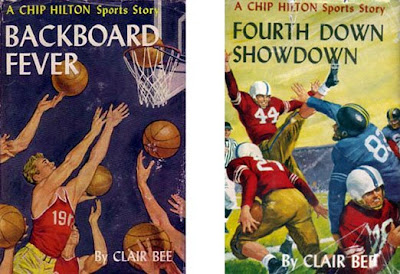

Well-loved by former kids, first editions of some of these titles -- particularly 1964’s HUNGRY HURLER -- now sell for hundreds of dollars. In recent years, Mr. Bee’s daughter, Cynthia Bee Farley, has republished updated editions of the novels. Here’s a complete list of the author’s books:

CHAMPIONSHIP BALL, 1948
TOUCHDOWN PASS, 1948
CLUTCH HITTER, 1949
STRIKE THREE, 1949
HOOP CRAZY, 1950
PITCHER’S DUEL, 1950
A PASS AND A PRAYER, 1951
DUGOUT JINX, 1952
FRESHMAN QUARTERBACK, 1952
BLACKBOARD FEVER , 1953
FENCE BUSTER, 1953
TEN SECONDS TO PLAY, 1955
FOURTH DOWN SHOW-DOWN, 1956
TOURNAMENT CRISIS, 1957
HARDCOURT UPSET, 1958
PAY-OFF PITCH, 1958
NO-HITTER, 1959*
TRIPLE-THREAT TROUBLE, 1960
BACKCOURT ACE, 1961
BUZZER BASKET, 1962
COMEBACK CAGERS, 1963
HOME RUN FEUD, 1964
HUNGRY HURLER, 1964
FIERY FURNACE, 2002 (published nearly twenty years after the author’s death)

Clair Bee was inducted into the Basketball Hall of Fame in 1968 and the "Clair Bee Coach of the Year Award" is given annually to a college basketball coach. Even better, ever since 1997 there has been a "Chip Hilton Player of the Year Award" which is given "to a Division I men’s basketball player who demonstrates outstanding character, leadership, integrity, humility, sportsmanship and talent both on and off the court.” Past winners include Tim Duncan and Shane Battier. The current winner is Jon Brockman from the University of Washington.

I can’t think of too many major awards named for a fictional character.

Much less a fictional character from a children’s book.

Score one for Chip Hilton!


HONORS

Speaking of honors, I’m happy to report that the Collecting Children’s Books blog has been chosen as one of the top ten book blogs by Larry D. Mitchell of the prestigious Private Library Blog.

Thank you for the honor! And score one for children’s books.

Thanks for visiting CCB. Hope you’ll be back.

Wednesday, August 5, 2009

Quality and Quantity

In the nearly ninety-year history of the Newbery Medal, five authors have been fortunate enough to receive the award twice.

E.L. Konigsburg won in 1968 (FROM THE MIXED-UP FILES OF MRS. BASIL E. FRANKWEILER) and 1997 (THE VIEW FROM SATURDAY.)

Katherine Paterson in 1978 (BRIDGE TO TERABITHIA) and 1981 (JACOB HAVE I LOVED.)

And Lois Lowry in 1990 (NUMBER THE STARS) and 1994 (THE GIVER.)

It's not surprising that these three are Newbery double-dippers. After all, they are among our finest contemporary authors. Each has produced a long list of extraordinary books praised by critics and loved by children.

However, it is somewhat surprising to consider the other two-time medalists, Jospeh Krumgold (...AND NOW MIGUEL, 1954 and ONION JOHN, 1960) and Elizabeth George Speare (THE WITCH OF BLACKBIRD POND, 1959 and THE BRONZE BOW, 1962.)

Although they are also distinguished novelists, Krumgold and Speare differ strikingly from the other two-timers in that their overall body of work is extremely small. In fact, I can count Speare's children's books on my left hand, Krumgold's on my right hand, and still have a finger left over to type this blog about them.

Mr. Krumgold won his first Newbery right out of the box with ...AND NOW MIGUEL. Six years later he won for his second children's book, ONION JOHN. In 1967 he published his last major novel, HENRY 3, followed by a slight storybook, THE MOST TERRIBLE TURK, in 1969. Although he lived another eleven years, he never published another word. So it's pretty amazing to think that out of only four children's books, he ended up winning the Big N twice.

Elizabeth George Speare's first children's book, 1957's CALICO CAPTIVE, was a notable debut. THE WITCH OF BLACKBIRD POND came just a year later and won the author her first Newbery. Three years later she was back at the podium accepting her second Newbery Medal for THE BRONZE BOW. Having published three superb books in five years, Ms. Speare appeared to be both a wonderful and a wonderfully-prolific author. However, after the nonfiction volume LIFE IN COLONIAL AMERICA in 1963, it would be another twenty years before she published her next -- and last -- children's novel, THE SIGN OF THE BEAVER. Incredibly this book was named a Newbery Honor. Pretty cool stats, huh? Five children's books. Two Newberys. One Newbery Honor.

This has gotten me thinking about the concept of quality vs. quantity. Not that those two terms are mutually exclusive, of course. The prolific Jane Yolen and Phyllis Reynolds Naylor have published literally hundreds of well-received books.

Other authors, including the aforementioned E.L. Konigsburg, Katherine Paterson, and Lois Lowry, carve out long, distinguished careers, consistently releasing a new volume every year or two to great acclaim.

Then there are those rare authors, such as Joseph Krumgold and Elizabeth George Spare, who publish relatively little...yet win children's literature's highest honors for their contributions.

I imagine that both Mr. Krumgold and Ms. Speare were under tremendous pressure -- from both publishers and readers -- to produce more books after their double-Newbery wins. One wonders what would have happened if they actually had gone on to publish a book every year or two for the rest of their lives. Would they have been able to maintain the high level of quality that distinguished ...AND NOW MIGUEL or THE WITCH OF BLACKBIRD POND? Might they have racked up several more Newberys? Or would future books have diluted and ultimately diminished the reputation of their early award-winners?

Who can say?

If you watch the Olympic track and field events, you know there are some athletes who specialize in long distances and others who excel in sprints. The gold medalist in the marathon doesn't have the speed to participate in the hundred yard dash, nor does the winner of the dash have the endurance to run the marathon.

Perhaps the same is true for authors. Some have the gift of writing a wide range of books over a long corridor of time. Others have a different set of skills that result in a body of work that is smaller -- but no less remarkable.

Sunday, August 2, 2009

Sunday Brunch for August 2, 2009

Today’s Sunday Brunch recalls the good old days of Yearling paperback books, shows off some treats from ALA, and ponders books about Reality TV....


FIRST TIME LUCKY

The other day I wrote a blog about Zilpha Keatley Snyder’s THE VELVET ROOM and now I can’t get Snyder out of my mind. Since writing that blog entry, several people have written to tell me about their own special Snyder books, such as 1970’s THE CHANGELING -- another real favorite of mine. Ms. Snyder belongs to that very small, select group of authors whose first manuscript was accepted by the first publisher that saw it. The author once mentioned this fact to a group of fellow writers, one of whom dramatically responded, "Stand back, everyone. I'm going to shoot her!" That first book was SEASON OF PONIES (1964), a title which not only introduced an exciting new author, but also brought a fresh illustrator into the field. Although authors generally have no say in who will illustrate their books, Ms. Snyder had submitted some drawings by Alton Raible -- an art instructor at the College of Marin, where Snyder’s husband taught -- to her editor and he was eventually chosen to illustrate SEASON OF PONIES. Mr. Raible went on to illustrate all of Snyder’s early books -- a perfect match, as his atmospheric, surreal, pebbly artwork was well-suited for the mystical qualities of these stories.

SEASON OF PONIES was published the same year as Maia Wojciechowska’s SHADOW OF A BULL. Wojciechowska viewed Snyder as her biggest threat for the Newbery Medal, but Maia ended up winning the prize while Zilpha’s novel wasn’t even named an Honor Book. However, three of Snyder’s titles would be designated Newbery Honors in the following few years. It’s a shame she never actually won the Big One.


EARLY EFFORTS

Every now and then you hear about famous authors who produced chapbooks or small self-published books when they were growing up. I believe Francesca Lia Block published one as a teenager. I know that Canadian author Jean Little released a small self-published book called IT’S A WONDERFUL WORLD back in 1947, when she was just fifteen years old. Even after she became a well-known author, Ms. Little continued to privately-publish small books as Christmas presents for friends and relatives. Her holiday gift for 1976, HEY WORLD, HERE I AM! was commercially published -- over a decade later -- by HarperCollins.

HEY WORLD! is a collection of poems written in the voice of Kate Bloomfield, a character first introduced in the 1970 novel LOOK THROUGH MY WINDOW. Anyone interested in books and writing should enjoy this story about, among other things, a creative writing club formed by a group of friends. There are fun “literary” touches throughout: a cat named William Shakespeare; references to the poems “Invictus,” “If,” “The Highwayman,” and “The Lady of Shallot,” and a scene in which a character, reading aloud from a Janice May Udry book, “turned the final page of A TREE IS NICE and sighed, as her listeners did, at the rightness of it.”

And then there’s the moment when one of the characters puts together a handmade poetry book and gives it to a friend for Christmas. The title? IT’S A WONDERFUL WORLD.

Joan Sandin illustrated LOOK THROUGH MY WINDOW and this is my absolute favorite illustration from the book. You may have to enlarge it (just click on the image) to see why I like it so much:


In LOOK THROUGH MY WINDOW, Kate’s parents own a bookstore and it’s clear that illustrator Joan Sandin visited an actual bookstore when she did this drawing, as so many of the details are just right. The reason I got such a kick out of this illustration when I read the book in 1970 -- and still get a nostalgic kick out of it when I read it today -- is that I recognize so many books on the shelves!

I don’t recognize the book near Mr. Bloomfield’s knee, but there’s HARRIET THE SPY sitting nearby.

One shelf up there’s STRAWBERRY GIRL and another I don’t recognize. (Any ideas?)

Above are CHARLOTTE’S WEB and STUART LITTLE.

Then there’s JOHNNY TREMAIN, THE WOLVES OF WILLOUGHBY CHASE and, I think, THE EMPTY SCHOOLHOUSE above that.

I always thought it was so cool that books I recognized -- that were, in fact, on my own shelves at home -- were featured in the illustrations of this novel.


YEARLING

Incidentally, all those covers represent Yearling Books.

I imagine that anyone who grew up reading in the late sixties/early seventies shares my fond memories of Dell Yearling Books?

At the time they were one of the few children’s paperback lines you could find in most bookstores. Distinguished by their identical trim size and logo of a fence-hopping foal, the Yearling titles were -- according to an inside note “designed especially to entertain and enlighten young people. The finest available books for children have been selected under the direction of Dr. Charles F. Reasoner, Associate Professor of Children’s Literature, New York University, and Dr. M. Jerry Weiss, Distinguished Professor of Communications, Jersey City State College.”

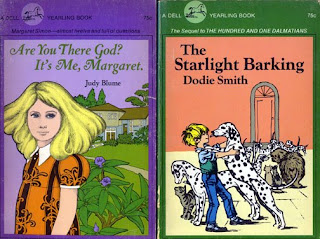
The variety of books offered by Yearling was pretty impressive, ranging from Newbery winners (RABBIT HILL) to translations to classics (surely the first paperback versions of CHARLOTTE’S WEB and STUART LITTLE) to modern books you’d never seen before. In fact, I will bet that most readers first encountered HARRIET THE SPY in her Yearling paperback incarnation. I say that because back then many library systems (including my own Detroit Public Library) didn’t/wouldn’t include HARRIET on their shelves back in the day. Ditto Judy Blume’s then-racy ARE YOU THERE, GOD? IT’S ME, MARGARET. and THEN AGAIN, MAYBE I WON’T, which the library didn’t carry but were passed eagerly around classrooms in their Yearling editions.


As a kid I was fascinated by these books and could barely wait to see what new Yearling titles would be on the shelves each time I visited the bookstore. I spent a lot of my paper route money on them, making brand-new discoveries or welcoming books I’d never been able to afford in hardcover (such as JOHNNY TREMAIN) onto my shelves in affordable paperback editions.


LIBRARY OF CONGRESS “LITERARY TIME CAPSULE”

Has anyone ever heard of this? I am doing research for an upcoming blog entry on Lurlene McDaniel’s “dying teen” books and keep seeing references to her novel SIX WEEKS TO LIVE being placed in a “literary time capsule” at the Library of Congress. This time capsule will not be opened until 2089.

Strangely, I can find no information of what other books were placed in this time capsule.

Does anyone know?

And though I understand the concept of time capsules in general, I’m not sure of the purpose for a literary time capsule. Isn’t a library in and of itself a kind of literary time capsule? Why bury books underground? Just keep them on the shelves till 2089!


REALITY TV BOOKS

What’s on the agenda for tonight? I hate to admit that I’ll probably be glued to the tube for an entire evening of reality television: BIG BROTHER, followed by THE NEXT FOOD NETWORK STAR, capped off by DESIGN STAR.

Yeah, I’m addicted to reality TV.

I’ll never forget the summer night SURVIVOR premiered. In the opening sequence they introduced the contestants: a truck driver, a retired Navy SEAL, a doctor...then they showed a sweet gray-haired woman identified as a cancer survivor. Right then I decided she’d probably win the game. I could envision the “feel good” conclusion to the series, with all the contestants banding together to help this “survivor” become THE final survivor in the game.

Well the contestants DID band together in that episode. They banded together to vote the little old lady off!

I was stunned.

And even more stunned when, several months later, the most conniving, underhanded, nastiest contestant of all ended up winning the entire game.

This was definitely a new kind of television. And one that was quickly excoriated by both TV writers and social critics. I understand the criticisms. These shows encourage people to behave badly. Some say they’re scripted...or at least closely-directed from the sidelines. Most of the contestants already seem to have some kind of show-biz/modeling background. I get all that...but I’m still hooked.

I probably wouldn’t even admit my addiction if it weren’t for the fact that, in my travels around the blogosphere, I’ve discovered that many children’s and young adult authors have expressed an interest in this television genre. Maybe they are drawn to the same qualities of reality TV that I am: the diversity of human behavior and the “truth is stranger than fiction” actions of the contestants. There’s a contrariness to the people on reality TV -- just like there is in life: good guys almost always end up disappointing you at some point...and bad guys usually have a redeeming moment that makes you look at them anew.

In recent years, several books for young people have placed their characters in reality TV situations. Titles include:

THE REAL REAL by Emma McLaughlin and Nicola Kraus
THE ACTUAL REAL REALITY OF JENNIFER JAMES by Gillian Shields
REALITY CHICK by Jennifer Barnholdt
LOSERVILLE by Peter Johnson
SURVIVING ANTARCTICA : REALITY TV 2083 by Andrea White

And then of course there is Suzanne Collins’ HUNGER GAMES and the forthcoming CATCHING FIRE. Not only do these novels have a reality show theme (the “Hunger Games” are played-out on televisions) but Ms. Collins herself has said that reality TV shows were one of the things that inspired this series. ...She probably didn’t mean that in a positive way, but still....

So you see: if it hadn’t been for shows such as SURVIVOR, we’d never have a great book like THE HUNGER GAMES on our shelves!

At least that’s what I keep telling myself.


ALA FREEBIES

A bookselling friend of mine recently attended the American Library Association conference in Chicago. A few days ago I received an envelope in the mail containing all manner of ephemera she picked up at the publishers’ tables: bookmarks, discussion guides, postcards....


It’s fascinating stuff and I was so glad to receive it. Discussion guides and reading group summaries seem to be the hot new thing. I wonder how one gets a job writing these?


TWO ISSUES

Another bookselling friend (do I have nice friends or what?) just gave me the new “Fall Children’s Announcements Issue” of Publishers Weekly. Published twice a year, in February (“Spring Children’s Announcements Issue”) and July, these two PW children book specials list all the titles being published by major publishers during the first and last halves of the year.

As you can see from this photo, my copy of the February issue is already worn, stained, crumpled, and well-used.


In a couple months, the new July issue will look the same. I love to browse through the pages, learning what is currently being published, noting trends in subject matter, and highlighting titles I can’t wait to read. The quality of the PW children’s book issues has fallen off this year. They always used to contain a major interview with a children’s creator and a preview of the next publishing season as well. I don’t think those components are still included.

But the magazines still make fascinating reading. And imagine: right now, with these two issues in my hand, I’m holding the titles and summaries of every new book published in 2009. Some will be classics...some forgotten. The names of the next Newbery and Caldecott winners are in these issues...we just don’t know what they are yet. The best book I ever read may be in these pages.

In a way, these two comprehensive magazine issues really could serve as a “time capsule” of children’s and young adult books, circa 2009.

Thanks for visiting Collecting Children’s Books.