No!
No sun -- no moon -- no morn -- no noon,
No dawn -- no dusk -- no proper time of day,
No warmth -- no cheerfulness -- no healthful ease,
No road, no street, no t’other side the way,
No comfortable feel in any member--
No shade, no shine, no butterflies, no bees,
No fruits, no flowers, no leaves, no birds, November!
-- Thomas Hood (1799-1845)
Hood’s depiction of a sunless, leafless November was valid in the nineteenth century and even held true for most of the following century. But it sure isn’t accurate in 2008 -- at least here in the midwest, where the sun is bright, most leaves remain green on trees, and people are still wearing shorts and t-shirts during the day.
And some say there is no global warming.
These days Novem-brrr has morphed into Not-vember. In fact, the only way I knew that yesterday was the first of November was that, as happens every year, a couple of our local radio stations switched over to an all-Christmas format which will continue through New Year’s Day. There is nothing so disconcerting as listening to “The Little Drummer Boy” and “Winter Wonderland” while eating a grape popsicle.
Today’s Sunday brunch contains random thoughts and info on chldren’s books old and new, plus a few musical interludes. No, I’m not instituting “Audio Sundays” to compete with the “Video Sundays” featured on Fuse #8’s superblog. But today I am going to throw in a few bits of trivia concerning moments when the worlds of children’s books and music converge.
MUSICAL INTERLUDE : SING ALONG WITH THE CALDECOTTS
There are a number of Caldecott winners and Honor Books with musical themes.
The 1946 winner, THE ROOSTER CROWS by Maud and Miska Petersham, contains traditional American rhymes and jingles including the words to “Yankee Doodle.”
The 1956 winner, FROG WENT A’COURTIN’ by John Langstaff and illustrated by Feodor Rojankovsky, is based on a traditional folksong.
Nonny Hogrogian’s 1972 winner, ONE FINE DAY is NOT based on the 1963 hit record by The Chiffons!
Musical Caldecott Honors include: SING MOTHER GOOSE (Opal Wheeler/Marjorie Torry, 1945), SING IN PRAISE (Opal Wheeler/Marjorie Torry, 1946), SONG OF ROBIN HOOD (Anne Malcolmson, Virginia Lee Burton, 1947), FOX WENT OUT ON A CHILLY NIGHT (Peter Spier, 1961.)
Am I missing any?KIDS' BOOKS FOR NOVEMBER
A LONG DAY IN NOVEMBER by Ernest J. Gaines was originally published in the author’s adult short story collection BLOODLINE, then rewritten and issued for young readers under this title in 1971.

MOOMINVALLEY IN NOVEMBER by Tove Janssen, is a 1971 volume in the still-popular Finnish series.
EASTER IN NOVEMBER by Lilo Hess is a photo-illustrated account of a girl who gets twelve Araucana chicks for her birthday and discovers they lay colored eggs. (Thank goodness. I thought it was about those all-Christmas radio stations really jumping the gun and starting to play “Here Comes Peter Cottontail” in November)
NOVEMBER EVER AFTER by Laura Torrres is a 1999 young adult novel about a complicated relationship between two teenage girls.
ONCE UPON A DARK NOVEMBER by Carol Beach York, is a 1989 thriller by this often-underrated author.
“Beware the Ides of November” is a story in Ellen Conford’s 1994 young adult collection I LOVE YOU, I HATE YOU, GET LOST.
THAT NOVEMBER PULITZER

Although not technically for young readers, I also want to mention the novel NOW IN NOVEMBER by Josephine Johnson, a book that some teenage readers might enjoy because the protagonist is a very young woman and the writing is so lyrical. Remarkably, the author was only twenty-four when this bleak story of a farm family destroyed by the Depression was published in 1934 -- and it went on to win the Pulitizer Prize for literature, no doubt making her the youngest winner ever of that award.
Josephine Johnson also published a children’s book called PAULINA POT in 1939, but I’ve never seen a copy and even the online booksellers don’t have it listed.
MUSICAL INTERLUDE : A CHILDREN’S BOOK ORCHESTRA
On strings:
ZIN! ZIN! ZIN! A VIOLIN (Lloyd Moss/ Marjorie Priceman, 1995)
A STRING IN THE HARP (Nancy Bond, 1977)
THE CELLO OF MR. O (Jane Cutler, 1999)
FIDDLESTRINGS (Marguerite De Angeli, 1974)
On horns:
BEN’S TRUMPET (Rachel Isadora, 1979)
THE TRUMPETER OF KRAKOW (Eric P. Kelly, 1928)
HONK, THE MOOSE (Phil Stong, 1935)
On reeds/woodwinds:
LOVE FLUTE (Paul Goble, 1992)
KOKOPELLI’S FLUTE (Will Hobbs, 1995)
PICCOLO’S PRANK (Leo Politi,1965)
LITTLE TOOT (Hardie Gramatky, 1939)
On percussion:
DRUMS (James Boyd, 1928)
DRUMS, GIRLS, AND DANGEROUS PIE (Jordan Sonnenblick, 2004)
BEAT THE TURTLE DRUM (Constance C. Greene, 1976)BACK TO THAT NOVEMBER POEM
By starting off today’s blog with a poem by Thomas Hood, I thought I’d give the impression that I’m the kind of guy who’s well-versed in nineteenth-century British poetry. ...But I have to admit that I discovered that piece in THE EGG AND I by Betty MacDonald. Although EGG was written for adults, I always consider it -- and the rest of MacDonald’s adult titles (THE PLAGUE AND I, ANYBODY CAN DO ANYTHING; ONIONS IN THE STEW) -- to be “honorary young adult books” since many of the author's most devoted fans discovered these books as teenagers and continue to return to them for the rest of their lives.
What other titles, first published for adults, could now be considered “honorary children’s books” or “honorary young adult books"?
Surely TO KILL A MOCKINGBIRD. Many of the classics, including A TALE OF TWO CITIES, OLIVER TWIST, JANE EYRE, and so many others now read in middle school and high school.
I’ll reveal a more recent “honorary young adult book” after this next musical interlude.
MUSICAL INTERLUDE : PARSLEY, SAGE, ROSEMARY AND THYME
 One of the books in my “to be read” pile -- and highly-anticipated -- is Nancy Werlin’s new novel IMPOSSIBLE. Since her 1994 debut with ARE YOU ALONE ON PURPOSE?, Ms. Werlin has shown incredible diversity, writing realistic fiction such as the National Book Award finalist THE RULES OF SURVIVAL, mysteries (THE KILLER’S COUSIN; BLACK MIRROR), science ficion (DOUBLE HELIX) and now this new fantasy, IMPOSSIBLE, which is based on the ballad we know as “Are You Going to Scarborough Fair.” I’m hearing great things about this novel.
A FAVORITE “HONORARY YOUNG ADULT BOOK”
I love this book. Everyone who reads it loves this book.
It’s THE DAY I BECAME AN AUTODIDACT -- AND THE ADVICE, ADVENTURES, AND ACRIMONIES THAT BEFELL ME THEREAFTER by Kendall Hailey.
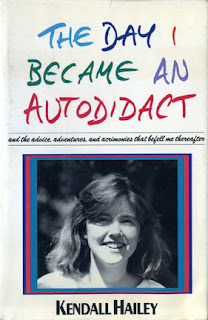
Published as an adult book in 1988 (when the author was just 21), it’s a first-person account of a smart, privileged teenager who decides to graduate early from high school, skip college, and educate herself. Her experiences studying literature, exploring the arts (painting, writing, acting), seeing plays and movies, and coming to terms with family and friends make for captivating, thoughtful reading. I think this is a book that every teenager -- especially those struggling with educational and career goals -- should read. And that goes double for creative kids.
Kendall’s refreshing voice is both unsophisticated and wise -- and some of her accidental aphorisms (such as "The great gift of family life is to be intimately acquainted with people you might never even introduce yourself to, had life not done it for you.”) are still quoted all over the internet.
For many years after reading THE DAY I BECAME AN AUTODIDACT, I wondered what happened to its author. Occasionally I’d do internet searches and encounter other readers and fans who were also trying to track her down. Finally I discovered her name in a blog run by her husband, Danny Miller, also a talented writer. Now I’m a fan of his work too, especially his detailed, nearly photographic recall of childhood experiences (he needs to write a children’s book!)
Kendall Hailey’s book is currently out of print, but some smart publisher should bring it back -- this time marketing it DIRECTLY to high school students. It may have been published for adults originally, but at heart it’s a young adult book -- and one that could change lives.
MUSICAL INTERLUDE : DID THE “BIG O” STAND FOR OSCAR?
Did you know that Shel Silverstein (THE GIVING TREE; WHERE THE SIDEWALK ENDS) was nominated for “Best Original Song” Oscar in 1990 for writing the country-themed “I’m Checkin’ Out” which was sung by Meryl Streep in the movie POSTCARDS FROM THE EDGE?HOW TO INFLUENCE PEOPLE
Back on August 8, I blogged about “attending” a book signing for those newly-minted children’s book authors Mary Kate and Ashley Olsen, whose just-published volume, INFLUENCE, has people talking “Newbery Award.” (Unfortunately, what they’re saying is “This book will never win the Newbery Award.”)
This past week, the tiny twosome celebrated the release of INFLUENCE with a book signing at New York’s Barnes and Noble Union Square store. Fans who attended were given a list of nine rules they had to strictly follow:
1) Mary-Kate Olsen and Ashley Olsen will be with us for a limited time. They will only be signing copies of their book, Influence. They will not be speaking, reading or taking questions.
2) Mary-Kate Olsen and Ashley Olsen will NOT sign any memorabilia or product other than Influence. There is a limit of one book per person, and your one book must be purchased here.
3) You will be directed to pay for your book upon entering the store and will be given a receipt for your purchase. Please keep your receipt. You will receive your book at the signing table.
4) Along with your receipt, you will be given a B&N wristband, and then directed to the event space on the 4th floor. You must have a receipt and a wristband to access the 4th floor.
5) Anyone approaching the signing table must have paid for the book and be wearing a B&N wristband. One person, one wristband, one book.
6) You will collect your signed book at the signing table. If you have paid for any additional copies, a staff member will provide you with those before you exit the space.
7) There is no photography allowed. You must put away your camera or cell phone before approaching the signing table. The authors will not pose for photos.
8) If you leave, or the authors leave, before you are able to collect a signed book, you may present your receipt to a cashier for either an unsigned book or a refund. (Refunds only issued within 14 days of receipt.)
9) There will be no extra signed copies available after the authors leave the store. They will not be able to sign for anyone who is not on line. No pre-orders.
Blah, blah, blah...but wasn’t it cute how they kept referring to the twins as “authors”?
What few people noticed is that the back of the list contained nine MORE rules. I think this is what they must have said:
1) If one or both of the twins should fall asleep during the signing, do NOT wake them up. They are not used to getting up before noon.
2) Do not, under any circumstances, smoke while waiting in line. Smoking is strictly prohibited at Barnes and Noble and anyone who does not follow this instruction will be reported to the police and suffer severe consequences. Again: ALL SMOKING IS FORBIDDEN!!!! (Note: This rule does not apply to the Olsens themselves.)
3) Do NOT ask the twins any questions about their book. They have not read it yet.
4) Do NOT throw papers, chewing gum wrappers, or any type of trash into the round, eight-gallon receptacles on each side of the signing table. Those are not wastebaskets. They are the Olsens’ cups of Starbucks coffee.
5) Do NOT get a book signed and then turn around and sell it on eBay. The Olsens’ own all intellectual property rights on these volumes, including their signatures (and the letter “X,” which is how Mary Kate signs her name.) If YOU make a profit from these signatures, you are depriving the Olsens of money that is rightfully THEIRS. These are tough economic times and the Olsens are down to their last 231.9 million dollars. Please keep that in mind before getting greedy.
6) Do NOT ask any questions about Heath Ledger.
7) Do NOT offer either twin a cookie, doughnut, bagel, cupcake or any other snack. The twins do not eat. Ever.
8) Do NOT hold the book over their heads and ask if they are “under the INFLUENCE.” It’s childish to do so and, anyway, the answer to that question should be obvious.
9) Do not ask Mary Kate and Ashley “Which one are you?” If
you don’t know, how can you expect
them to know?
You may wonder what could happen if a fan broke any of the above rules. ...I don’t know for sure...but I’ve heard those Barnes and Nobles wristbands were electrified. One broken rule and ZAP! You’d be history!
MUSICAL INTERLUDE : SING ALONG WITH SENDAK
Anyone familiar with an early, and seldom-discussed, Maurice Sendak volume called SINGING FAMILY OF THE CUMBERLANDS? Written by Jean Ritchie, this nonfiction volume contains words and music for over forty songs and many half-page illustrations by Sendak. I don’t think his art was included in all the later editions, so keep an eye out for the Oxford University Press edition, first published in 1955. Sendak later adapted his 1960 title THE SIGN ON ROSIE’S DOOR and  the books in his 1962 “Nutshell Library” (CHICKEN SOUP WITH RICE, PIERRE, ONE WAS JOHNNY, ALLIGATORS AROUND) into the musical REALLY ROSIE, for which he wrote the book and lyrics. Carole King (who wrote “One Fine Day” -- the song, not the Caldecott-winning book) wrote the music. REALLY ROSIE was broadcast as an animated television special in 1975, released as a record, and has enjoyed stage success as a children’s show. Finally, singer Shawn Colvin adapted several pieces from one of her favorite childhood books -- LULLABIES AND NIGHT SONGS, which was written by Alec Wilder and illustrated by Maurice Sendak -- for her 1998 Christmas CD HOLIDAY SONGS AND LULLABIES -- and Sendak provided the artwork.
PLAYING FOR THE NBA
I’m in the midst of reading all five of the nominees for this year’s National Book Award for Young People’s Literature:
CHAINS by Laurie Halse Anderson
THE UNDERNEATH by Kathi Appelt
WHAT I SAW AND HOW I LIED by Judy Blundell
THE DISREPUTABLE HISTORY OF FRANKIE LANDAU-BANKS by E. Lockhart
THE SPECTACULAR NOW by Tim Tharp
I plan to do a special blog with reviews of all five NBA nominees (and thus destined-to-be-collectable-books) before the November 19 award ceremonies. If you haven’t read them yet, we have about seventeen days to do so. I’ll meet you back here to discuss them soon!
MUSICAL INTERLUDE : THE WRITER WHO NAMED A BAND
Before she achieved fame writing for young people as M.E. Kerr, Marijane Meaker was one of the top suspense authors of the 1950s and 1960s, writing as “Vin Packer.” One of the best Packer books was called THE DAMNATION OF ADAM BLESSING.
Does that name sound familiar?
If you’re a fan of young adult fiction, you may recall that a boy named Adam Blessing is the protagonist of Kerr’s THE SON OF SOMEONE FAMOUS.
If you’re a fan of music, you may recognize “The Damnation of Adam Blessing” as the name of a rock group from the 1960s. Legend has it that they were searching for name for their band and happened to have a copy of the Vin Packer paperback on their bus at the time.
Like the book, which was recently brought back into print by Stark House, the band is also still around, and performed at the fifth anniversary of Cleveland’s Museum of Rock and Roll in 2000.
MUSICAL INTERLUDE / BONUS TRACK : SINGING THANK YOU
In 2002, when M. T. Anderson and Kevin Hawkes won a Boston-Globe Horn Book Honor Award for their book HANDEL, WHO KNEW WHAT HE LIKED, the author and illustrator sang their acceptance speech in two-part harmony.
MUSICAL INTERLUDE / SECOND BONUS TRACK : YOU KNOW DASHER AND DANCER AND DONNER AND BLITZEN...BUT DID YOU KNOW THIS?
Rudolph the Red-Nosed Reindeer originated as a promotional book that was given free to shoppers at Montgomery Ward. In 1939, one of the store’s copywriters, Robert L. May, was given the assignment of writing the story, which he based partly on Hans Christian Andersen’s THE UGLY DUCKLING and partly on his own experiences growing up as a small, shy “misfit.” Writing in couplets, May rejected the names Rollo (too jolly) and Reggie (too British) before naming his reindeer Rudolph. Montgomery Ward executives were concerned that red noses were often associated with drunkeness, but when they saw the illustrations by Denver Gillen, who worked in Ward’s art department, the execs were finally won over by the story of RUDOLPH, THE RED-NOSED REINDEER. Nearly 2.5 million copies of the booklet were given to Montgomery Ward shoppers during the Christmas season of the 1939. The song, the TV show, and the many adaptations all came later.I began this blog on a sunny November morning and am finishing it on a cold and cloudy November afternoon.
I also began this entry decrying the playing of Christmas Carols so early in the season...and end it by telling the story of Rudolph!
Oh no.
Oh No-vember.
 schemes devised by Samuel Clemens. Such endeavors included trading coca, mining silver, and harvesting timber. Even his public lectures (whose advertising catchphrase -- "Doors open at 7. The trouble begins at 8" -- provides the book's title) were initially viewed as just another money-making opportunity. Mr. Fleischman's book focuses primarily on Twain's early adventures, then hurriedly giddyups through his later literary triumphs. Interestingly, even after he became a famous writer -- famous enough to be pictured in the deck of "Authors" playing cards -- he never quit looking for ways to make a quick buck.
 board contained space for one hundred answers in the categories of Accessions (i.e. president elected to office or royalty assuming throne), Battles, and Minor Events. According to the lengthy instructions: "The board represents any century. Also, it represents all centuries. You may choose a particular century and confine your game to one nation's history for that period; Or you may include the contemporaneous history of all nations." Twain, who wrote the instructions in first person, provided some examples of game play: You stick a pin in 64...and say, "Shakespeare born, 1564. Or pin 76...and say, "Declaration of Independence, 1776. You stick a pin in 15...and say, "Waterloo, 1815." You stick a pin in 3...and say, "James I. ascended the English throne, 1603."


