Saturday, January 12, 2008

Two Phrases Collectors Hate. Usually.


First there's the thrill of discovering the book you want listed in a catalog or on an internet site. Correct title! Correct author! First edition! Then your eyes light on a phrase that changes everything. Sometimes the phrase is "ex-lib," meaning the book being offered once belonged to a library and is now probably inked all over with library stamps and contains torn remnants of a pocket and date due slip. Other times the phrase is "book club edition," meaning it was mass produced on cheap paper and doesn't have the distinctive elements that one associates with a true first edition. You close the catalog or log off the internet site because no self-respecting book collector is interested in "ex lib" volumes or "book club" printings. Usually.

A friend recently asked if I had any ex-lib books in my collection. I started to say, "No way!" then remembered that I have at least two -- the 1935 Newbery Medal winner DOBRY by Monica Shannon and the 1962 Newbery winner THE BRONZE BOW by Elizabeth George Speare. Even though I now own true first editions of both titles, I still keep these duplicate ex-lib copies on my shelves. They're nothing much to look at. Both have been rebound. Both have pockets glued to the endpapers. Yet I keep these volumes because they are IDENTICAL to the copies that I used to check out of the local library again and again when I was a kid. Just seeing the colors of these bindings (DOBRY's grayish-turquoise, THE BRONZE BOW's creamy blue) takes me back thirty years, as does touching the thick woven endpapers and covers, which are always slightly cold and feel rough yet glossy. The books have no real value (I think I bought them for twenty-five cents each) but they are as important to my collection as any hundred dollar book because of the sensory, tactile memories they provide.

I also have a few book club editions in my collection. The Peoples Book Club published an edition of Mary Stolz's READY OR NOT that I keep mainly because of Victor Olsen's endpaper illustration. I'm sure the original Harper edition of this novel did not include illustrated endpapers and I appreciate that fact that the book club made this extra effort. I love the winter-in-the-city setting, with the snow coming down, the Christmas tree slung over the teenage boy's shoulder, the pensive expression of the teenage girl, and the openiness in the younger boy's face. Wish I had a copy of this picture to frame.


And here's another book club volume I own: THE WIDER HEART by Norma Johnston. I actually love most of Johnston's later books ("The Keeping Days" series, etc.) but her earlier work tends to be...well, awfully...prissy. This one is no exception, starting with the heart design on the cover, the fact that the heroine calls her mother "Mimsy," and that it was published by the "Best Loved Girls' Books" book club!


So why do I keep it on my shelves?

Because I can't separate this mellifluous, muliebral book with the folded note I found tucked inside it after I brought it home from a used booksale. Please click on the picture to enlarge the image:


I've owned this book for a good ten years, and still can't stop thinking about Pam, whose tale is potentionally more dramatic than the story found within the pages of Johnston's novel. Did she actually run away? Did she take THE WIDER HEART with her on the lam, or leave it behind with the note inside for Mr. and Mrs. Mack to find? How long did she "survive" on her $41...and did she ever return home?

Friday, January 11, 2008

Encyclopedia Brown and the Mystery of the Newbery Medal


Over the next couple days the Newbery Award committee will meet in Philadelphia to begin the mysterious process of picking the next winner. I use the word “mysterious” because, even though the names of all the committee members are known and the rules for selecting the prize book are clearly stated, the entire process is swathed in secrecy and mystery. So we will never know what titles were on the shortlist of possible winners. Or if our favorite book almost made the cut or wasn’t even considered. Or whether the final selection was a slam-dunk or a compromise choice. These are the mysteries I ponder every year when the winning book is announced.

There are also a few historical mysteries connected with the Newbery and I wish some literary-minded Encyclopedia Brown or Nancy Drew would find a way to crack them.

Here are the top three:

1) The Mysteriously Missing Honor Books.

Every year the Newbery committee picks a winner and some Honor Books. Originally called “runners-up” (the name was changed in the early 1970s), there can be one or more Honors. On at least two different occasions there were eight Honor Books! (The more the merrier, in my opinion.) But there have also been three years, early in the history of the awards, when there is no record of which Honor Books were selected. It’s odd, because the Honor Books were duly noted in 1922, the first year the award was given. But there is no record of the Honor Books for the following year when THE VOYAGES OF DOCTOR DOLITTLE won, or the next year when THE DARK FRIGATE claimed the gold medal. We do know the Honor Books for the following two years, 1925 and 1926, but someone dropped the ball again in 1927 and there is no record of the runners-up to SMOKY, THE COWHORSE. I find it frustrating beyond belief that there are a handful of Newbery Honors out there, languishing on dusty library shelves, that we know nothing about. Not that they’d be particularly popular if we did know their names today (when was the last time anyone read the 1922 Honors CEDRIC THE FORESTER or THE OLD TOBACCO SHOP?) But still...it would be nice to see them acknowledged -- even at this late date. I wish I’d made some attempt to solve this mystery when I was younger. Even in the 1970s and 1980s there might have been a few librarians alive who served on those early committees, but it’s now too late to get any firsthand information. Dead librarians tell no tales. The best we can hope for is that some old notebook or sheet of paper containing this information will turn up some day. Imagine someone buying an old library desk from an antique store, then getting it home and finding it once belonged to the American Library Association and one of the drawers contains a scrap of paper with the 1923 runners-up jotted on it. What a dream. And what a nightmare if the person who finds it knows nothing about the Newbery and just flips it over and writes their grocery list on the back.

2) What are the 1933 Honor Books?

According to the list presented in NEWBERY AND CALDECOTT MEDAL BOOKS : 1956-1965, edited by Lee Kingman and published by the Horn Book in 1965, there were three Honors that year:

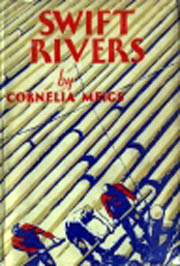
SWIFT RIVERS by Cornelia Meigs
THE RAILROAD TO FREEDOM by Hildegarde Swift
CHILDREN OF THE SOIL by Nora Burglon

But wait. Another major reference volume, A HISTORY OF THE NEWBERY AND CALDECOTT MEDALS by Irene Smith, published by Viking in 1957, gives us an entirely different slate of Honors:

HEPATICA HAWKS by Rachel Field
ROMANTIC REBEL by Hildegarde Hawthorne
AUNTIE by Maud and Miska Petersham
TIRRA-LIRRA by Laura E. Richards
LITTLE HOUSE IN THE BIG WOODS by Laura Ingalls Wilder

There isn’t even an overlap between these lists. Which one’s correct and which one’s wrong? Kingman’s list seems to be the most accepted and has been reprinted in many different reference books over the years, but Smith’s 1933 Honors have been reprinted in some subsequent reference volumes as well, giving us a case of dueling Honor books and a mystery that should be answered definitively at some point. Incidentally, here's a little mystery within a mystery: there actually isn't any book named AUNTIE by the Petershams, though they did write one named AUNTIE AND CELIA JANE AND MIKI.

3) The Newbery Honor That Wasn’t.

WHERE THE LILIES BLOOM was written by Vera and Bill Cleaver and published by Lippincott in 1969. Certainly one of the high points of their amazing literary career (and why aren’t the Cleavers’ books read as much today as they were a few years ago? They seem timeless to me. But I digress....) I think I can state unequivocally that, as much as it deserved an award, WHERE THE LILIES BLOOM was not honored with a Newbery. And yet...and yet...this book is frequently referred to as a Newbery Honor Book. It was even billed this way in the film adaptation of the novel -- on all the advertising and right there in the opening credits, “Based on the Newbery Award Winning Honor Book.....” Sorry the picture below is blurry, but if you click on the image, you can see that the poster mentions the Newbery.


I’m sure there are many more mysteries associated with the Newbery. If you know of any...or know the answers to any of the puzzles I’ve just related, please post the solutions here. Though I suspect that, for most of us, the biggest Newbery history remains, "How in the world did...(insert title of your personal least-favorite winner here)...ever win the Newbery?"

Thursday, January 10, 2008

One-of-a-Kind


You really CAN'T judge a book by its cover.

There's a volume on my shelf whose spine says TOMMY AT THE GROCERY STORE. That's the title of a picture book written by Bill Grossman and illustrated by Victoria Chess. However, if you take the volume off the shelf you will see that it's not really TOMMY AT THE GROCERY STORE at all. Someone has altered the pages to create a brand new book called BILLY'S RISE TO POWER. For the most part, the illustrations remain the same, but a new rhyming text has been taped over TOMMY's words. This new story parodies the career of William Morris, the library promotions director at HarperCollins, and was presented to him when he retired from the company. Inside are a few loose Polaroids of Bill Morris at his retirement party, including one of him cutting the cake:


I never met Bill Morris, but have heard nothing but wonderful things about him. At the time of his death in 2003, several trade journals published tributes to Mr. Morris and his infectious enthusiasm for children's books. He sounds like one-of-a-kind and I'm so glad to have this one-of-a-kind book honoring the man and his career.

How did I come to own it? Shortly after Mr. Morris's death, much of his personal library was sold by an auction house in New York. I knew nothing about this at the time, but learned about it later. From what I understand, boxes of books were sold in random "lots." There was great interest in his collection of titles by Maurice Sendak, but most of the other lots sold for very reasonable prices. Soon individual books began to turn up at New York bookstores, selling for $30-$60 a piece. I'm all about preserving the history of children's books, so made it a mission to collect as many of these books as I could find. Thus I have books signed to Mr. Morris by Jennifer Holm, Jean Craighead George, Bruce Brooks ("For Bill -- Always the reader (and friend) I like most to please"), Francesca Lia Block, Walter Dean Myers, and dedication copies of books by Laurence Yep and Pam Conrad/Brian Selznick. I have no idea where the rest of his collection went (I heard a rumor that some of his books ended up at a thrift store) but I always keep an eye out for other volumes that may have belonged to him. While my favorite remains the one-of-a-kind BILLY'S RISE TO POWER, I also have a soft spot for IN THE FOREST OF YOUR REMEMBRANCE, a collection of Bible retellings by Gloria Jean Pinkney and illustrated by Jerry Pinkney. Signed by both (and with a drawing by Mr. Pinkney), it's poignantly inscribed "Dear Bill, Miracles are given everyday." It's dated September 5, 2003, just days before his death, and may well be the last book he ever received as a gift.

My collection of Bill Morris books feels like something of a gift to me as well. I don't really feel like I'm the "owner" of these books. I prefer to think that I'm their "caretaker," holding these books and preserving this part of literary history, until they -- like the rest of my personal collection -- are eventually passed on to a library where they can be shared with writers, researchers, librarians, and others interested in the history of children's books.