I hope everyone had a good Thanksgiving. Although I realize that, after several days of leftovers, you probably don’t want to see another drumstick or giblet till next November, I couldn’t help serving up a little more turkey in today’s Sunday brunch. This blog entry also includes thoughts on a Pulitzer possibility, examines the book release dates of recent Newbery winners, and notes Aunt Bee’s appearance in an overly-padded teenage horror novel.
TURKEY LEFTOVERS
A few months ago I came across a 1956 novel with a Thanksgiving theme -- RISKY BUSINESS by Elaine Macmann. A character in the tradition of Beverly Cleary’s Henry Huggins or Carolyn Haywood’s Eddie Wilson, every-boy Terry Morse schemes to earn the money for a new bicycle by raising turkeys to sell for Thanksgiving dinner. Humorous chaos ensues when Terry’s slow-to-grow gobbler, Hector, accidentally unravels an elderly woman’s skirt, disrupts a school Thanksgiving pageant, and -- unlike the rest of his feathered friends -- manages to make it to the end of the book without losing his head.
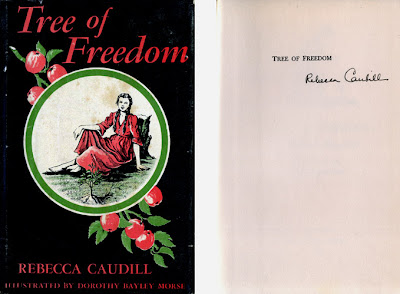
I actually first encountered RISKY BUSINESS in the library, but when I discovered that an online bookstore had signed copies of both this title and Elaine Macmann’s second, similar book, OZZIE AND THE 19TH OF APRIL (1957), for under ten dollars each, I decided to order them. Imagine my surprise when the bookseller wrote back saying he couldn’t find the books on his shelves and asking if I had any idea what they looked like! (Me: “Well...they’re bound...and they have pages...because they’re, you know,
books.” Actually, I was a little more helpful than that and was able to supply their dimensions and pagination.) A day later he wrote to say that, with my help, he had found them. First time I ever located books on a shelf one thousand miles away.
I particularly like the inscription, as it provides some information about the author I didn't know -- that she apparently attended the prestigious Bread Loaf Writers’ Conference and that she went by the nickname “Mac.”

Incidentally, the Bread Loaf Writers’ Conference has been held every summer at Vermont’s Bread Loaf Inn since 1926. Attendees include famous authors as well as aspiring writers who either pay tuition or receive “waiterships,” meaning they attend the conference while also serving meals to the paying guests.
Maybe “Mac” had a waitership and one of the lunch items, turkey on rye, led to the creation of RISKY BUSINESS.
MY THANKSGIVING PROJECT
About a week ago I blogged about the National Book Award finalists. In my review of Laurie Halse Anderson’s CHAINS, the story of a slave’s quest for freedom during the Revolutionary War, I loftily and authoritatively intoned: “Many, if not most, slavery stories are set during the era of the Civil War.”
Now I feel like something of a turkey myself.
I can’t believe I completely forgot about another major, just-published book, THE KINGDOM ON THE WAVES by M.T. Anderson, which also concerns a slave seeking freedom during the American Revolution!
And it’s not as if this book is unknown (it’s the concluding volume of THE ASTONISHING LIFE OF OCTAVIAN NOTHING, TRAITOR TO THE NATION, whose first volume, THE POX PARTY (2006) won the National Book Award and was named a Printz Honor Book) or easy to ignore (it’s nearly 600 pages in length!)

Since I had four days off work for the Thanksgiving holiday, I decided to use that time to tackle both the Octavian Nothing books -- all 900-plus pages. I finished KINGDOM OF THE WAVES yesterday and am still somewhat stunned. Has there ever been a book for young readers as densely-written, with as many classical references, and as many passages and even single sentences that both electrify the intellect and pierce the heart?
THE POX PARTY relates the early years of a black youth being raised by a group of philosophers known as the Novanglian College of Lucidity. Although he leads a life of great privilege, he comes to realize that he is nonetheless enslaved. In THE KINGDOM ON THE WAVES, Octavian experiences the horrors of war as a member of Lord Dunmore’s Royal Ethiopian Regiment. However, at various times he, like the protagonist of CHAINS, aides both sides of the revolution and comes to understand that “Rebel or Redcoat, there were none who needed to use us sufficiently to save us.”
I have recently been reading an interesting discussion of the Octavian Nothing books on an internet listserve. Some young-adult librarians said they cannot justify the purchase of THE KINGDOM ON THE WAVES for their collections because the first volume sits on their shelves unread. Others have said that, with sufficient booktalking and urging, they’ve been able to introduce these titles to young people with great success.
I’m sure that
some young readers will read and enjoy these books. I also think that many more will be scared off by their ornate and antiquated prose; their obscure references to classic works of literature, religion, and philosophy; the realistic violence of their wartime scenes, and the sheer
depth of their plots and characterizations. (I honestly feel that I could read both books over and over and continue uncovering new material, new ideas, and new meanings each time.)
But I keep asking myself: Are these books -- particularly THE KINGDOM ON THE WAVES -- really for young readers at all? What distinguishes an adult novel from a book for young readers? Do these two volumes straddle both genres -- children’s and adult -- or can they be definitively placed in one category? And if so, why?
THE POX PARTY won the NBA for Young People's Literature and was named a Printz Honor Book. I’ve heard THE KINGDOM ON THE WAVES mentioned for both the Printz and the Newbery.
I have another idea. I think the publisher, Candlewick, should submit it for Pulitzer contention. From the little bit of research I’ve done, I don’t see anything in the Pulitzer rules that say a book must be published specifically for adult readers. Instead I read:
Eligibility for these awards shall be restricted to works first published in the United States (check!)
during the year in either hardcover or bound paperback book form (check!)
and made available for purchase by the general public (check!)
We’re also told that the Pulitzer is an award
for distinguished fiction (check! check! check!)
by an American author (check!)
preferably dealing with American life (check!)
I can easily see it joining the ranks of past Pulitzers, such as THE KNOWN WORLD by Edward P. Jones, ANDERSONVILLE by MacKinlay Kantor, and so many other historical winners. And if the Pulitzer committee is nervous about giving their Letters/Fiction award to a “children’s” book, there’s always the option of a Pulitzer Prize Special Award, such as those given to Alex Haley for ROOTS or Art Spiegelman for MAUS.
This soaring work of fiction, staggering in its historical scholarship, deserves some kind of honor and I’m not sure that, in this case, either the Newbery or even the Printz would be the proper “fit” in terms of reading audience.
STEROID SCANDAL
You’ll note that in my list of reasons why kids may shy away from THE KINGDOM ON THE WAVES, I did not mention its sheer size. Twenty years ago, a nearly 600-page book for young readers would have been mind-boggling. Now these behemoths are becoming increasingly common. Heck, the two volumes of Octavian don’t even measure up to Katherine Applegate’s two summertime paperbacks, BEACH BLONDES and TAN LINES, which run over 1250 pages!
What has brought about this change in books for young people? Is it the influence of the Harry Potter books, each volume thicker than the last? Are editors getting too lazy to edit? (I began to brace myself for angry

letters from editors, then realized any editor too lazy to edit is probably too lazy to send me a letter of protest.) Are writers getting so self-indulgent and egotistical that they refuse to have any of their precious prose cut? (I began to brace myself for angry letters from writers, then realized any writer too egoistical to allow their prose to be edited is probably too egotistical to recognize themselves in my comment.) Are bookbuyers now intent on “getting the most for their money” by choosing only large volumes? I really don’t know. All I know for sure is that books are getting bigger and bigger.
And I’m amused to see how publishers are bulking up what must be fairly short manuscripts into big old hefty books through the use of wide margins, large fonts, and double-spacing. One of the more flagrant examples is Lauren Myracle’s spooky new young-adult novel BLISS. I’m reading it right now and, while I enjoy the sixties setting (with references to the Apollo moon landing, the Manson murders, Trix cereal, and Clairol commercials) and think the characters and their relationships are very intriguing, I’m surprised by how many blank pages the book contains. Some feature only a small vignette of a dove in the middle of a white page. Then there are the black two-page spreads containing just a brief line from a TV ad or THE ANDY GRIFFITH SHOW. Don’t get me wrong, I love everything about Aunt Bee, from her fried chicken to her willingness to fly a small airplane when other folks her age are content to sit in their rocking chairs. Heck, I even love her kerosene pickles -- and
nobody likes those! So as tickled as I am to see her words appear in BLISS, I’m somewhat surprised the book devotes an entire two pages to her favorite two-word scoff, “Oh, flibbertigibbet!”

Actually, I’m not really complaining about books being thicker these days...just making an observation. In a way, I even understand this trend toward supersizing. Maybe it's just a way of being noticed. A way of saying, “We’re still here.” A last ennobling effort to show that books -- real books made out of paper and ink and glue -- still exist and still matter as we head for a time when every novel goes digital and every book is re-Kindled into electronic particles on a lighted screen.
THE NEWBERY SEASON
As the year winds down, people are talking more and more about what books may win the Newbery in January. It struck me the other day that many of the titles bandied about earlier in the year no longer seem to be mentioned as much in Newbery discussions: BIRD LAKE MOON by Kevin Henkes, SAVVY by Ingrid Law, THE PENDERWICKS ON GARDAM STREET by Jeanne Birdsall and TROUBLE by Gary D. Schmidt are just a few that come to mind. Is this because, as the year went on, other, better titles supplanted them as favorites -- or have they simply been forgotten?
And is there any rule of thumb about whether books from the spring or fall are more likely to win the Newbery?
I went back and checked the publication dates for the last twenty Newbery winners:
2008 / Good Masters! Sweet Ladies! JULY
2007 / The Higher Power of Lucky NOVEMBER
2006 / Criss Cross AUGUST
2005 / Kira-Kira FEBRUARY
2004 / The Tale of Despereaux SEPTEMBER
2003 / Crispin: The Cross of Lead JUNE
2002 / A Single Shard MARCH
2001 / A Year Down Yonder OCTOBER
2000 / Bud, Not Buddy OCTOBER
1999 / Holes SEPTEMBER
1998 / Out of the Dust OCTOBER
1997 / The View from Saturday SEPTEMBER
1996 / The Midwife's Apprentice MARCH
1995 / Walk Two Moons JUNE
1994 / The Giver APRIL
1993 / Missing May MARCH
1992 / Shiloh SEPTEMBER
1991 / Maniac Magee APRIL
1990 / Number the Stars APRIL
1989 / Joyful Noise: Poems for Two Voices MARCH
I discovered that of the twenty winners, ten were published in the first half of the year and ten in the last half.
Well, that's fair.
However, in the most recent decade, seven of the ten were published in the fall and only three in the spring.
Yet in the previous decade, seven of the ten were published in the spring and only three in the fall.
Coincidence? The luck of the draw? What do you think?
THIRTEEN
Back to that other slave-during-the-Revolutionary-War-novel by that other author named Anderson: CHAINS by Laurie Halse Anderson.

I love this book. But a couple people have mentioned that the age of the protagonist, Isabel, is not mentioned in the novel. I didn’t notice it either. Did I miss it somewhere? However, someone pointed out to me that Isabel’s age
is listed as thirteen on the front flap of the dustjacket. IF this is the only mention of Isabel’s age, does it really count? Do we get our information from the text only, which was written by Anderson herself, or do we accept what’s on the dustjacket, which may have been written by an editor or someone else at the publishing house? Should reviewers say Isabel is thirteen at the start of the book if the only place it’s mentioned is on the dustjacket? What about kids writing book reports? Does it matter?
Of course all this is contingent on the idea that Isabel’s age ISN’T mentioned in the book. Maybe it’s there but I, and a few other readers, missed it because we were focusing so much on her story.
Anyway, that’s all for today. Thanks for dropping by. You can now return to your regularly-scheduled turkey soup, turkey hash, mulligatawny stew, turkey salad, or other Thanksgiving leftovers. Or maybe it’s time to take a break and order a pizza.