Sunday, December 5, 2010

Sunday Brunch for December 5

Among other topics, today’s Sunday Brunch anticipates this week’s Morris Award finalists, revisits adult mystery authors who also write for kids, and asks if you finish every book you begin.


A CHRISTMAS GIFT FROM HALLMARK

I’m a big fan of Christmas movies. The holiday season wouldn’t be the same without old standards such as WHITE CHRISTMAS, HOLIDAY INN, and A CHRISTMAS STORY. And I’m usually glued to Lifetime TV for the entire month of December, watching their large assortment of Christmas flicks. Last night I watched a Hallmark Hall of Fame movie that I recorded earlier in the week -- NOVEMBER CHRISTMAS. It’s the story of a town that bands together to bring an early Christmas to a sick little girl. Yes, it was sentimental. But what made it especially interesting to me was that one of the characters worked in the children’s department of a library and another character, a troubled teenage girl, hoped to write and illustrate children’s books when she grew up. One scene even referenced two famous volumes, THE FIVE CHINESE BROTHERS and HAROLD AND THE PURPLE CRAYON.

It’s not often that children’s books get that much attention on TV. Thanks Hallmark!


SPOT THE DIFFERENCE

There are often visual differences between the cover of an ARC (advance reading copy) and the final hardcover book. Sometimes the original illustration has been replaced; other times there are only minor changes in the artwork. Occasionally a title will even change. But this is one or the rare times I’ve noticed an author’s name changing between ARC and hardcover:


I have no idea why the ARC’s Margaret Peterson later became Margaret Stohl.

Change in marital status?

Did she decide to adopt or discard a pseudonym with this book?

All I know is that BEAUTIFUL CREATURES was one of 2009’s most popular YA titles -– and the series is still going strong with the recent publication of second volume BEAUTIFUL DARKNESS.

Though I don’t know the reason for the name change on the books, I suspect that the ARC is now worth a bit more money to collectors due to this variation in names.


MORRIS AWARD

Incidentally, it was just about this time last year that BEAUTIFUL CREATURES was shortlisted for the William C. Morris award.

Just three years old, the Morris award “honors a debut book published by a first-time author writing for teens.”

Within the next couple days, the five finalists for the 2011 Morris Award will be announced. I love award shortlists. They allow us prize fans to “play along at home” by reading all the nominated books and evaluating them for ourselves, rather than waking up to out-of-left-field surprises on awards day.

Which titles will be on the Morris list this week? SHIP BREAKER by Paolo Bacigalupi? SPLIT by Swati Avasthi? BEFORE I FALL by Lauren Oliver? THE SKY IS EVERYWHERE by Jandy Nelson? MATCHED by Allie Condie? THE RED UMBRELLA by Christina Gonzalez? THE MOCKINGBIRDS by Daisy Whitney?

Those are some of the titles that spring to my mind, but the Morris Award has proven to be hard to predict. I would not be surprised to see a list of nominees that I’ve never heard of before.

Guess we’ll find out in a day or two!


ANOTHER SHORTLIST

If you also love award shortlists, here’s another one for you.

This past week brought the announcement of the five finalists for the 2011 YALSA Award for Excellence in Nonfiction for Young Adults.

The titles are:

JANIS JOPLIN : RISE UP SINGING by Ann Angel

THEY CALLED THEMSELVES THE KKK : THE BIRTH OF AN AMERICAN TERRORIST GROUP by Susan Campbell Bartoletti

SPIES OF MISSISSIPPI : THE TRUE STORY OF THE SPY NETWORK THAT TRIED TO DESTROY THE CIVIL RIGHTS MOVEMENT by Rick Bowers

THE DARK GAME : TRUE SPY STORIES by Paul Janeczko

EVERY BONE TELLS A STORY : HOMININ DISCOVERIES, DEDUCTIONS, AND DEBATES by Jill Rubalcaba and Peter Robertshaw

The winner will be announced January 10 -- the same day we learn the winners of the Morris Award…and Newbery…and Printz…and Sibert….

I’m taking that day off work!


THE FLOATING CHUCKIE DOLL

Nearly two years ago I wrote a blog about scary dolls from children’s books.

This week I encountered another one.

Someone at work brought me a slim black picture book that needed its call number changed. I opened the book to see this strange tableau:


The book was called GHOST DOLL, a 1983 volume written and illustrated by Bruce McMillan.

The story concerns a young girl named Chrissy who is beckoned inside an old house by a faint voice calling, "Come in. Come in. Come in and play with me."

Chrissy breaks into the house (okay, the book just says "She opened the front door and peered inside" but the next thing you know she's all over the place -- peeking under the sofa, climbing the stairs. Hasn't she, technically, committed a B&E?) while the voice taunts her: "I'm in here. I'm in here. Please come in here."

An abandoned doll, photographed to look hazy, is shown floating through the mansion. Chrissy pursues her and when the doll realizes that "You didn't run away. You wouldn't leave me. Now I'm sure! I want to be your doll" the ghost floats into a box, the box floats out the door, and Chrissy presumably keeps her. (Until, at least, Chrissy discovers boys, tosses the doll under her bed, and the ghost doll must scare up some other companion.)

I’m not sure what’s scary about the book -- the story or the stark black-and-white photographs of Chrissy and the doll. If the doll had been the least bit beguiling, I could understand Chrissy’s quest, but there’s something malevolent about this doll…especially the way she fades in and out of the pictures.


Also, there were a couple near-vulgar pictures of the doll swirling above a staircase that reminded me of a baby making its way down the birth canal. If babies were born already diapers that is.

I found GHOST DOLL so creepy that I couldn’t wait to check Amazon.com to see how many readers had submitted customer comments saying this book had traumatized them as children.

Strangely, there is not one single comment -- either pro or con -- for GHOST DOLL.
Does anyone remember this oddity?

Did it freak you out as a child?


MORE MYSTERIES


Last Sunday I blogged about adult mystery authors who have also written for young readers.

First, I wanted to clear up the misconception that all of the books M.E. Kerr wrote under the pseudonym “Vin Packer” are out of print. Six of these super suspense novels have been brought back into print by Stark House Press , a company known for reprinting some of the best mystery novels from the past.

Also, three of the Vin Packer novels are now available on Kindle. You can read SPRING FIRE, the very first novel by the author of DINKY HOCKER SHOOTS SMACK! and GENTLEHANDS for only one dollar. And the Packer novels LOOK BACK TO LOVE and THE YOUNG AND THE VIOLENT are available on Kindle for less than $5 each.

Several people wrote in to mention other authors who have written both adult mysteries and kids’ books.

How could I have skipped over Sandra Scoppettone! She’s one of my all-time favorite young adult authors (TRYING HARD TO HEAR YOU; LONG TIME BETWEEN KISSES) and her adult mysteries (which include the Lauren Laurano series, the Faye Quick series, and three books written under the pseudonym Jack Early) contain the same type of colorful, likable characters and amazing dialogue that make her books for young readers so good.

Sam wrote to say, “I've always been amazed that the two most famous talking bear authors also wrote adult mysteries. I've never read A.A. Milne's mystery, but I've read some of Michael Bond's. I eventually had to stop because I was blushing too hard to continue!”

Milne’s “murder-in-a-locked-room” novel, THE RED HOUSE MYSTERY, was published in 1922 and still remains in print. Michael Bond’s adult books (or what Sam might call THE RED FACE MYSTERY) feature a culinary critic named Monsieur Pamplemousse.

Reka wrote to say: “Jane Langton! One of my favorite children's writers became one of my favorite authors of adult mysteries when she wrote the wonderful Homer Kelly series, set near the author's beloved Walden Pond.

Then there's Joan Aiken ("Beware of the Bouquet," anyone?) who wrote mysteries and thrillers and Jane Austen sequels as well as her incomparable Wolves chronicles.

And Nina Bawden and Penelope Lively have written a few adult mysteries, it seems.”

Ankita wrote to say, “Make an unforgettable event with our gorgeous flowers, designer flower bouquets, awesome flower arrangements, holiday gifts, birthday gifts, startling gift baskets, imported chocolate gifts and other thrilling gifts for delivery in Hong Kong.”

Thanks for your comments, Sam and Reka!

Go away, Ankita.


ADULT MYSTERIES THAT INSPIRED CHILDREN’S BOOKS

Blog reader CLM mentioned an intriguing tie-in between an adult mystery and a children’s novel.

In 1979, Dorothy Gilman (perhaps best-known for her “Mrs. Polifax” mysteries) wrote a stand-alone suspense novel called THE TIGHTROPE WALKER.


Throughout that book, the narrator frequently mentions her favorite childhood novel, THE MAZE AT THE HEART OF THE CASTLE. Many readers were so intrigued that they tried to track down that novel for themselves. Unfortunately, it was a fictitious title; no such book had ever existed.

However, in 1983, Dorothy Gilman actually published a children’s novel called THE MAZE AT THE HEART OF THE CASTLE, which was inspired by the fictional book she created for THE TIGHTROPE WALKERS.


This is very similar to what happened with Dean Koontz’s 1993 suspense novel MR. MURDER. That mystery for adults includes several scenes in which a father creates a rhymed bedtime story for his daughters called “Santa’s Twin.”


The tale of Santa’s Twin is truncated in MR. MYSTERY, but after publication Mr. Koontz received over 4000 letters from fans, demanding to hear the entire story. Three years later he published SANTA’S TWIN as a lavishly-illustrated book for children:


Can you think of any other titles that were conceived within the pages of an adult book and later published as children’s books?


SPEAKING OF THE TIGHTROPE WALKER…

Helen Schinske wrote to say, “I think I remember THE TIGHTROPE WALKER -- if it's the one I'm thinking of, there was some gossip a few years ago about a modern children's book possibly having been plagiarized from it.”

Yep, I remember that fuss as well.

Several readers thought there were some pretty strong similarities between THE TIGHTROPE WALKER and one of Betsy Byars’ “Herculeah Jones” mysteries, DEAD LETTER.

I read both books and did find the premise to be similar in both books, but the characters and general narrative styles were so different that I couldn’t get too incensed about it.

I do remember that at least one published review did note the similarities between the two books though.


A PREDICTION

As the year draws to a close, many people begin making predictions about what will happen in the coming year. Here’s one of my predictions buried within some thoughts about a forthcoming book.

I recently received an ARC of a new novel called NO PASSENGERS BEYOND THIS POINT by Gennifer Choldenko. Having enjoyed the author’s Newbery Honor AL CAPONE DOES MY SHIRTS and, being the obedient type, I followed the directive on the cover: “Spectacular!! Drop everything and read me!!”

So I did.


In this timely story, a widowed mother loses her home to foreclosure and must send her three children -- earnest Finn, his typically teenage sister India, and their eccentric little sister Mouse -- to live with their uncle in Colorado. Instead, they land in an odd fantasy land where nothing makes sense. The ARC I read apparently had several pages missing. Strangely, this did not seem to impact the overall quality of this novel, which read like an everything-but-the-kitchen-sink fever dream, crammed with random details that neither advanced nor enhanced the plot. I was hoping the conclusion would tie everything together in one of those slap-yourself-on-the-side-of-the-head moments when one says, “Oh, NOW I get it!” But that was not the case for me. When the hardcover comes out, I think I’ll give this one another shot (hoping the chapter “India’s Cat,” which ran only two pages in the ARC, will be complete) to see if I can make heads or tails of it, but I suspect this is one of those hallucinogenic works that everyone seems to love but me. In fact, I’ll go further: I predict this is going to be one of those love-it-or-hate-it novels, and that next year at this time we will see its ardent fans (those who liked Horvath's EVERYTHING ON A WAFFLE, Potter's THE KNEEBONE BOY, or Grey's FALCON'S EGG…to name three other books whose meanings totally eluded me) pushing for this to win the Newbery, while a few detractors (those of us who never understood the charms of WAFFLES, KNEEBONES, or FALCON’S EGGS) will be standing on the sidelines sputtering, "But...but...but...."


FINISHING SCHOOL

CLM, who told me about the connection between TIGHTROPE WALKER and THE MAZE AT THE HEART OF THE CASTLE, recently mentioned a thought from Natalie Savage Carlson’s book LUVVY AND THE GIRLS: that it is a sign of weak character not to finish a book.

Agree?

Disagree?

If it’s a sign of weak character not to finish a book, I’m sure my bookstore friends think I’m the weakest character of all! Seems like every time they ask me about a recently-purchased book, I respond, “Oh, I haven’t finished it yet.”

But I have to say that I seldom set a book aside with the intention of never returning to it. I almost always doget back to it, whether it takes days, weeks, months, or (gulp) years.

Today I did some hunting around the internet to see what some famous authors had to say on the subject of “finishing every book you start.”

My favorite author, M.E. Kerr, said: “I read an awful lot. I read too much because I can't really get everything out of it that I want to when I read that fast. And now I've learned that I don't have to finish a book and it's taken me a lifetime to learn that. I always felt that if I bought it or if someone gave it to me or I took it from the library, I would have to read it all but I don't do that anymore.”

Barbara Park write: “I used to have a policy that, no matter what, I would finish reading every book I started. Recently, I have readjusted my position on this issue. These days, I give a book about 100 pages to catch my interest. Then -- if I'm still not liking it -- I drop it like a hot potato! (Word of warning: DO NOT DO THIS WITH SCHOOL READING PROJECTS…and I MEAN it!)”

Gail Gauthier says, “Like many serious readers, I've always had a need to finish reading every book I start. Over the last few years, I've been able to begin to get over that compulsion by skimming books I'm not enjoying. I've only recently started giving up altogether. Giving up on 3 books in 24 hours as I did this weekend was a liberating experience. The number of books published goes up and up and up, but for some reason or another the number of hours in the day remains constant. How much of my life do I want to sacrifice reading stuff I don't like? Not much, it seems.”

So, what about you?

Do you finish every book you start?

If you don’t, how long do you give a book before giving up? 100 pages? One chapter? A few paragraphs…?


FINALLY

I often enjoy Adele Griffin’s books and I look forward to reading her latest, THE JULIAN GAME.

But does the dustjacket illustration give anyone else the willies?


Brrrr.

Hope they come up with something a little more engaging for any future paperback editions and leave the current photo for the cover of a magazine like HIP PROCTOLOGISTS MONTHLY or maybe use it for some futuristic TSA poster.

Thanks for visiting Collecting Children’s Books. I hope to be back with at least one or two weekday reviews this week Hope you’ll join me!

Sunday, November 28, 2010

A Sunday Brunch Full of Mysteries

Welcome to Sunday Brunch at Collecting Children’s Books. Most of today’s entries concern mysteries….


DEAD INDEED

The year was 1955 and the place was the "juvenile department of a highly respectable New York publishing house."

The problems started slowly but, according to this published report, they progressed with malicious abandon: “Ink was spilled on art work, manuscripts were stolen, files were jumbled, the punch at a company cocktail party was spiked, and a letter opener was misplaced -- but found soon enough, protruding from the throat of brilliant but odious young illustrator.”

A true crime story from Court TV?

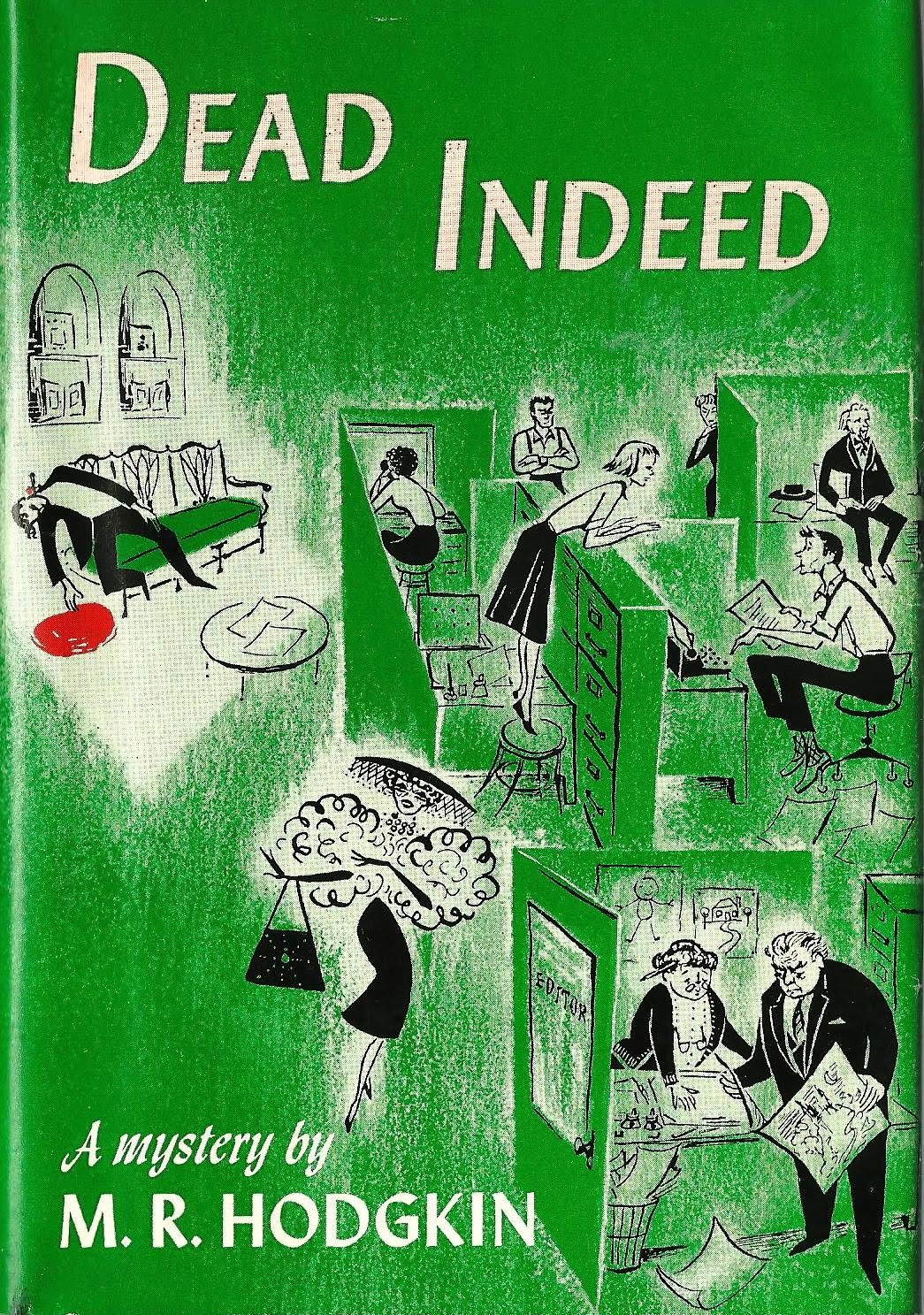
It was actually the plot of an old mystery novel, DEAD INDEED by M.R. Hodgkin.

I recentlyy learned about this book in FROM CHILDHOOD TO CHILDHOOD, which was written by the late great Atheneum editor Jean Karl. Ms. Karl said that DEAD INDEED was read most avidly by those in the children’s book industry.

I tracked down a copy this week:


I was so intrigued by the Ursula-like editor in the bottom right-hand corner, as well as the girl standing on the stool leaning into her co-worker’s cubicle (how come I never work in this kind of fun office?) that I almost missed the dead illustrator with the letter opener in his neck slumped over the pool of blood (I repeat: how come I never work in this kind of fun office?) in the upper left-hand corner.

I thought DEAD INDEED would make great Thanksgiving-weekend reading, but I’ve been so busy eating leftovers and napping and putting in the storm doors and napping and working of our Candlewick book and napping that I haven’t gotten to all the reading that I planned for this weekend.

But I like what I’ve read so far. According to the jacket flap, the author “served in various capacities at the firms of Holiday House, William R. Scott, Inc., and principally the Junior Books Department of the Viking Press, Inc.” The publishing house depicted in the novel is called Brewin Books and a note informs us that “The premises of Brewin Books, Inc., have been freely, not to say impertinently, adapted from those of an existing firm of the utmost respectability.” So reading this book is a lot of fun if you’re trying to figure out Brewin’s real-life counterpart, as well as guess who’s who among the characters. The first scene takes place at the Christmas Book Festival in the Children’s Room of the New York Public Library. The event ends with famous authors standing up to take a bow as the head librarian (ACM?) reels off their names:

“Salute to Rachel Mullins!”

“Salute to Julia Pindar for giving us the incomparable horse, Trottie!”

“A salute, a Christmas salute, to Terence Oldfather!”

One wonders if this event bears any resemblance to Anne Carroll Moore’s annual Christmas events at the NYPL? And if there is a real-life counterpart for “Mrs. Drummond,” an author/storyteller who presents a “spirited story” and “always sang at some point in every story she told.” (Did Ruth Sawyer sing?) And who could resist dialogue that includes this line from an editor: “Really I think we stand a good chance for the Caldecott Medal with Fly with Me.”

Reading DEAD INDEED, I wondered why no one in the five decades since it was published has ever placed a mystery novel in the colorful world of children’s books -- especially in recent years when the field has achieved some public renown? Isn’t it about time for a kids’ book roman a clef?

I think it would be a lot of fun to read a book like this.

Heck, I think it would be even more fun to write one!

Imagine creating a world of quirky editors and even quirkier authors. Writers “accidentally” electrocuted by their word processors and copyeditors felled by heavy paperweights. Dialogue such as, “This book is sure to be the next Harry Potter!” or “She would KILL -- and I do mean KILL -- to win the Newbery!” or “He was blackmailing a critic for starred reviews!”

And even someone like me, who operates on the very outside periphery of the children’s book world, knows a few editors who I’d like to bump off (figuratively) in the pages of a crime novel.

And if today’s world of children’s publishing is too cold and corporate to capture anyone's imagination, a mystery writer could find a goldmine of material writing about yesteryear. We’ve already got mystery novels featuring Jane Austen as a detective. How about a 1940/1950s “children’s book noir” that teams up Ursula Nordstrom and Anne Carroll Moore (with doll Nicholas in tow) to solve THE CASE OF THE CALDECOTT KILLER or LITTLE HOUSE OF ILL REPUTE (in which Laura Ingalls Wilder is kidnapped by a rival publisher and hidden in a brothel.)


AN EDITOR BECOMES A LADY

You may be wondering about the author of DEAD INDEED, M.R. Hodgkin. Her real name was Marion Rous and, in addition to the publishing companies mentioned earlier, she was later an editor at Macmillan in Great Britain. She moved to Great Britain after marrying British physiologist Alan Lloyd Hodgkin. In 1963, Dr. Hodgkin won the Nobel prize in Physiology or Medicine. As if that weren’t enough, three years later, Marion Rous Hodgkin’s own father won the Nobel in the same category. Overachievers. In 1972, Alan Hodgin was knighted by the Queen of England, making “Editor Marion Rous” into “Lady Hodgkin.” Talk about a “storybook ending.”


MYSTERY COMEBACK?

Speaking of mysteries, are murder mysteries and detective stories starting to make a comeback in young adult fiction? For the past few years, paranormal themes have dominated YA books, but over the past few months I’ve noted more traditional mysteries being published. There’s LOSING FAITH by Denise Jaden, ALL UNQUIET THINGS by Anna Jarzab, THE RIVER by Mary Jane Beaufrand, THE SPACE BETWEEN TREES by Katie Williams, LAST SUMMER OF THE DEATH WARRIORS by Francisco X. Stork, and several more. And true crime has hit YA nonfiction with AN UNSPEAKABLE CRIME : THE PROSECUTION AND PERSECUTION OF LEO FRANK by Elaine Marie Alphin. …A trend for the future?


MYSTERY AUTHORS FOR ADULTS AND THEIR NEW AUDIENCES

Another recent trend involves writers of mystery and suspense authors for adults joining the field of children’s and young adult books. James Patterson has made his presence known with the “Maximum Ride” books. Peter Abraham has written several recent books for young readers. John Grisham has published THEODORE BOONE : KID LAWYER. By writing for kids, all these authors have broadened their fan bases and expanded their “franchises.” But as far as I’m concerned, they’re all still a bunch of pikers.

My favorite adult mystery and suspense author turned YA writer is, was, and always will be M.E. Kerr.

Throughout the 1950s and 1960s, the author published twenty suspense novels under the pseudonym “Vin Packer”:

Spring Fire, 1952
Dark Intruder, 1952
Look Back to Love, 1953
Come Destroy Me, 1954
Whisper His Sin, 1954
The Thrill Kids, 1955
The Young and Violent, 1956
Dark Don't Catch Me, 1956
3 Day Terror, 1957
The Evil Friendship, 1958
5:45 to Surburbia, 1958
The Twisted Ones, 1959
The Girl on the Best Seller List, 1960
The Damnation of Adam Blessing, 1961
Something in the Shadows, 1961
Intimate Victims, 1962
Alone at Night, 1963
Sudden Endings, 1964
The Hare in March, 1967
Don't Rely on Gemini, 1969

Originally published in paperback and acclaimed by critics, who described her work as reminiscent of John O’Hara, these books are now considered collectors’ items and deserve to be brought back into print for twenty-first century audiences. After leaving "Vin Packer" behinad and writing a handful of novels under her own name -- Marijane Meaker -- the author entered the field of young adult literature in 1972 with DINKY HOCKER SHOOTS SMACK! As M.E. Kerr, she has continued to publish some of the best YA fiction of the last forty years. I don’t even want to list individual titles for fear of leaving off another favorite. Suffice to say, nearly every M.E. Kerr book is wonderful.

What I admire about Marijane Meaker is that, unlike the authors mentioned above -- such as Patterson and Grisham -- she didn’t just move into YA books to expand her core mystery and suspense audience. She reinvented herself and began writing a completely different type of book in a brand new genre. And succeeded brilliantly. The only “Kerr” books in which the author re-visited her “mystery book” past were FELL, and its sequels FELL BACK and FELL DOWN.

They are also among her few young adult books that went out of print.

Go figure!

Marijane Meaker would later explain in an interview:

I hadn't planned well, nor had I planted enough fascinating recurring characters. My editor said "FELL is not exactly falling off the shelves." I replied, "He's not on the shelves to fall off," taking a slap at the distributors, but despite good reviews and an Edgar nomination, sales perhaps reflected my lack of foresight. I always felt Fell should have had a brother instead of a baby sister, so he could have interaction with a close contemporary. Dib, his dull roommate, who could have been developed were he not so dull, I had to murder in the second book he was so boring to write.


QUESTION

As mentioned above, there are quite a few writers of adult mysteries who have later written for kids. Can you think of any writers for young people who have later attempted adult mystery and suspense novels?

I can think of a couple.

After a long line of hilarious teenage fiction, Paul Zindel published an adult suspense novel called WHEN A DARKNESS FALLS.

Chris Crutcher of STOTAN! and STAYING FAT FOR SARAH BYRNES fame published the adult mystery THE DEEP END.

Can you think of any others?


MEDICAL MYSTERY

Sometimes it takes modern science to solve an historical mystery.

Louisa May Alcott died in 1888 of a stroke. She was only fifty-five, but had been complaining of ill health in her journal for many years. Even before LITTLE WOMAN was published, Louisa May had suffered from headaches, digestive issues, and fatigue, usually blaming these problems on overwork.

However, in 2007, Drs. Ian Greaves and Norbert Hirschhorn wrote a paper suggesting that the author had died from lupus. They based their “diagnosis” on a portrait of LMA that hangs at “Orchard House,” the Louisa May Alcott Museum in Concord, Massachusetts. The portrait reveals a rash that appears in a “butterfly” formation across the author’s nose and cheeks. This is usually considered a primary sign of lupus.

The doctors’ comments are considered speculation and probably wouldn’t hold up in court, but it’s intriguing to see a mystery from the past tackled one hundred years after the death of this classic children’s book author.


MALICE, NOT MYSTERY

Nearly every children’s mystery series -- from Nancy Drew to the Three Investigators -- features a story involving invisible ink.

In the past this meant mysterious notes written with lemon juice held up to a candle. Today it may refer to the rapidly changing pixels of Wikipedia.

Although I love using the Wikipedia for quick reference, I just had another lesson in why an encyclopedia that “anyone can edit” is not necessarily trustworthy.

Writing about LMA made me wonder what the character Beth March died from in LITTLE WOMEN. I believed it was the after-effects of Scarlet Fever, but wanted to check and make sure. Imagine my surprise when I checked the Wiki and read:

When Beth's health eventually begins a rapid decline, the entire family nurses her -- especially Jo, who rarely leaves her side. [...] In her last year, Beth is still trying to make it better for those who will be left behind. She is never idle, except in sleep. But soon, Beth puts down her sewing needle, saying that it is "too heavy", never to pick it up again. In her final illness, she overcomes her quietness when she discusses the spiritual significance of her death to Jo. She becomes more and more ill, until she can not talk. But Beth gradually gets better and does NOT die.

What the ???

Obviously some joker went online and inserted that last incorrect line to be funny. I’m sure that someone will remove it soon. In fact, it may be gone by the now. But the point is, it was there this afternoon and some kid who didn’t read the book and relied on the Wiki in doing their homework assignment may soon learn that “anyone can edit” does not necessarily mean “anyone can edit” correctly!


BOOK REVIEW : DARK SONG by Gail Giles

Fifteen-year-old Ames Ford leads a charmed life: a mansion, an exclusive private school, and vacations to Alaska to soak in hot springs and view the aurora borealis. But her family’s lifestyle proves to be as ephemeral as those northern lights when Dad is caught mishandling money at work and loses his job. In this timely narrative, Ames watches in stunned disbelief as her family loses everything, Dad begins drinking, and Mom becomes cold and short-tempered. The family is forced to move from Boulder to rural Texas, renting a filthy tract house from Dad’s parents, whom Ames never even knew existed. Enter Marc -- a neighbor who agrees to help the family clean and restore their home. To Mom and Dad, he’s a religious, homeschooled teenage boy. But Ames soon learns he’s much older, and very different, than he seems. In fact, he embodies the anger that Ames feels toward her parents and their sudden change of circumstances, quickly becoming a controlling and dangerous partner to the confused fifteen-year-old caught between her own need for love and a desire for revenge. There is nothing subtle about either the plot or the characters here. Many elements of the narrative seem rushed while others -- such as the introduction of Ames’ heretofore unknown grandparents (who ask her to call them Mr. and Mrs. Ames) – seem underdeveloped within the larger confines of the story. Despite these flaws, this teen-pleasing story moves quickly, and with mounting suspense, toward a pulse-pounding conclusion.


INDEED DEAD

By the way, did you recognize the title DEAD INDEED from a nursery rhyme?

I did not.

The rhyme, printed at the front of the novel, goes like this:

A man of words and not of deeds
Is like a garden full of weeds;

And when the weeds begin to grow,
It's like a garden full of snow;

And when the snow begins to fall,
It is like a bird upon a wall;

And when the birds begin to fly,
It's like a shipwreck in the sky;

And when the sky begins to roar,
It's like a lion at the door;

And when the door begins to crack,
It's like a stick across your back;

And when your back begins to smart,
It's like a penknife in your heart;

And when your heart begins to bleed,
Oh, then you're dead, and dead indeed!

Thanks for visiting Collecting Children’s Books. Hope you’ll be back!

Sunday, November 21, 2010

Sunday Brunch : Kimba Commits Hari-Kari, but Barbie Lives On

Every Sunday morning, as I sit in front of this computer pulling out my hair as I attempt to pull together a blog, my mind wanders back to my childhood when neither blogs nor computers existed. It was a simpler time. Back then Sunday mornings usually meant watching Detroit's main UHF station (does anyone remember UHF these days?) Channel 50. The animated series KIMBA THE WHITE LION aired every week at 11:00 AM, followed at 11:30 AM by SHIRLEY TEMPLE THEATRE, which ran -- week after week -- the same handful of Shirley Temple movies in rotation. We couldn't get enough of Shirley. I probably saw CURLY TOP and BRIGHT EYES a hundred times each...and probably still know 'em by heart. KIMBA is a different story. I very clearly remember the big "build up" to the series -- with Channel 50 running many commercials for the show in the weeks leading up to its premiere. I also remember watching that first episode, which supplied the backstory of how Kimba lost his parents. I want to say it was in the spring of 1966; I know it was a beautiful sunny day because I remember running outside that afternoon with my friends, romping around and pretending we were Kimba. I continued to watch the show for the next four or five years, at least till I got out of grade school and decided "cartoons are for babies" but I can't actually remember any of the storylines other than the one from that intial episode in 1966.

Yet the show must have a strong visceral pull on me, because when I came across this clip of the opening theme on Youtube the other day, I almost hugged my computer monitor:


There's a word I rarely, if ever, use on this blog.

A word which I hate to apply to children's books.

But maybe it's okay to use the word when talking about this cartoon series:

Cute.

Okay, maybe I'm looking at the past through rose-colored glasses, but is there anything, well, cuter than little Kimba bounding through the savanna and then making that flying leap as the perky theme song chants, "Kimba. Kimba! Kimba. Kimba!" And I love the simple innocence of the lyrics as well: "Who believes in doing good and doing right? Kimba the White Lion is the one!"

Before you think I'm old-fashioned and square, let me add that KIMBA was actually very modern for its time. "Cartoons are for babies" indeed! Produced in Japan, this series introduced anime to the United States long before it became hip. It was even based on a manga!

KIMBA was created by Osamu Tezuka who was known as the "godfather of anime." In Japan, Kimba was called "Leo" and his story, JUNGLE TAITEI, originally appeared in Manga Shōnen magazine between 1950 and 1954. The first KIMBA TV series had only 52 episodes and ran for years on American television. There have also been a couple television and film adaptations since then, including 1997's JUNGLE EMPEROR LEO, which is based on the latter chapters of Osamu Tezuka's manga. I don't think I ever want to see this movie. According to the Wikipedia, the downbeat story concerns an older Leo (Kimba) with a family of his own. After his mate dies and he's separated from his cubs, Leo (Kimba!) assists in an effort to save the world from evil, with the white lion ultimately committing suicide -- throwing himself on a dagger so a human companion can eat his flesh and wear his pelt as he makes a dangerous escape from the bad guys.

Over the years, there have been accusations that THE LION KING "borrowed" some elements from KIMBA. Now that I read about Kimba's sacrifical death, I wonder if Osama Tezuka didn't borrow some elements from C.S. Lewis's CHRONICLES OF NARNIA and its lion character, Aslan, as well.


ANONYMOUSLY YOURS

Suppose someone gave you an advance reading copy (ARC) to read, but neither the title nor the author's name were on the book?

That's what happened to over 3000 bookstore owners and librarians recently, when they received this unusual volume in the mail:


It turns out that the book is called MIDDLE SCHOOL : THE WORST YEARS OF MY LIFE, and the author is James Patterson, along with Chris Tebbetts.

The book's editor, Megan Tingley, revealed the theory behind the blind mailing to Publishers Weekly: “We wanted to recreate the feeling that many of us had when we first read it. If Jim’s name hadn’t been on the manuscript, we would never have guessed he wrote it. It almost feels like the debut of a whole new author, and that’s how we wanted to treat it. We wanted people to have that same ‘wow!’ moment of surprise.”

Mr. Patterson is known for his bestselling suspense novels for adults, though he has also moved into the YA field in recent years with titles such as MAXIMUM RIDE and DANIEL X. It seems as if every time I walk through a bookstore there's a new Patterson novel on the shelves. I guess that has something to do with all those co-writers lending a hand....

In this book, he's assisted by Chris Tebbetts, probably best known for M OR F?, a YA novel he cowrite with Lisa Papademetriou. (Doesn't anyone write by themselves anymore?)

From a collecting perspective, I think one of those untitled, unattributed ARCs would be a nice "find" for anyone who collects odd or unusual children's book ephemera. I'm also intrigued by the whole concept of reading and responding to a book when one has no idea who the author is. I know that many orchestras have "blind auditions" in which musicians try out behind a curtain, so they are being judged by their WORK and not their NAME. Wouldn't it be something if every manuscript was also submitted blindly to every publisher? I wonder what changes that would lead to in the field of children's books. Last week I talked about editor Jean Karl. When she decided to try her hand at fiction writing, she submitted her first book with a pseudonym on it to make sure that it was accepted on its own merit. And when Katherine Paterson was writing BRIDGE TO TERABITHIA, she was so concerned about its quality that she considered submitting it to her regular editor under a pseudonym. In the end she submitted the book under her own name...and it won the Newbery Medal.

But it makes one wonder: have their been any other cases where famous authors have submitted manuscripts under false names, had them rejected, and never told anyone...?


GEARING UP FOR THE BOOK AWARDS

The American Library Association book awards -- the Newbery, Caldecott, Printz, and all the rest -- are going to be announced extra early in 2011. January 10 is the big day. I'm trying to prepare by catching up on 2010 books, as well as constantly checking for updates on the Heavy Medal blog in which Nina Lindsay and Jonathan Hunt discuss all things Newbery.

However, this week I had some problems with the blog. Nina wrote a spirited piece supporting the novel ONE CRAZY SUMMER by Rita Garcia-Williams. In the blog she proactively addressed a couple questionable elements in the book:

Some have raised the question of the likelihood of a Japanese-American kid being named “Hirohito.” A teacher who had read the book and had Williams-Garcia visit his school emailed me directly with her response to his posing that question:

“The point that she wanted to make with Hirohito was that identity is trickier if one is “two things”, like Japanese and black. She also said that when she was growing up in northern California she went to school with one boy named Hirohito, another named Hiroshima and another named Yamashita!”

I’m good with that. It might have been interesting to have that context fleshed out a little for readers, but I’m not sure it makes the book weaker without it.


Nina also talked about some of geography in the novel and said:

In an exchange with Garcia-William’s editor, I’ve learned that they plan to change the references from “Orchard” street to “Adeline” street in the next printing, which does resolve the street layout issue.

Regarding the hill (there is one in the story, but not in actuality)…Williams-Garcia and her editor considered it, having learned of the “mistake”. But it plays such an important part in Delphine’s character development, about “how big the world looks through a child’s eyes, and how things come more into focus as they mature” that it was impossible to remove, and I recognize and support that. “We’d gain fact accuracy, but would lose a good deal of what the character and reader ultimately gain.” These quotes are from Williams-Garcia, with thanks to her and her editor Rosemary Brosnan for sharing.


Reading these remarks, I thought, "Whoa, doggie! I thought each Newbery candidate had to be evaluated from the text alone. Since when is it okay to get after-the-fact clarification from the author or exchange words with the book's editor?" Granted, Nina is not on the Newbery committee this year, but she is using the author's and editor's comments to justify her recommendation of this book. (And, let's face it, she's publishing it in a blog that this year's committee members are quite likely reading.) So I wrote a note asking if this kind of discussion would be allowed in the actual Newbery panel discussion. Nina responded:

Peter, if I were on the committee this year, I’d first of all beat the bushes to get some outside “expert” opinions on the Hirohito thing, in order to help form my own opinion. (For instance, Japanese-Americans who were the same age at that time. They don’t have to know anything about children’s lit or the award. They’d just have to be willing to read the book and let me know their reaction to it).

I wouldn’t take an author or editor’s words to the table as evidence, but I might use them to inform my own opinion. Extremely circumspectly. The book is what it is, published, and it’s the readers reaction that matters at this point. But I personally found comment from Williams-Garcia to be helpful in thinking about these issues in different ways.

In general, a chair of a Newbery committee will instruct members that all opinions at the table need to be their own. They can use reviews, expert content reviews, and child reader comments to inform themselves…and they *should* do this, in order to remove as much personal bias from the process as necessary [...] but you can’t just quote from them as evidence to justify a book. You could say, “after reading so and so’s comments, I’m convinced that X because of Y….”


This clears it up somewhat (thanks, Nina!) but I'm still slightly confused by the last statement. Does the Heavy Medal blog about ONE CRAZY SUMMER count as an "expert content review" since it does quote directly from the book's creator? If so, COULD a committee member now say, "After reading Rita Garcia-Williams' comments about geography, which appeared on the Heavy Medal blog, I'm convinced that..."?

I hope not.

Though if it's true, I would (and I'm only half-joking here) suggest that any author or illustrator whose work is likely being considered for one of this year's awards get out there and proactively address any questions the committee may raise before it's too late:

Illustrator A: Some readers have questioned the color of the horses in my new book. Horses of this color actually do exist and I'm posting a photo of my equine "models" on my blog so you can see how accurate I was.

Writer B: I understand some readers are questioning my characterization of an elderly grandmother with Alzheimer's in my novel. Just so you know, this character was based directly on my own mother's struggles with Alzheimer's disease. (Not only does this quote clear up any questions of accuracy, it gets the writer some sympathy votes.)

Illustrator C: I have heard some complaints about the last spread in my picture book not being up to the same quality as the previous illustrations. Please know that this picture was painted when I had a broken arm.

Writer D: Some people are speculating on why my nonfiction book does not contain sufficient documentation. The initial plan was to release my book along with a website that contained bibliographical references and supporting documentation. At the last moment, my publisher did not provide funding for the website, but I hope this will not reflect badly on my book and prevent it from winning any awards....


SCARY WINNING TRENDS

The Tea Party won 28 seats in the House of Representatives.

Gretchen won PROJECT RUNWAY on TV.

MOCKINGBIRD just won the National Book Award.

Bristol Palin is poised to win DANCING WITH THE STARS this week.

No wonder I'm worried about what's going to win the Newbery this year!


THE GOOD, THE BAD, AND THE BARBIE

Subtitled "A Doll's History and Her Impact on Us," Tanya Lee Stone's latest nonfiction book (after last year's Sibert winner, ALMOST ASTRONAUTS : 13 WOMEN WHO DARED TO DREAM) takes a compelling look at the teenage doll that has become a cultural icon. The book traces Barbie's creation by Ruth Handler who, with her husband and another partner, founded the Mattel company, as well as the doll's evolution over the next fifty years. Beginning as an impossibly shapely figure who wore high fashion and dabbled in traditional careers such as stewardess and nurse, Barbie would later become an achiever and role-model, outfitted as an astronaut, race car driver, and a myriad of other modern choices. Barbie also broke down racial barriers. After Mattel offered up a young black cousin for Barbie named Colored Francie (a shockingly dated name even for 1967) that flopped with consumers, there were soon African American, Puerto Rican, and Asian Barbies. In a copiously-illustrated volume, which includes an insert of glossy color plates, Stone explains through both sociological research and personal anecdotes why Barbie is loved by some, hated by others, and why nearly every kid undresses the doll within seconds of receiving it. Strangely, there are actually more tales about kids who twist off Barbie's head and subject her to bizarre sexual poses than there are stories about what the average girl imagined and dreamed about as she played with Barbie for hours on end. Source notes and bibliography included.


EVERYTHING WE KNOW ABOUT BARBIE WE LEARNED FROM A BOOK

As mentioned above, one thing I found missing from Tanya Lee Stone's book was information about how individual girls played with Barbie. Did they create elaborate stories about her life and adventures? Did they view Barbie as a friend, or did they see her as their own alter-ego? I imagine that Barbie is a kind of Rorschach test on which each human playmate foists her own needs and interests.
The doll itself is pretty much a blank slate otherwise. But I was surprised to learn that much of the Barbie mythology actually came from children's books. Over the years there have been hundreds of books about Barbie, ranging from Golden Books to sticker books to coloring books, but Ms. Stone credits the following novel-length books, published by Random House in the early 1960s, with establishing "who she was, complete with a birth date, parents, and a significant other, Ken":


If it wasn't for these Barbie novels, we'd never know Barbie's full name (Barbara Millicent Roberts), who her parents are (George and Margaret Roberts), where she lives (Willows, Wisconsin), where she attends school (Willows High) and where she hangs out afterward (the Pop Shoppe.)

According to Tanya Lee Stone, "The novels establish Barbie as a modern, independent kind of girl who was not going to be bound by the 1950s sterotypes she felt kept her mother tied to the house."

Because these books are so instrumental in creating the Barbie we know today, I assumed they'd be rare collectors' items. But many can be found for less than $10 today.


BLUE MOON

I started writing this blog early today at the time when KIMBA used to be on TV. Now, after many interruptions and computer problems, I'm finally finishing it by moonlight.

And it's a blue moon.


I always heard that a "blue moon" was the second full moon in a month. Kathi Appelt must have thought the same thing, as she talks about it right there on page two of her highly-regarded new novel KEEPER ("So much had depended on tonight's moon, a blue moon, second full moon of the month.")

But this morning my cousin sent me this link which states that everything I thought about the blue moon is wrong!

It may be called a Blue Moon...

...But it's the first and only full moon in November.

Go figure.

Oh well, I still have a feeling that, somewhere out there tonight, Keeper's guardian Signe is stirring up "onions, garlic bacon...with a mysterious spice called 'file'" as she cooks up her once-in-a-you-know-what Blue Moon Gumbo.

Thanks for visiting Collecting Children's Books. Hope you'll come back more than a once in a blue moon!