Sunday, November 16, 2008

A Traveling Brunch

More randomness about children’s books old and new, this time featuring a road trip that begins at the Ann Arbor Public Library, makes a virtual visit to the Newport Public Library, and ends in the great green room. Get in the car and fasten your seat belts.

IT’S NOT EASY SEEING GREEN

Although it’s true that I have tennis shoes older than he is (click on image for graphic proof. Then be grateful this isn’t a scratch-and-sniff blog), I am mightily impressed by that very young, very talented young adult author John Green. His first novel, LOOKING FOR ALASKA, won the Printz Award. His second (and, I think, even better) book AN ABUNDANCE OF KATHERINES was named a Printz Honor. His new novel, the smart and funny PAPER TOWNS, hasn’t won a thing...but then it’s only been out for thirty days. Give it time. When I heard that Green was going to be appearing at the Ann Arbor Public Library this past Friday evening, I took an hour of vacation time so I could leave work early, and get there in plenty of time to hear his presentation and get my books signed. Unfortunately, I did not consider that I’d be driving in rush hour. Or that it would be raining. Or that the streets of Ann Arbor would be so crowded. Or that I’d drive past the library twice without noticing it because I am a nitwit. All told, it took me nearly two-and-a-half hours to get there...and I arrived about thirty minutes late. Nonetheless, I figured I’d still be able to sneak into some back row seat, catch the last part of Green’s presentation, and probably get my books signed. Instead, I was shocked to encounter a sign saying the basement where the event was being held was “FILLED TO CAPACITY.” However, we were told the presentation was being simulcast on a TV upstairs on the fourth floor. Well, if I wanted to see John Green on a screen, I could have just stayed home and looked at his vlog (video blog) on the internet or watched him on Youtube. Plus, I figured that us leftover people upstairs either wouldn’t get the opportunity to attend the signing...or would have to wait hours and hours until all the basement attendees got their books signed. So I ended up going home without getting my books inscribed. But that’s okay. I’m sure he’ll be back on tour again. But next time I’ll take off two, maybe three, vacation hours, so I can get there EARLY.

THOSE DUELING DUSTJACKETS

Incidentally, PAPER TOWNS has been issued with two different dustjackets:


The bookstore I go to only had the yellow/happy jacket, so I tried another store and they too only had yellow. I wonder if certain parts of the country only got the green jackets. I’ll be curious to know which version sells better. Completist collectors like me will probably end up getting both.

NATTERING ABOUT NATALIE

Ever since writing my previous blog entry on Natalie Savage Carlson, I can’t get this underrated author out of my head. Here are six fun facts you may or may not know about her:

-- ALPHONSE, THAT BEARDED ONE was not the only book Ms. Carlson published with Harcourt during her long career with Harper. She also had three other Harcourt books (did Ursula reject these as well?) One of them, HORTENSE : THE COW FOR A QUEEN was even an Honor Book in 1957’s New York Herald Tribune Children’s Spring Festival Awards. During her career, she won this award twice and had two Honor Books!

-- Natalie was married to Rear Admiral Daniel Carlson of the U.S. Navy and traveled around the world with him, often using the unusual locales they visited for her stories. While they were stationed in Hawaii, Natalie Carlson was an eyewitness to the attack on Pearl Harbor.

-- The above portraits of Rear Admiral Daniel Carlson and Natalie Savage Carlson are on display in the lobby of the Newport Public Library in Newport, Rhode Island. Anyone up for a field trip?

-- Natalie Carlson was the 1966 American nominee for the Hans Christian Andersen Award.

-- Carlson’s 1958 classic, THE FAMILY UNDER THE BRIDGE, was recently presented as an off-Broadway musical -- written by Kathy Lee Gifford.

-- Want to know about her early life? Natalie Carlson wrote two autobiographical novels about her childhood: THE HALF-SISTERS (1970) and LUVVY AND THE GIRLS (1971.)

HEY, WHAT’S THAT HANS CHRISTIAN ANDERSEN PRIZE YOU WERE TALKING ABOUT?

Because it’s an international award that honors a creator’s complete body of work, the Andersen is sometimes called the “Nobel Prize for Children’s Literature.” Every other year since 1956 (the prize is given in even-numbered years) the U.S. submits one nominee for this prize, which is sponsored by the International Board of Books for Young People. There is no record of which American author was nominated in 1956 and 1958, but the 1960 nominee was Jean Craighead George, which strikes me as odd, since her best work was still to come. The other nominees have been:

1962 / Meindert DeJong
1964 / Madeleine L’Engle
1966 / Natalie Savage Carlson
1968 / Elizabeth Coatsworth
1970 / E. B. White
1972 / Scott O'Dell
1974 / Irene Hunt
1976 / E. B. White (yeah, again)
1978 / Paula Fox
1980 / Katherine Paterson
1982 / Natalie Babbitt
1984 / Beverly Cleary
1986 / Jean Fritz
1988 / William Steig
1990 / Katherine Paterson (if at first you don't succeed...)
1992 / Virginia Hamilton
1994 / Sid Fleischman
1996 / Lloyd Alexander
1998 / Katherine Paterson (try, try and WIN)
2000 / Lois Lowry
2002 / Susan Cooper
2004 / Lois Lowry (there may still be other chances to come)
2006 / E. L. Konigsburg
2008 / Lloyd Alexander (it would have been posthumous)

Of these, the only American winners have been Meindert DeJong, Scott O’Dell, Paula Fox, Virginia Hamilton, and Katherine Paterson (in 1998).

Since 1966 there has also been a Hans Christian Andersen Award for Illustrators. Can you guess the lone American winner? I’ll put the entire list in next Sunday’s brunch.

MARGARET K. MCELDERRY

One of the best parts about writing a blog is seeing who drops in to visit. My previous blog entry received a comment from someone named “Rathacat,” who I realized was Clare Bell, author of the “Ratha” series and many other memorable books including TOMORROW’S SPHINX and THE JAGUAR PRINCESS! How cool is that? In her note, Ms. Bell wondered if anyone had written a biography of her former editor, Margaret K. McElderry.

To my knowledge, there is no such book. Or rather: It’s a book waiting to be written.

Certainly Ms. McElderry deserves a biography. She’s one of the all-time greats. Working at Harcourt for nearly three decades, she published authors such as Eleanor Estes, was known for introducing many European and translated books to American children, and was the first editor whose books claimed the Newbery and Caldecott in the same year -- 1952, when GINGER PYE by Eleanor Estes won the Big N and FINDERS KEEPERS by “Will” and “Nicolas” (as they billed themselves -- actually writer William Lipkind and illustrator Nicolas Mordvinoff) won the Caldecott. In the 1970s she got her own imprint at Atheneum and published some of that decade’s best (including Susan Cooper’s “Dark is Rising” series), then continued publishing “Margaret K. McElderry Books” through Simon and Schuster.

Now nearing one hundred years old, Margaret McElderry definitely deserves a biography!

PRONOUNCING PUBLISHERS

Incidentally, I always thought the editor’s last name was pronounced Mick-ELDER-ee. Not too long ago I learned it’s Mackle-dairy.

RECENT TRENDS, DIFFERING PERSPECTIVES

Here’s an old/new trend: adult books being “adapted” for young audiences. In a way it’s an old trend, because throughout the years many classics (ROBINSON CRUSOE, GULLIVER’S TRAVELS, PILGRIM’S PROGRESS, UNCLE TOM’S CABIN, etc.) have been adapted for children. However, in recent years I’ve been noticing that, increasingly, many contemporary books are published for adults and then, a year or two, later, rewritten, repackaged, and retitled for kids. Here are just three recent examples:


I wonder about the necessity of this. Surely any kid old enough to have an interest in Marley the dog can read and comprehend the original MARLEY AND ME (not exactly GRAVITY’S RAINBOW in terms of reading level, depth, or content) without needing an adaptation. If there are words they don’t understand, there’s always the dictionary. If they encounter difficult syntax or sophisticated situations, they’ll muddle through them -- that’s what stretching and growing is all about. Obviously everyone does not agree with me on this, or we wouldn’t be seeing a proliferation of titles “adapted for young people.”

Another recent, questionable trend is acknowledgment pages in novels that have the self-serving purpose and length of a really bad Oscar acceptance speech. Think back at the history of children’s books -- and you don’t even have to think back that far, maybe just ten years. Back then it was common to see “Acknowledgments” in a nonfiction title, where it was necessary to mention certain reference books that an author used for research and thank helpful experts who gave advice or read the manuscript for errors. That makes sense. You might also find acknowledgment pages in historical fiction, where the author needed to mention factual books and experts consulted.

But today you find acknowledgment pages (and pages and pages) in every kind of novel -- and even picture books. I generally don’t mind them -- even the ones resembling Oscar speeches -- unless they turn into something like Greer Garson’s infamous acceptance and the author rambles on like a latter-day Mrs. Miniver, thanking not just their spouse and kids, but the guy who served them an especially inspiring latte at Starbucks and the assistant to the assistant at the computer store who talked them through that ugly paper jam in their printer. And I get irritated by Acknowledgments that are littered with in-jokes (“And to Rob: you will always be my go-get-’em-Tigerboy...RRRRR!” or “Amy, Louise, Katydid, Jillian, and Marta -- BUT NOT Penelope -- you are all pizza-heads and pepperoni-plotters! Save me the mushrooms!”) which make me feel left out, and like I’m eavesdropping on someone else’s conversation -- which, in a way, I am -- but it’s also a conversation, lest we forget, that I paid $16.95 to read. What I DO like about acknowledgment pages are the occasional insights into how a book came to be -- the author’s motivation for creating this story and the circumstances under which it was written.

But I have friends who HATE any type of acknowledgment page in a book.

What do you think -- is it a good trend or a bad one?

TUCKED IN

Opus, the cartoon penguin who first turned up in Berkeley Breathed’s “Bloom County” and later starred in his often eponymous comic strip, has now reached the end of his run.

Mr. Breathed held a contest for readers to guess where Opus’s journey would end. Out of six thousand entries, fifty-five people guessed correctly -- and a random drawing chose one of those entrants to win a $10,000 grant to their local humane society to help “dogs and cats find the loving home -- their paradise -- that otherwise might have been lost to them.”

So where did Opus conclude his nearly thirty-year journey? In the pages of a children’s book:


According to his creator, “Opus is napping. He sleeps in peace, dreaming of a world just ahead brimming with kindness and grace and ubiquitous bow ties.”

That sound like a wonderful world. Except for the bowties.

But it’s a nice place for Opus to end, and good place for me to end today’s blog as well. I must get back to my reading. I’m currently trying to finish all five of the National Book Award nominees for young people’s literature:


so I can post a review of them here on Wednesday, as the winner will be announced that evening.

Hope to see you back here then.

Thursday, November 13, 2008

The Big Brush-Off

In 1951, a first-time author named Natalie Savage Carlson submitted a manuscript of French-Canadian tales to Harper and Brothers. Accepted by the brilliant editor Ursula Nordstrom, THE TALKING CAT AND OTHER STORIES OF FRENCH CANADA was published in 1952 and immediately won the prestigious New York Herald Tribune Children’s Spring Book Festival Award. Later that year, however, Ursula Nordstrom rejected Ms. Carlson’s second manuscript, ALPHONSE, saying she did not feel it was “a worthy successor to THE TALKING CAT.” Nordstrom suggested that Carlson submit the manuscript to Margaret McElderry at Harcourt, adding “She does lovely books.”

Apparently ALPHONSE wasn’t quite lovely enough for Ursula’s own list!

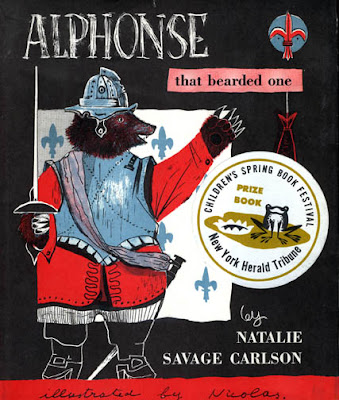
As it happened, Ms. McElderry did accept the book and ALPHONSE, THAT BEARDED ONE was released by Harcourt in early 1954. Here’s the cover of the book:


Oh shoot. I didn’t line that up on my scanner quite right. Let me move it over so you can get a look at the entire cover:


Hey...wait a minute....! What’s that I see on the right side of the jacket? Is that...is that...a sticker saying this book won the New York Herald Tribune Spring Book Festival Award...?

How can that be?

Didn’t Ursula Herself say that this book didn’t “come up to the high standard of THE TALKING CAT”?

Yet ALPHONSE ended up winning the exact same prize that Carlson’s first book received two years earlier!

The purpose of this blog entry isn’t to pick on Ursula Nordstrom. She was the best in the business and probably published more classic titles than any other twentieth-century children’s book editor. But even she made mistakes (she also rejected Robert Cormier’s CHOCOLATE WAR and I suspect she was among the myriad who turned down Madeleine L’Engle’s A WRINKLE IN TIME during its long quest for publication.) No editor is infallible. No editor gets it right 100% of the time. I doubt most even get it right 80% of the time. (I personally know one editor who’s only right about 6% of the time, but that’s a whole ‘nother story.)

What fascinates me about this case isn’t simply that Nordstrom rejected ALPHONSE, but that she did it so brusquely. In his indispensable book DEAR GENIUS : THE LETTERS OF URSULA NORDSTROM (a volume that is never far from my desk nor far from my thoughts), Leonard Marcus includes Nordstrom’s actual rejection letter:

December 9, 1952

Dear Natalie,

With a heavy heart I must write you that we still think ALPHONSE (revised version) is not a worthy successor to THE TALKING CAT.

This makes me sad. I read it, and so did Miss Powers and Miss Russell. So we are all sad. We understand that you will want to send it to another publisher and of course we all wish you luck with it.

Declining this book is a tough decision, because of course it probably will be taken elsewhere and so you will probably feel any future books by you should go to the publisher that accepts ALPHONSE. So we are in the unfortunate position of being sorely tempted to take ALPHONSE so that we will keep you on the list. But we shouldn’t accept and try to publish it on that basis because it, in our judgment -- and we may be wrong, doesn’t come up to the high standard of THE TALKING CAT. So we have decided that in spite of everything we must regretfully decline this manuscript. I can’t tell you how sorry I am, Natalie.

If by any remote chance it is not taken by one of the top publishers, we certainly hope that you will send us something else by you in the future. Let me know what happens, will you? I have been happy to think of you as a Harper author up to now. Coming unexpectedly upon the delightful manuscript of THE TALKING CAT, and publishing it so successfully, was one of the high spots in my experience as an editor. Well, let me know who takes ALPHONSE, if you are willing, will you? By the way, I hear via the grapevine that Harcourt turned down THE TALKING CAT and I think they would be EXTREMELY glad to have a chance at ALPHONSE. You know Miss McElderry, don’t you? She does lovely books.

We return the manuscript herewith. Please don’t disappear into the blue now. Let me hear from you and tell me how things go with you and the manuscript.

Yours sincerely,


Now granted, we all see things differently. This letter may sound heartfelt and conciliatory to you (especially if you sit behind an editor’s desk) but to me (someone on the other side of that desk) it seems unduly harsh. I don’t doubt Ursula’s sincerity at all, but I’m just surprised she didn’t try to smooth things over by saying something along the lines of, “Why not set this manuscript aside for a while and try writing something else for us? After stretching your skills on a new book, you may return to ALPHONSE with fresh eyes and see its problems and/or potential.” I guess what bugs me MOST is that Ursula seems quite willing to lose Carlson permanently to a different publisher. Again, this may just be me, but the line “Please don’t disappear into the blue now” sounds awfully dismissive. Granted, it’s not as bad as “Don’t let the door hit ya where the good Lord split ya,” but it just seems like the kind of hollow nicety that's automatically tossed off as an author goes crawling out the door, dejected and rejected -- and with his "tale" between his legs. (Believe me, I know whereof I speak.)

I can only imagine the sense of vindication Natalie felt when, not only was ALPHONSE accepted by Harcourt...but it also went on to win her another New York Herald Tribune Children’s Spring Book Festival Award!

I wonder how Ursula felt. Was she sorry she rejected ALPHONSE or did she always continue to believe she’d done the right thing?

Perhaps the most amazing part of this story is that even though Ursula cut her loose with the expectation that she’d move to a new publishing house, Carlson apparently did not bear the editor any hard feelings at all! In fact, despite the fact that Harcourt published ALPHONSE and she racked up yet another New York Herald Tribune Children’s Spring Book Festival Award (what a mouthful!) Carlson ended up returning to Ursula. Her very next book, WINGS AGAINST THE WIND, was published by Harper in 1955. Incredibly, it was named a runner-up for that year’s NYHTCSBFA (even the acronym is long and unwieldy!) And for the next two decades, Harper continued to publish nearly all of Carlson’s work, which included the Newbery Honor THE FAMILY UNDER THE BRIDGE (1958), the popular THE LETTER ON THE TREE (1964), important early books on civil rights such as THE EMPTY SCHOOLHOUSE (1965), the much-loved “Orphelines” series, and many more.

I ask myself what I would have done if I were in Carlson’s shoes. If Ursula gave me the big brush-off, would I return to her fold? Maybe, maybe not. ...But if I did, I’d probably always show up at her office wearing a sweatshirt embossed with the cover illustration of ALPHONSE “that book I published with Harcourt.” And I’d use 1954 as a touchstone in every author-editor conversation (“Back in 1953...oh wait, it was 1954 -- I remember because that was the year I won that award for my Harcourt book....”) and I’d probably even call my dog, my cat, or even my kid “Alphonse” just so I could repeat the name over and over whenever I got a phone call from Harper (“Hello? Oh hi, Urs. Could you hold on a minute, Alphonse is barking at the back door and I have to let him in the house. In fact, could I call you back later? I also need to go pick up my son Alphonse at school.”)

But that’s just me: pugnacious. Pugilistic. And what’s that other word? Oh yeah, repugnant.

But Natalie Savage Carlson was a much nicer person than that. She obviously didn’t hold a grudge -- and she ended up publishing a great list of books at Harper after the ALPHONSE rejection. I wonder if she and Ursula ever discussed that letter again or just considered it “water under the bridge”? I guess we'll never know. All I know is that in 1971 Ursula wrote Natalie a very different sort of letter, reminiscing about their “wonderful and happy relationship all these years,” and ending with the words “I am so glad that you are ours and we are yours.”

Sunday, November 9, 2008

Brunching with Some Old Friends

Another Sunday, another brunch -- this time featuring old friends, new books, dead teachers, and a June B. Jones toothbrush.

SPOOKY STORIES

In a recent blog entry, I mentioned an old friend who liked to stretch out her birthday over an entire month. Well, she’s not the only one who enjoys protracted celebrations. Here in the midwest, we’ve got radio stations that began playing all-Christmas-carols-all-the-time starting November first. As much as I enjoy holiday music, I think that’s pushing it. Especially when it’s just now -- finally and tardily -- beginning to look like this outside:


So this year I’ve decided I’m going to prolong Halloween for a couple extra weeks and, luckily, I’ve found just the book to keep me in the spirit. A book-buddy in Connecticut just arranged for me to get an inscribed copy of the new young adult book PRETTY MONSTERS by Kelly Link.


I was not familiar with Ms. Link’s work before now, though she’s published two previous collections, STRANGER THINGS HAPPEN and MAGIC FOR BEGINNERS. This new volume features surreal and spooky stories written in the kind of sublime prose that often makes you stop reading for a moment or two just to savor a particular turn of phrase.

People often ask me about “collecting ahead” -- looking out for current titles that will be desirable in the future. PRETTY MONSTERS strikes me as that kind of book. The design, the dustjacket, the illustrations (by no less than Shaun Tan!) give a classic feel to this volume. Even with our current economy, it’s probably better to buy a first edition today for $19.99 than try to track one done several years from now for $100 or more.


NEW FRIEND KELLY LINK, OLD FRIEND JOAN AIKEN

When I was growing up, Joan Aiken books were ubiquitous. In fact, every year seemed to bring something new and dazzingly different from the author’s pen: Dickensian melodramas, fantasies, mysteries, short stories, gothic novels, and even that most neglected genre of children’s books -- plays. I never got into Aiken's sprawling series that began with THE WOLVES OF WILLOUGHBY CHASE (though perhaps reading those books should be my 2009 New Year’s resolution), but I loved some of her mysteries, such as the evocatively-titled DIED ON A RAINY SUNDAY, and still think that MIDNIGHT IS A PLACE is one of the best novels I’ve ever read. I remember carrying a Joan Aiken paperback to junior high school one autumn day and returning home without it. I had no idea how, or where, I had lost it. Several months later, on an early spring morning, I was standing at the traffic light across from school when I looked down at my feet and saw my missing Aiken paperback peeking out from under a pile of dead leaves. Walked over by thousands of junior high feet, then covered by snow and ice all winter long, it was now dirty, waterlogged, and every page was rippled and wavy, yet finding that book was like meeting up with an old friend -- and I took it home and read it, smoothing every page flat as I went along.

I kind of felt like I was meeting up with my old friend again this week, with the arrival of a new Joan Aiken volume, THE SERIAL GARDEN : THE COMPLETE ARMITAGE STORIES.


This posthumous publication contains all the magical tales about the Armitage Family, from “Yes, But Today is Tuesday,” which Ms. Aiken sold to the BBC at age twenty, to four previously-unpublished stories written just prior to the author’s death in 2004. Collected in one volume for the first time, the stories are introduced by Aiken’s daughter Lizza and novelist Garth Nix.

One of the most interesting aspects of this book is that it was released by Big Mouth House, a publishing company owned by Kelly Link and her husband, Gavin J. Grant. According to the dustjacket, Big Mouth House is “an imprint devoted to fiction for readers of all ages. We will publish one or two weird and great titles (short story collections and novels) per year. We expect to publish books for readers aged 10 and up. Future titles include: more Joan Aiken, Holly Black’s THE POISON EATERS AND OTHER STORIES, and Delia Sherman’s THE FREEDOM MAZE."

That’s exciting news! Especially since small presses frequently issue intriguing titles that might be ignored by larger, commercial publishers. I look forward to seeing what comes next.

THERE ARE SMALL PRESSES -- AND THEN THERE ARE REALLY, REALLY SMALL PRESSES

I was just thinking about the fact that books issued by small presses generally don’t make a lot of money, yet they always seem to be labors of love.

This made me recall some of the publications in my own collection that fall into that same category -- items that have such unique appeal that they were self-published and only shared with a few like-minded individuals: a series of Christmas newsletters from a friend, printed up and illustrated with color photographs...a fanzine that a man in the midwest created in honor of Natalie Nevins, his favorite performer on the Lawrence Welk Show in the 1960s (Yes, I’ve been known to watch Welk repeats on PBS. Yes, I will pause for a moment so you can etch the shape of a SQUARE in the air with your index fingers)...and even a book containing a collection of letters and cartoons that, over the years, my brother and I created for a lifelong friend -- and which she presented back to us in a bound volume called “The Best of Peter and John, 1964-1984.”


You may not find these publications in any other library, but they were clearly viewed as labors of love by those who created them and are thus important to me. Because they are so rare, they’d probably be among the first things I’d grab in case of a fire.

ANOTHER OLD FRIEND RETURNS

Many blogs ago, I mentioned that it had been a long time since we’d had a new book by one of my favorite authors, Randy Powell. Someone then wrote to inform me that Mr. Powell had a novel coming out this fall called SWISS MIST. I was thrilled to learn this, as several of the author’s titles, including IS KISSING A GIRL WHO SMOKES LIKE LICKING AN ASHTRAY?, DEAN DUFFY, and RUN IF YOU DARE are way up there on my own personal “best books” list.

I just picked up a copy of SWISS MIST and am really enjoying it so far. Powell is especially good at exploring complex relationships -- between boys and girls, between parents and kids, and between friends -- with humor and perspicuity. And I usually find myself thinking about his characters after I’m finished reading each book.

I had to laugh at the dustjacket of this new one though. As we all know, most dustjackets for young adult novels these days are printed on glossy paper, feature a photograph rather than a hand-crafted illustration, and almost inevitably show a decapitated or semi-decapitated face. SWISS MISS breaks from that tradition somewhat in that it’s printed on a wonderful old-fashioned papery-paper and, instead of a stock photo, uses a real illustration from a real artist, Richard Mia:


But -- ACK! -- why did they have to cut his head off!

Ah well, two out of three ain’t bad.

WHEN TEACHERS “LET DIE”

The stat counter on my blog allows me to see the “keyword activity” that brings each visitor here.

Sometimes a person will Google a specific title or author that I’ve mentioned and then come to read that particular blog entry.

Other times they are looking for something completely unrelated to children’s books. For example, they are trying to find “brunch recipes” and are sent here because I refer to my Sunday smorgasbord-style entries as “brunch.”

Occasionally the connections are humorous. Someone Googled “Curly-haired dude on Antiques Roadshow” and, since I blogged about Antiques Roadshow a couple weeks back and, even further back, happened to mention that I have curly hair, the Googler ended up here at Collecting Children’s Books.

Then there are the sad entries. Someone is hunting for “a book to tell a child his parents are getting divorced” or looking for a “a funny book to cheer up a kid in the hospital.” This week someone came here searching for a book to help “a student whose teacher was killed in a car accident.”

Painful.

I can’t think of any books that deal with the very specific situation of a teacher in a car accident (can anyone else out there?), but I can relate to the topic in general, as I knew several teachers who died while I was in school.

Just after I started third grade, our school’s second-grade teacher -- who I had just spent the previous year with -- collapsed in her classroom. Rumors ran rampant. One kid said the class was gathered together in a “reading circle” and the teacher fell sideways and landed with her head in a boy’s lap. Someone else reported that she had just stood up and said, “Class, I have a big surprise for you!” and then keeled over on the floor. Everyone who was in school that day claims to have been there and seen the whole thing. Even my own brother, only a first grader at the time, claims he was the one who suggested someone put a wet towel on the teacher’s head.

I don’t remember a bit of it -- not even hearing the ambulance sirens.

What I do remember is the next afternoon. Our third grade teacher had just given us each a piece of rock salt as part of a science project and I was anxious to take it home and show my family. Then the principal came in, sat down in front of the class, and told us that “You probably have heard that Mrs. ____ became ill in class yesterday. Now I have to tell you some very sad news. Today Mrs. ____ let die.”

“Let die”? The phrase didn’t make sense to me then and it doesn’t make sense to me now. But I still recall the chill that ran right through me from head to toe. Actually, it was more like an electric shock, followed by a chill. I had never known anyone who died before. I remember running home from school to tell my mother, then sitting down at the kitchen table where she had placed a cup of hot chocolate for me, suddenly afraid to say the words out loud. So I took a sip of my hot chocolate and then licked my piece of rock salt, took a sip of hot chocolate and licked the rock salt, afraid that saying it aloud would make it real. It was an awful feeling.

Strangely, we never talked about it in school after that. (Nowadays they’d bring grief counselors in, wouldn’t they?) But we just accepted it -- after all, she was very, very old. (She was fifty-seven which doesn’t seem so very, very old to me anymore.)

You’d think that one traumatic experience like that would be enough for any schoolkid but, as time went on, more and more of our teachers died. A couple years later, one of the grade school teachers didn’t return from Christmas break and, a few weeks later, she too died.

Then came junior high where our math teacher didn’t return from Christmas break (obviously that is never a good sign!) and she ended up dying. Our cranky art teacher climbed up on a stool to get something from a cupboard, fell off and, in the melodramatic words of our school newspaper, “the death angel came for her.”

High school: one teacher died of cancer, another had a stroke.

I think there were even more that I’ve blocked.

I used to think that this kind of thing only happened at my schools, but I’ve since talked to other people who shared similar sad tales of teachers dying...so it’s really surprising there aren’t more books out there for kids who might face this very traumatic situation. The only one I know, and would recommend, is REMEMBERING MRS. ROSSI by Amy Hest, the story of a young girl whose school-teacher mother dies and is remembered by her students. A friend gave me an autographed copy of this book as a gift and I’ve always though Ms. Hest's little heart drawing was telling, as this book is written with a lot of heart and compassion.


I don’t know if the person who came here looking for this type of book will return to my blog, but I hope they do -- as REMEMBERING MRS. ROSSI may be helpful.

TO MARKET, TO MARKET

On a lighter note, I thought I’d share some children’s book marketing pieces I’ve recently gotten. There’s strawberry gummy-candy celebrating Polly Horvath’s new MY ONE HUNDRED ADVENTURES and a Junie B. Jones toothbrush to brush your teeth after eating them. There’s a baby rattle to promote Barbara Park’s MA! THERE’S NOTHING TO DO HERE! and a vial of glitter for Nicholas Scott’s THE ALCHEMYST. There are also postcards/learning activities cards for Kate DiCamillo’s latest, a bookmark for Nancy Werlin’s IMPOSSIBLE, and a pin (Dr. Seuss), a magnet (OFFICER BUCKLE AND GLORIA) and trading cards (SO YOU WANT TO BE PRESIDENT):


DEUX VINCI BOOKS

One of my favorite E. L. Konigsburg titles is THE SECOND MRS. GIANCONDA, which tells of Da Vinci’s creation of the Mona Lisa. This season brings us Donna Jo Napoli’s THE SMILE, which concerns the same topic. (Gosh, even the Mona Lisa is semi-decapped in this dustjacket illustration!)


These might make a good pair of readalikes -- especially for those who have an interest in -- but aren’t yet ready to read -- THE DA VINCI CODE.

Thanks, as always, for stopping by Collecting Children's Books -- whether you're an old friend or Googled your way here by chance.