Thursday, May 15, 2008

Books are Like a Box of Cracker Jack

Forrest Gump once said that life was a like a box of chocolates.

I think that books are like a box of Cracker Jack -- because quite often you find a surprise inside.

Here are three surprises I recently encountered in children's books.

THE PRE-SIGNED BOOK

Last year I heard some good things about a debut novel called FIRST LIGHT by Rebecca Stead. Although I'm not a big fan of fantasy, I do like books with wintry settings, so decided to give this one a try.


I bought the book at my favorite independent bookstore, brought it home, opened it up to read, and was surprised to find the author's signature on the title page!


It's not uncommon to find an older signed book at a used bookstore, but this was the only time I've ever picked up a brand new book at a store and discovered it had already been signed. (And no, Rebecca Stead had not done a book signing event at this store.) So how did it happen? I can only come up with a couple possible explanations. One is that perhaps Ms. Stead did a signing at another store and autographed a bunch of extra books, which were later returned to the distributor and resold to other bookstores. Or perhaps the author, who lives in New York, came to the midwest to visit family or friends, happened to drop into my bookstore and (as all authors do) checked to see if her book was on the shelf. When she saw that it was, she covertly pulled out a red felt tip and mischievously signed her name -- an unlikely scenario, but fun to imagine.

If Rebecca Stead ever comes to this area to do a booksigning, I guess I could ask her theory on the matter. (But then why would I need to attend the booksigning when my copy is already autographed?)

A FAMILIAR FACE

Every so often someone will ask me why children's book publishers almost never publish books that are written by children. Oh I don't know. Could it be because...they're usually not very good? I know the old arguments: kids have fertile, unspoiled imaginations unfettered by the conventions that limit jaded adult writers. But they also generally lack the polish and technique that's required to write a readable book. I think it's just as well. We've already seen what happens to child actors once grown. Do we really want to create another whole population of twentysomething has-beens? ("There's Janie. So sad. Won the Pulitzer at twelve...washed up at seventeen. Is it any wonder she drinks?" or "Poor Ethan. Michiko Kakutani just slammed his new novel in the Times. That kind of thing is tough on a fourth-grader.")

There is one publishing house that specializes in books written by children for children. Landmark Editions (http://www.landmarkeditions.com/Scripts/index.asp) sponsors the "David Melton Memorial Written & Illustrated by...Contest for Students" which annually publishes books representing young writers in three different age categories. In terms of quality, most of these books would not fare well compared to volumes published by mainstream publishers, but I don't think that's really the goal of Landmark Editions, whose mission statement mostly talks about awakening creativity in young people.

I was looking at a Landmark volume recently and noticed the back pages list previous winners. None were familiar names, until I came across the following. (Please click on the picture to enlarge the image.)


In 1987, Landmark Editions published WORLD WAR WON by then-nineteen-year-old Dav Pilkey, who has since gone on, of course, to write and illustrate dozens of works including the Caldecott Honor Book THE PAPERBOY and the hugely-popular "Captain Underpants" series.

I imagine a first edition of Pilkey's first book would be highly collectable these days.

SEALED WITH A KISS

A bookselling friend of mine recently sent me a book for free:


RIVER OF THE WEST is a lesser book by Armstrong Sperry, who is best known for his Newbery-winning classic CALL IT COURAGE. I wasn't quite sure why my friend had sent the book until I opened the front cover and...MWAH!


Knowing how much I like unusual or offbeat inscriptions, my friend knew I'd find this red lipstick print pretty irrestistible. I noticed that the book's original owner (a seventh grade girl in 1954, according to the inscription) referred to the kiss as her "trademark" and I envisioned her going through life adding her trademark to every book she owned, every letter she wrote, every document she signed:

Milkman,
Please leave an extra quart of cream today. Thanks.
KISS!!!


Honey,
I can explain about the letter I left for the milkman -- really!
KISS!!!


("Do I have to actually sign this divorce decree, or can I just use my trademark kiss?")

Then I began doing some research and discovered that this girl is not the only one who kisses books. I found examples of authors (such as Linda Barry and STAR TREK's Nichelle Nichols) who have signed their books with lipstick prints and, even better, anonymous kisses planted in random books -- including a kissable copy of Colleen McCullough's THE THORN BIRDS and a volume of children's poetry by Rachel Field called TAXIS AND TOADSTOOLS that a reader felt compelled to kiss.

All I can say is that someone must have really, really loved those books!

A surprise signature...an early appearance by a now-famous author...an unexpected kiss....

You never know what you will stumble upon when you open a children's book.

Tuesday, May 13, 2008

She Even Called Me "Mr."

Some kids have favorite baseball teams or favorite singers. I had a favorite publisher.

Visiting the library as a child, I constantly checked out books by E.L. Konigsburg and Zilpha Keatley Snyder -- and at some point realized that all their titles were published by Atheneum. After a while I began to associate the name "Atheneum" with "quality." It was like the Good Housekeeping Seal of Approval for children's books. I became a "brand snob," seeking out other volumes from this publisher and discovering new favorites by authors such as Sylvia Louise Engdahl, Barbara Corcoran, William D. Hayes, Barbara Wersba, and Peter Zachary Cohen. Maia Wojciechowska published her first children's novel, SHADOW OF A BULL, with Atheneum, won the Newbery, then soon moved on to greener pastures. Conversely, two-time Newbery winner Joseph Krumgold left Crowell and came to Atheneum to publish his third and final children's novel, HENRY 3.

I loved most of these books but often wished I could have my own copies rather than keep carting them back and forth to the library in my newspaper-route saddle bags. But Atheneum books were never reprinted in paperback then -- and I certainly couldn't afford to buy hardcovers.

Then one day I went to the B. Dalton bookstore and saw a copy of E.L. Konigsburg's JENNIFER, HECATE, MACBETH, WILLIAM MCKINLEY AND ME, ELIZABETH on the paperback shelf.


It turned out to be the very first book that Atheneum was publishing in their new paperback line, Aladdin Books. I quickly looked through the shelves and found another, Wojciechowska's SHADOW OF A BULL with a blood-red cover. I'd finally found copies of these books I could afford...copies I could put on my shelves and take down to look at or read any time I felt like it. I wanted to thank someone!

But who?

I decided to write Atheneum Itself. Using my father's old manual typewriter and both index fingers, I typed a "To Whom It May Concern" thank you note to the publisher, saying how happy I was that they were now publishing books I could afford. I even included a "wish list" of other Atheneum titles I wanted to see in paperback.

A couple weeks later I opened the mailbox and found an envelope from Atheneum:


And inside was not just a form reply, but an actual letter from Jean Karl, the famous editor who had started the children's department at Atheneum, discovered and guided the careers of so many famous authors, and had edited dozens of my favorite books. (If you click on the image, the letter will enlarge so you can read it better.)


I was under no illusions that my original letter looked like it came from an adult -- not with all of its strike-overs and inky fingerprint marks (some of the keys on that manual typewriter stuck and always had to be pried off the ribbon), not to mention the bad grammar and misspelled words (hey, YOU try spelling Wojciechowska correctly!) -- so I was thrilled that Ms. Karl responded in such an adult, nonpatronizing way. She even called me "Mr." It wasn't until years later that I realized this was probably one of the reasons she was such a great editor: she didn't look down on kids, but treated them with respect.

In the coming seasons, I continued to purchase as many Aladdin books as my paper route money would allow: the long-awaited paperback publication of FROM THE MIXED-UP FILES OF MRS. BASIL E. FRANKWEILER; a true story about young test pilots called LET X BE EXCITEMENT by Christie Harris; Robert C. O'Brien's eccentric first novel, THE SILVER CROWN. Nearly forty years have passed since those first books were released. Aladdin continues to thrive as a paperback publisher. I'd like to think my early "hearty support" and "enthusiasm" had something to do with it, but who'd believe that? I guess the person we should thank today is the same person I thanked in 1972: Jean Karl -- the editor who published so many great books at Atheneum, who created the Aladdin paperback line, and even called thirteen-year-old boys from the midwest "Mr."

Sunday, May 11, 2008

A Mother's Day Brunch


Welcome to a Mother’s Day Brunch at Collecting Children’s Books. Today’s entry is a mamacentric collection of thoughts, opinions and information dedicated to all the mothers out there -- especially mine!

THE REAL MOTHER GOOSE

Who doesn’t remember this volume, which has been around in one form or another since 1916?


When I dug out my old copy today, I was surprised by how many of illustrations (by Blanche Fisher Wright) were still emblazoned in my memory. I remember nearly every single one, including Little Jack Horner:


When you’re a kid you hear a lot of things you don’t quite “get” -- but you figure you’ll understand them when you grow up. I remember not understanding some of these nursery rhymes as a child and I hate to admit this, but...I still don’t understand some of them now. Take “Oh, Dear!” which reads:

Dear, dear! what can the matter be?
Two old women got up in an appletree;
One came down, and the other stayed till Saturday.

What the...? Why did the two old women climb the tree and why did one stay for so long? And it doesn’t even rhyme.

Originally published by Rand McNally, the book’s checkerboard pattern became so well known that it’s now published by the Checkerboard Press.

IT’S A DAY FOR MOTHERS-IN-LAW TOO

Here’s a book from my collection, written by Leclaire Alger. I think it’s so odd that she began to sign this book on the front of the dustjacket -- something I’ve never seen any author do before. (Look just below the title.)


She eventually gave up on that idea and signed it inside. I believe “Mother Alger” is actually the author’s mother-in-law:


Alger only wrote three novels: JAN AND THE WONDERFUL MOUTH ORGAN (1939), DOUGAL’S WISH (1942) and THE GOLDEN SUMMER (1942.) Ever heard of her? Twenty years later she adopted a pseudonym and published a dozen more highly-acclaimed books, some of which were honored by the Newbery and Caldecott committees. ...But that is a story for another blog entry.

THE REALLY SINGLE MOTHER

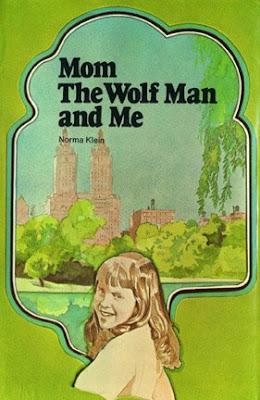
Today we probably wouldn’t blink an eye at this story, but in 1972 MOM, THE WOLF MAN AND ME was considered quite a shocking book.


Although I’m sure there were other “illegitimate children” in juvenile literature before 1972, this novel’s protagonist Brett was one of the first to talk about the fact that her parents never married. And, to make the story even more modern, Brett’s mom is living with another guy in anticipation of possibly getting married.

Reportedly, Norma Klein produced this novel in less than two weeks by writing ten pages a day. She continued to write at a prolific rate for the next two decades: picture books, middle-grade novels, young adult books, and adult fiction. One of her most successful books was actually a paperback novelization of the TV movie SUNSHINE. Her own work was usually edgier than that. She toppled taboos at every turn and was quite vocal about not getting the credit she deserved for her work. Her death at age fifty remains somewhat shrouded in mystery. I’ve only seen one book that alluded to the cause of death...and then only in a footnote.

MAMA DON’T ALLOW

In 1984, Thacher Hurd adapted the traditional song “Mama Don’t Allow” into a riotous picture book.


MAMA DON’T ALLOW won the Boston Globe-Horn Book Award in 1985. Nearly twenty years later, I found out that the Horn Book Magazine had decided to sell their library, which contained copies of nearly every book the magazine had reviewed. I was upset to learn this great collection was being dissolved and when the books started turning up for sale on the internet, I tried to “save” as many as I could. I thought it was especially important to preserve the Horn Book’s own copies of the Boston-Globe-Horn Book Award winners. Most are now sitting on shelves, with a “HORN BOOK” ink stamp on the front endpaper. Many are autographed, such as my copy of MAMA DON’T ALLOW, which also includes a sketch by Thacher Hurd!


SOMETIMES PEOPLE LEAVE YOU, HALFWAY THROUGH THE WOOD

Elizabeth Enright wrote some of the greatest children’s books of the twentieth century, but not many know that she also published several volumes of eloquent, beautifully-written stories for adults. One day I happened across the British edition of her adult volume DOUBLEFIELDS and discovered it was poignantly inscribed by Enright’s oldest son Nicholas.


Michele Murrary was not nearly as well-known as Elizabeth Enright. In fact, she had just begun her career in children’s books, publishing two well-received novels, NELLIE CAMERON and THE CRYSTAL NIGHTS -- the latter nominated for the Newbery Medal during that brief era when Newbery nominations were released to the public. Michele Murphy died at age forty in 1974; we can only wonder about how many great children’s books she might someday have written. I have never found autographed copies of her two children’s books, but I did find an adult volume of poetry that one of the author’s children signed:


A DAUGHTER WRITES ABOUT HER MOTHER

Author Crescent Dragonwagon has posted a thoughtful and sometimes painful essay about her mother, writer/editor Charlotte Zolotow, at http://crescentdragonwagon.typepad.com/. Look for the May 10, 2008 entry. For a fictional look at their relationship, you might also like to read Crescent Dragonwagon’s novel THE YEAR IT RAINED.

AND A SON WRITES ABOUT THE MOTHER HE HAD...OR WISHES HE HAD

One of the authors that Charlotte Zolotow discovered was Paul Zindel. A former high school science teacher, Zindel had written the play THE EFFECT OF GAMMA RAYS ON MAN-IN-THE-MOON MARIGOLDS, which would eventually go on to win the Pulitzer Prize for Drama. Ms. Zolotow saw an early production of the play on PBS and asked Zindel if he had ever thought about writing for teenagers. His first young adult book, THE PIGMAN, is one of the all-time greats, and he went on to write many more enduring novels. Anyone who has ever read Zindel’s complete body of work knows that he had a troubled relationship with his own mother. Many of his works feature variations on the same mother -- a high-strung kleptomaniac nurse who usually shows up with a milk bottle in hand. A milk bottle would seem to be a metaphor for a mother’s love and nurturing, but in Zindel’s books and plays it’s used as a method of humiliation. Despite the difficult, often shrewish, mothers who appear in Zindel’s dramas and young adult novels, when he eventually wrote his one and only picture book, this was the poignant title:


I find that so telling.

Happy Mother’s Day, everyone!