PAPER MEMORIES
Several years ago I took a trip to Toronto and stumbled across a store that sold nothing but paper ephemera -- illustrations, advertisements, and other pictures clipped from books, magazines, and calendars. Each illustration was neatly backed by a piece of cardboard and slipped inside a thin plastic bag. The pictures were stored upright in bins, the way old record albums used to be displayed in music stores. They were separated by subject dividers (fruits, musical instruments, fathers and sons, ladybugs) and you’d flip through them the same way we used to flip through lp records. At first I wasn’t exactly sure why this store existed. Why would someone pay $10 for a picture cut from a 1964 LIFE magazine? But I realized that some customers planned to frame these pictures as artwork; other customers were art students who needed sample illustrations of lions or zucchinis. Really, it was kind of a neat store. And I thought I’d finally found a job well-suited to my limited capabilities as an employee. Imagine just sitting around all day cutting pretty pictures from magazines!
I was thinking of that store in Toronto this morning as I flipped through one of my favorite Halloween books:
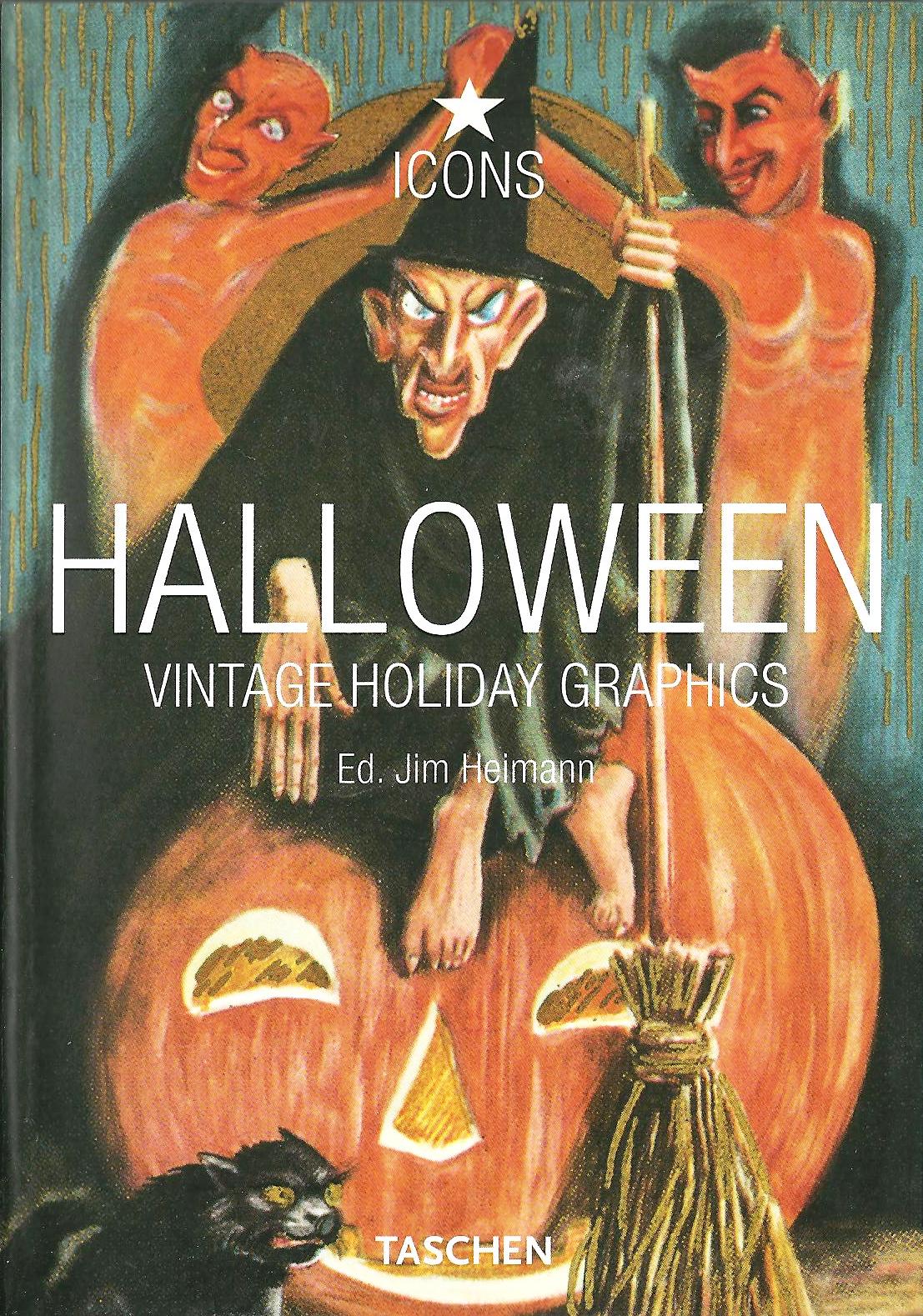
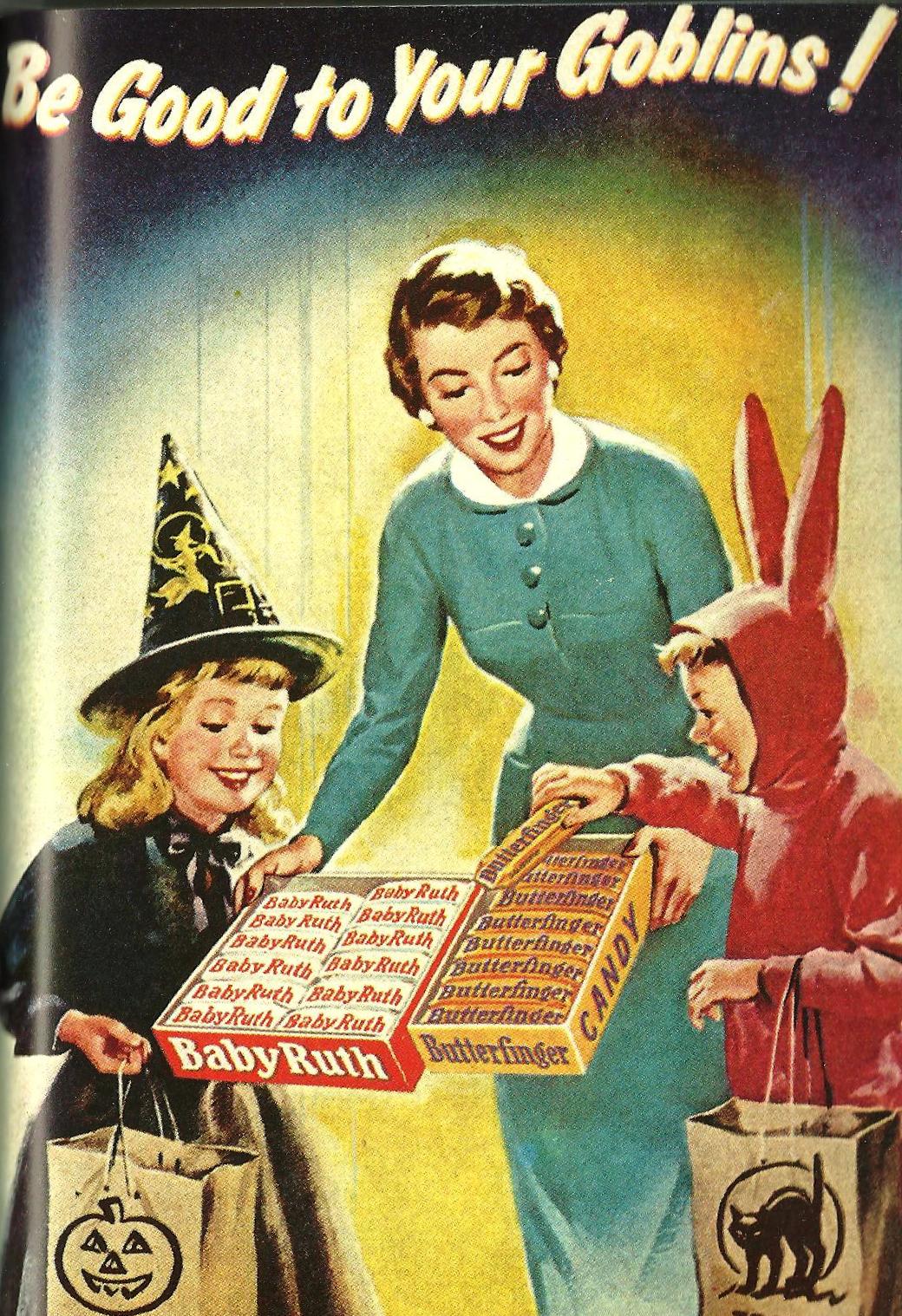
HALLOWEEN : VINTAGE HOLIDAY GRAPHICS, edited by Jim Heimann and published by Taschen as part of their “Icons” series, is like having the Halloween section of that Toronto paper store within the binding of a book. There are old ads, like the Baby Ruth piece above, that provide a nostalgic look at how Halloween was celebrated in the past. And paging through the book, you may find artwork from your own childhood. Our family had these very same cut-out decorations:
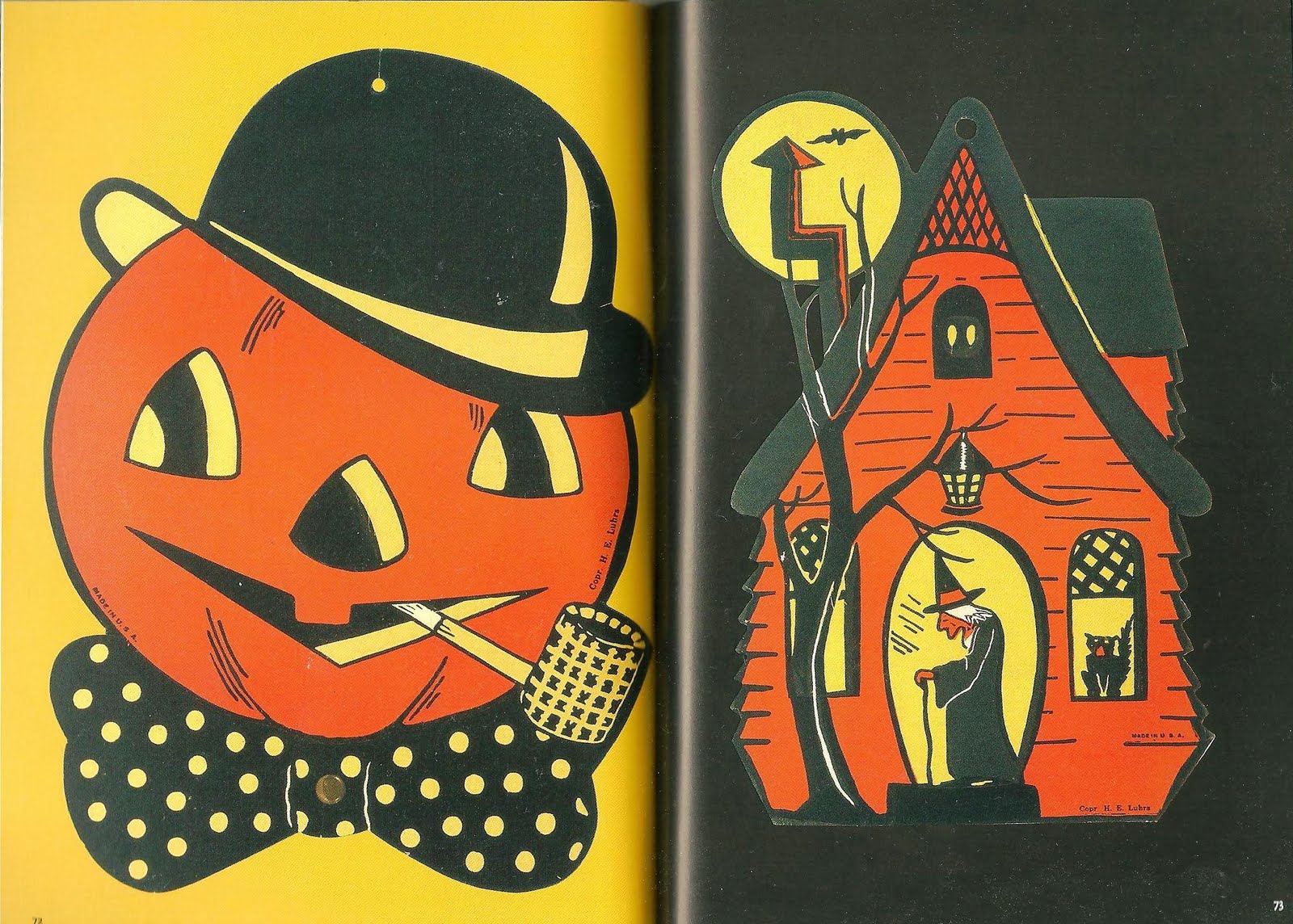
I particularly love the style of these old-school illustrations:

And look how many Halloween motifs are squeezed into this single illustration: a moon, a broom, a cat, a bat, kids bobbing for apples, and a witch in the Stella Dallas role:

I know these images aren’t from children’s books, but they are related to childhood. And wait -- there is at least one illustration with a kid-book connection. Here's a cover from the October 1934 CHILD LIFE magazine, whose contributors that month included two Newbery winners -- Rachel Field and Lois Lenski -- as well as Caldecott winners Dorothy Lathrop and Berta and Elmer Hader:

There are over 200 volumes in the Icons series, including books devoted to vintage Valentine’s and Christmas memorabilia.
BRING BACK THESE HALLOWEEN TREATS!
Spirits are said to arise from the dead on All Hallow’s Eve.
Well, if I had the power bring back books from the dead, here are two Halloween-themed novels that I’d conjure back to life.
For younger readers, I’d summon back THE LITTLE LEFTOVER WITCH by Florence Laughlin. Published by Macmillan in 1960, this perfectly-crafted narrative concerns a young witch who -- due a broom malfunction -- is trapped on earth from one Halloween until the next.

Taken in by Lucinda Doon and her family, Felina-the-witch transforms -- over the course of one year -- from a rather prickly and unlikable character to a charming and likable girl; her peaked witch’s hat is the last of her old life to go, ending up on the head of a snowman during the Christmas holidays. While the tone of the book occasionally gets a little sweet, the compact story is atmospheric and engaging. It’s hard to imagine most readers not falling under its spell.
For older readers, I’d bring back Charles P. Crawford’s 1972 novel BAD FALL. Like THE LITTLE LEFTOVER WITCH, this is a tightly-written and fast-paced tale. But while WITCH is the kind of book that some would classify as “a warm and cozy story,” BAD FALL is edgy and twitchy and unsettling.

Yet there’s not a witch in sight. The novel contains no ghosts, no vampires, and the only monsters are the human kind. Sean tells the story of his friendship with new-kid-in-town Wade Sabbat – a controlling relationship in which Wade slowly seduces Sean into shoplifting and bullying other kids over the course of one autumn season…a “bad fall”…all leading up to Halloween and an abrupt, uncompromising conclusion. Today I came across this comment about BAD FALL from an Amazon.com customer in Minnesota:
I have never been much of a novel reader, but in the mid 1970s, when I was around 11 or 12 years old, I saw this paperback on a table in the front porch of our house. It was a hot, boring summer and I had nothing better to do so I picked it up...having never heard of the book or being familiar with the author.
Several hours later I finally put it down and my life was changed. Not only did I relate to the characters in the book as I had never done before, but it was the first novel that I read that spoke to me. I understood the isolation of the character of Sean and how he could find the wickedness of his new found pal Wade so appealing. The book stimulated in me a love for novels that, for a time, surpassed my fondness for biography, current events and science. To this day, I credit Crawford's work every time I reach for a novel instead of another type of work.
That’s pretty powerful praise, but then the BAD FALL is a pretty powerful book.
I think both THE LITTLE LEFTOVER WITCH and BAD FALL should join the “undead” by being published in new editions for twenty-first century readers.
TRICKSTERS
Incidentally, the reason I used the paperback cover of BAD FALL above -- a picture I poached off the internet -- is because my hardcover copy of this book -- which featured a jagged jack-o-lantern on the cover -- is missing!
I was so careful packing and moving all my books to this new house, but so far I've discovered three titles missing. Strangley, one of the other missing books is also by Charles P. Crawford, THREE-LEGGED RACE.
Obviously I have to do an inventory of my library very soon. I wonder how many other books are missing that I haven't noticed. I wonder what literary Halloween tricksters took or hid them from me?
HAVE YOU SEEN THIS GHOST?
A blog reader sent in a query about a seasonally-themed volume. Does this book ring a bell with anyone?
I'm searching for a book of ghost stories I saw back in 1972. It was in my elementary school library in Ottawa, Canada. It was a drawn and painted illustration of a young confederate ghost and plantation house on cover. The back cover had a few more soldier ghosts floating along in the dark swampy mist.
This illustration actually does sound familiar to me…but I can’t recall a title and a quick look through our library shelves didn’t shake up any ghosts. But I’m anxious to help this reader because he credits that book cover with influencing his current hobby/occupation of creating ghost art. I always love to hear that a children’s book ending up changing one’s entire life and career…so I’d love to be able to track down this book for him. Do you have any ideas?
SEE, I’M NOT THE ONLY ONE
Last week I wrote about having heebie-jeebies at the prospect of writing a world-famous Newbery-winning author. I’ve often wondered if I’m the only person who gets awestruck at the prospect of having contact with a literary idol. I found out I am in good company.
Brian Wilhorn, a teacher from Wisconsin who writes the “Help Readers Love Reading” blog wrote to tell of his experience sharing the novel HOPE WAS HERE with his classes. When the students discovered what they believed to be an error in the book, they did some research, then asked Mr. Wilhorn to contact the author. He was nervous. Brian shares the story on his blog, beginning here and continuing for the rest of the week. Not only does the blog contain the students’ letter to Joan Bauer, but it also includes her response, a review of HOPE WAS HERE, and a list of all the political topics mentioned in this novel.
WHEN I’M CALLING YOU
Back when I was growing up in the Jurassic era, whenever we went to friends’ houses, we would stand outside the door (usually the back or side door for some reason) and call their names until they answered. I remember standing in the cold, stamping my feet on people’s porches and calling-calling-CALLING, never knowing if the family inside could hear me or if they were home at all. Also, you never knew whether to kick it up a notch to make SURE they were home or call more quietly so their neighbors wouldn’t get mad at you for disturbing the peace. Two-syllable names were great for calling. One-syllable names didn’t work as well. If a friend had a single-syllable name, you usually had to add a syllable to it when calling, so “Liz” became “LEEEE-uz!” and “Tim” became “TEEE-um.”
This was in the sixties, in the Midwest.
Did you “call” your friends too, or was that something we did only in my area and era?
I’ve noticed that the days of “calling” seem to be over. In recent years, I’ve seen even teeny-tiny kids approach their friends’ front doors (we had to use the back door!) and knock or ring the bell like little adults. These days they probably don’t even do that. Now they probably TEXT from the driveway!
Anyway, even though there seems to be a tradition of “calling,” at least when I was growing up, I am hard-pressed to think of a single example of kids “calling their friends” from the porch or back door in any children’s book past or present.
Can you re-“call” any examples from literature?
ON THE EDGE
Last Sunday I wrote about words being printed on the fore-edge of Pittacus Lore’s I AM NUMBER FOUR as part of the book’s design. Since then, a couple people have suggested I check out the writings of dustjacket designer and novelist Chip Kidd. A bookselling friend reported, “He said he did his novel CHEESE MONKEYS that way, with words on the side, because he remembered writing on his books in high school to show it was his book, same in college.” My friend said that, depending on how you look at the edge of the book, it either says GOOD IS DEAD or DO YOU SEE.
I’ve got to track down a copy of that!
THE KNEEBONE’S CONNECTED TO THE....
I probably never would have picked up THE KNEEBONE BOY on my own accord. I hate the cover with its awful staring kids (I thought of them as Wednesday, Pugsley, and Cousin It) and am not at all fond of books where characters have last names like “Hardscrabble.” Well, it’s okay when Dickens does it, but otherwise I find it a rather arch and lemony (if you know what I mean) device that almost always signals a parody and makes me think I shouldn’t take the book too seriously. I find this kind of affected writing usually provides more style than substance. Still, a great many people whose opinions I respect are trumpeting this book -- with at least one saying it deserves Newbery consideration -- so I knew I’d better read it.

Thirteen-year-old Otto Hardscrabble (who suffers from that disease which impacts children’s book characters in epidemic proportions – elective mutism) and his younger siblings Lucia and Max live in the English village of Little Tunks. Their mother is missing. Their artist father frequently leaves town to paint portraits of deposed royalty. When Dad must quickly go away on business, the kids end up -- through a series of confusions and complications (let’s call the “unfortunate events”) -- traveling to a seaside village where they find lodgings in a miniature castle, meet their surprisingly-young great aunt, and learn the local legend of the Kneebone Boy, who was kept captive in his own family’s castle many years earlier.
The book contains some intriguing elements, including an unidentified narrator (“I can’t tell you which Hardscrabble I am – Otto, Lucia, or Max – because I’ve sworn on pain of torture not to”) but the story takes a long time to get going (it’s ages before we hear much about the Kneebone Boy) and the conclusion is darker, sadder and more “real world” than the whimsical antics that have led up to it. The denouement also opens up a whole new set of questions that probably shouldn’t be examined too closely or the whole plot of the book gets shaky.
The arch prose makes Otto, Lucia, and Max seem remote, while other characters, such as Great-aunt Haddie, remain vague and contradictory. And while the kids sound British enough in their dialogue, the narrative of the book -- which is supposed to have been written by one of the siblings -- doesn’t much reflect the “Britishness” of the narrator. One seldom feels an English kid is telling this story.
THE KNEEBONE BOY has entertaining moments, yet some readers may find that reaching the jarring and unsatisfying conclusion after nearly 300 pages of stylized writing matches the dictionary definition of “hardscrabble” -- yielding meagerly in return for much effort.
WOULD YOU LIKE TO BE “DISCOVERED”?
It may only take 250 words.
I just received this press release and thought I’d pass it on to my competitors…I mean, blog readers:
Have a young adult novel—or a YA novel idea—tucked away for a rainy day? Are you putting off pitching your idea simply because you’re not sure how to pitch an agent? No problem! All you have to do is submit the first 250 words of your novel and you can win both exposure to editors, and a reading of your manuscript from one of New York’s TOP literary agents Regina Brooks.
Regina Brooks is the founder of Serendipity Literary Agency and the author of Writing Great Books for Young Adults. Brooks has been instrumental at establishing and building the careers of many YA writers, including three-time National Book Award Honoree and Michael Printz Honoree Marilyn Nelson, as well as Sundee Frazier—a Coretta Scott King Award winner, an Oprah Book Pick and an Al Roker book club selection. As an agent, she is known for her ability to turn raw talent into successful authors.
NOVEMBER IS NaNoWriMo: In honor of National Novel Writing Month (NaNoWriMo.org)—an international event where aspiring novelists are encouraged to write an entire novel in 30 days—this contest is meant to encourage the aspiring YA author to get started on that novel by offering an incentive for completing the first 250 words.
HERE’S HOW IT WORKS: The top 20 submissions will all be read by a panel of five judges comprised of top YA editors at MacMillan, Scholastic, Candlewick, Harlequin, Sourcebooks and Penguin. The first 100 will receive free autographed copies of Writing Great Books for Young Adults by Regina Brooks. Of the 20, they will pick the top five submissions and provide each author with commentary. These five winners will also receive a free ONE YEAR subscription to The Writer magazine. ONE Grand Prize Winner will win a full manuscript reading and editorial consultation from Regina Brooks and free 10-week writing course courtesy of the Gotham Writer’s Workshop.
Please submit all entries via the contest website at WritingClasses.com/YAPitch. One entry per person; anyone age 13+ can apply. Open to the U.S. & Canada (void where prohibited). Entries for the YA Novel Discovery Contest will be accepted from 12:01am (ET) November 1 until 11:59pm (ET), November 30th
So enter now! http://bit.ly/YAContest
GREAT PRIZES: The Grand Prize Winner will have the opportunity to submit an entire manuscript to YA literary agent Regina Brooks AND receive a free, 10-week writing course, courtesy of Gotham Writers' Workshop.
The Top Five Entrants (including the Grand Prize winner) will receive a 15-minute, one-on-one pitch session with Regina Brooks, one of New York’s premier literary agents for young adult books. They will also receive commentary on their submissions by editors, Scholastic, Macmillan, Penguin, Harlequin, Candlewick, and Sourcebooks. In addition, they will receive a year’s subscription to The Writer magazine!
JUDGING: YA literary agent Regina Brooks and her team , will read all of the entries and determine the top 20 submissions. These submissions will then be read by Nancy Mercado, Executive Editor at Roaring Brook Press(Macmillan); Nicole Raymond, Editor at Candlewick; Cheryl Klein, Senior Editor at Arthur Levine Books (Scholastic); Leila Sales, Editor Viking (Penguin) Evette Porter, Editor at Harlequin and Leah Hultenschmidt, Executive Editor at Sourcebooks. These judges will whittle the top 20 down to five, and each of the five winners will be provided commentary on their submissions.
I can’t vouch for the legitimacy of this contest, except to say that all the individuals and publishers listed above are highly reputable, so I assume this contest must be “the real thing.”
THOUGH I GUESS I SHOULDN’T BOTHER ENTERING….
I’ve mentioned before that I’m going to be one of the judges for the LA TIMES Book Prize in the Young Adult category. The books have been trickling in, though it’s a wonder they ever arrive consider no one ever spells my name correctly on the packages.
I guess I shouldn’t be surprised. My retirement fund has been sending me letters for TWENTY YEARS with my name spelled S-I-E-R-U-T-O. (I think it’s a plot. They’re going to wait till I try to claim my money and then tell me there is nobody by the name of Peter Sieruta in their fund, only Peter Sieruto -- who is obviously a different person.)
In the meantime, Random House:

is calling me Peter S-L-E-R-U-T-A, and Houghton Mifflin:

thinks I’m Peter S-T-E-R-V-T-A.
It’s no wonder I’ve never had the career I imagined. No one ever sends me book contracts or job offers -- or even advance reading copies! Meanwhile, somewhere in the United States, three guys named Peter Sieruto, Peter Sleruta, and Peter Stervta are sitting pretty, reaping the benfits of my labors!
HAPPY HALLOWEEN
Boy, it’s taken all day to write this blog. It’s now Halloween night. I’ve got my first fire of the season going in the fireplace and I’m going to sit down shortly to a traditional Stervta...I mean SIERUTA...Halloween meal of chili, cornbread, and cider. I’ve also got a pumpkin. In the spirit of “choose your own adventure books,” one side is scary:

and the other is smiling:

So now I can turn the pumpkin around to reflect whatever mood I’m in.
Happy Halloween! May you encounter more smiling pumpkins than scary ones on this dark and spooky night!