In the nearly ninety-year history of the Newbery Medal, five authors have been fortunate enough to receive the award twice.
E.L. Konigsburg won in 1968 (FROM THE MIXED-UP FILES OF MRS. BASIL E. FRANKWEILER) and 1997 (THE VIEW FROM SATURDAY.)
Katherine Paterson in 1978 (BRIDGE TO TERABITHIA) and 1981 (JACOB HAVE I LOVED.)
And Lois Lowry in 1990 (NUMBER THE STARS) and 1994 (THE GIVER.)
It's not surprising that these three are Newbery double-dippers. After all, they are among our finest contemporary authors. Each has produced a long list of extraordinary books praised by critics and loved by children.
However, it is somewhat surprising to consider the other two-time medalists, Jospeh Krumgold (...AND NOW MIGUEL, 1954 and ONION JOHN, 1960) and Elizabeth George Speare (THE WITCH OF BLACKBIRD POND, 1959 and THE BRONZE BOW, 1962.)
Although they are also distinguished novelists, Krumgold and Speare differ strikingly from the other two-timers in that their overall body of work is extremely small. In fact, I can count Speare's children's books on my left hand, Krumgold's on my right hand, and still have a finger left over to type this blog about them.
Mr. Krumgold won his first Newbery right out of the box with ...AND NOW MIGUEL. Six years later he won for his second children's book, ONION JOHN. In 1967 he published his last major novel, HENRY 3, followed by a slight storybook, THE MOST TERRIBLE TURK, in 1969. Although he lived another eleven years, he never published another word. So it's pretty amazing to think that out of only four children's books, he ended up winning the Big N twice.
Elizabeth George Speare's first children's book, 1957's CALICO CAPTIVE, was a notable debut. THE WITCH OF BLACKBIRD POND came just a year later and won the author her first Newbery. Three years later she was back at the podium accepting her second Newbery Medal for THE BRONZE BOW. Having published three superb books in five years, Ms. Speare appeared to be both a wonderful and a wonderfully-prolific author. However, after the nonfiction volume LIFE IN COLONIAL AMERICA in 1963, it would be another twenty years before she published her next -- and last -- children's novel, THE SIGN OF THE BEAVER. Incredibly this book was named a Newbery Honor. Pretty cool stats, huh? Five children's books. Two Newberys. One Newbery Honor.
This has gotten me thinking about the concept of quality vs. quantity. Not that those two terms are mutually exclusive, of course. The prolific Jane Yolen and Phyllis Reynolds Naylor have published literally hundreds of well-received books.
Other authors, including the aforementioned E.L. Konigsburg, Katherine Paterson, and Lois Lowry, carve out long, distinguished careers, consistently releasing a new volume every year or two to great acclaim.
Then there are those rare authors, such as Joseph Krumgold and Elizabeth George Spare, who publish relatively little...yet win children's literature's highest honors for their contributions.
I imagine that both Mr. Krumgold and Ms. Speare were under tremendous pressure -- from both publishers and readers -- to produce more books after their double-Newbery wins. One wonders what would have happened if they actually had gone on to publish a book every year or two for the rest of their lives. Would they have been able to maintain the high level of quality that distinguished ...AND NOW MIGUEL or THE WITCH OF BLACKBIRD POND? Might they have racked up several more Newberys? Or would future books have diluted and ultimately diminished the reputation of their early award-winners?
Who can say?
If you watch the Olympic track and field events, you know there are some athletes who specialize in long distances and others who excel in sprints. The gold medalist in the marathon doesn't have the speed to participate in the hundred yard dash, nor does the winner of the dash have the endurance to run the marathon.
Perhaps the same is true for authors. Some have the gift of writing a wide range of books over a long corridor of time. Others have a different set of skills that result in a body of work that is smaller -- but no less remarkable.
Wednesday, August 5, 2009

Sunday, August 2, 2009
Sunday Brunch for August 2, 2009
Today’s Sunday Brunch recalls the good old days of Yearling paperback books, shows off some treats from ALA, and ponders books about Reality TV....
FIRST TIME LUCKY
The other day I wrote a blog about Zilpha Keatley Snyder’s THE VELVET ROOM and now I can’t get Snyder out of my mind. Since writing that blog entry, several people have written to tell me about their own special Snyder books, such as 1970’s THE CHANGELING -- another real favorite of mine. Ms. Snyder belongs to that very small, select group of authors whose first manuscript was accepted by the first publisher that saw it. The author once mentioned this fact to a group of fellow writers, one of whom dramatically responded, "Stand back, everyone. I'm going to shoot her!" That first book was SEASON OF PONIES (1964), a title which not only introduced an exciting new author, but also brought a fresh illustrator into the field. Although authors generally have no say in who will illustrate their books, Ms. Snyder had submitted some drawings by Alton Raible -- an art instructor at the College of Marin, where Snyder’s husband taught -- to her editor and he was eventually chosen to illustrate SEASON OF PONIES. Mr. Raible went on to illustrate all of Snyder’s early books -- a perfect match, as his atmospheric, surreal, pebbly artwork was well-suited for the mystical qualities of these stories.
SEASON OF PONIES was published the same year as Maia Wojciechowska’s SHADOW OF A BULL. Wojciechowska viewed Snyder as her biggest threat for the Newbery Medal, but Maia ended up winning the prize while Zilpha’s novel wasn’t even named an Honor Book. However, three of Snyder’s titles would be designated Newbery Honors in the following few years. It’s a shame she never actually won the Big One.
EARLY EFFORTS
Every now and then you hear about famous authors who produced chapbooks or small self-published books when they were growing up. I believe Francesca Lia Block published one as a teenager. I know that Canadian author Jean Little released a small self-published book called IT’S A WONDERFUL WORLD back in 1947, when she was just fifteen years old. Even after she became a well-known author, Ms. Little continued to privately-publish small books as Christmas presents for friends and relatives. Her holiday gift for 1976, HEY WORLD, HERE I AM! was commercially published -- over a decade later -- by HarperCollins.
HEY WORLD! is a collection of poems written in the voice of Kate Bloomfield, a character first introduced in the 1970 novel LOOK THROUGH MY WINDOW. Anyone interested in books and writing should enjoy this story about, among other things, a creative writing club formed by a group of friends. There are fun “literary” touches throughout: a cat named William Shakespeare; references to the poems “Invictus,” “If,” “The Highwayman,” and “The Lady of Shallot,” and a scene in which a character, reading aloud from a Janice May Udry book, “turned the final page of A TREE IS NICE and sighed, as her listeners did, at the rightness of it.”
And then there’s the moment when one of the characters puts together a handmade poetry book and gives it to a friend for Christmas. The title? IT’S A WONDERFUL WORLD.
Joan Sandin illustrated LOOK THROUGH MY WINDOW and this is my absolute favorite illustration from the book. You may have to enlarge it (just click on the image) to see why I like it so much:

In LOOK THROUGH MY WINDOW, Kate’s parents own a bookstore and it’s clear that illustrator Joan Sandin visited an actual bookstore when she did this drawing, as so many of the details are just right. The reason I got such a kick out of this illustration when I read the book in 1970 -- and still get a nostalgic kick out of it when I read it today -- is that I recognize so many books on the shelves!
I don’t recognize the book near Mr. Bloomfield’s knee, but there’s HARRIET THE SPY sitting nearby.
One shelf up there’s STRAWBERRY GIRL and another I don’t recognize. (Any ideas?)
Above are CHARLOTTE’S WEB and STUART LITTLE.
Then there’s JOHNNY TREMAIN, THE WOLVES OF WILLOUGHBY CHASE and, I think, THE EMPTY SCHOOLHOUSE above that.
I always thought it was so cool that books I recognized -- that were, in fact, on my own shelves at home -- were featured in the illustrations of this novel.
YEARLING
Incidentally, all those covers represent Yearling Books.
I imagine that anyone who grew up reading in the late sixties/early seventies shares my fond memories of Dell Yearling Books?
At the time they were one of the few children’s paperback lines you could find in most bookstores. Distinguished by their identical trim size and logo of a fence-hopping foal, the Yearling titles were -- according to an inside note “designed especially to entertain and enlighten young people. The finest available books for children have been selected under the direction of Dr. Charles F. Reasoner, Associate Professor of Children’s Literature, New York University, and Dr. M. Jerry Weiss, Distinguished Professor of Communications, Jersey City State College.”
The variety of books offered by Yearling was pretty impressive, ranging from Newbery winners (RABBIT HILL) to translations to classics (surely the first paperback versions of CHARLOTTE’S WEB and STUART LITTLE) to modern books you’d never seen before. In fact, I will bet that most readers first encountered HARRIET THE SPY in her Yearling paperback incarnation. I say that because back then many library systems (including my own Detroit Public Library) didn’t/wouldn’t include HARRIET on their shelves back in the day. Ditto Judy Blume’s then-racy ARE YOU THERE, GOD? IT’S ME, MARGARET. and THEN AGAIN, MAYBE I WON’T, which the library didn’t carry but were passed eagerly around classrooms in their Yearling editions.
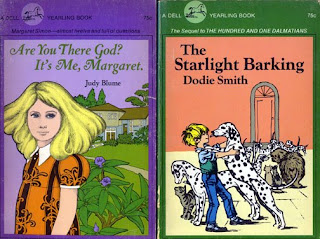
As a kid I was fascinated by these books and could barely wait to see what new Yearling titles would be on the shelves each time I visited the bookstore. I spent a lot of my paper route money on them, making brand-new discoveries or welcoming books I’d never been able to afford in hardcover (such as JOHNNY TREMAIN) onto my shelves in affordable paperback editions.
LIBRARY OF CONGRESS “LITERARY TIME CAPSULE”
Has anyone ever heard of this? I am doing research for an upcoming blog entry on Lurlene McDaniel’s “dying teen” books and keep seeing references to her novel SIX WEEKS TO LIVE being placed in a “literary time capsule” at the Library of Congress. This time capsule will not be opened until 2089.
Strangely, I can find no information of what other books were placed in this time capsule.
Does anyone know?
And though I understand the concept of time capsules in general, I’m not sure of the purpose for a literary time capsule. Isn’t a library in and of itself a kind of literary time capsule? Why bury books underground? Just keep them on the shelves till 2089!
REALITY TV BOOKS
What’s on the agenda for tonight? I hate to admit that I’ll probably be glued to the tube for an entire evening of reality television: BIG BROTHER, followed by THE NEXT FOOD NETWORK STAR, capped off by DESIGN STAR.
Yeah, I’m addicted to reality TV.
I’ll never forget the summer night SURVIVOR premiered. In the opening sequence they introduced the contestants: a truck driver, a retired Navy SEAL, a doctor...then they showed a sweet gray-haired woman identified as a cancer survivor. Right then I decided she’d probably win the game. I could envision the “feel good” conclusion to the series, with all the contestants banding together to help this “survivor” become THE final survivor in the game.
Well the contestants DID band together in that episode. They banded together to vote the little old lady off!
I was stunned.
And even more stunned when, several months later, the most conniving, underhanded, nastiest contestant of all ended up winning the entire game.
This was definitely a new kind of television. And one that was quickly excoriated by both TV writers and social critics. I understand the criticisms. These shows encourage people to behave badly. Some say they’re scripted...or at least closely-directed from the sidelines. Most of the contestants already seem to have some kind of show-biz/modeling background. I get all that...but I’m still hooked.
I probably wouldn’t even admit my addiction if it weren’t for the fact that, in my travels around the blogosphere, I’ve discovered that many children’s and young adult authors have expressed an interest in this television genre. Maybe they are drawn to the same qualities of reality TV that I am: the diversity of human behavior and the “truth is stranger than fiction” actions of the contestants. There’s a contrariness to the people on reality TV -- just like there is in life: good guys almost always end up disappointing you at some point...and bad guys usually have a redeeming moment that makes you look at them anew.
In recent years, several books for young people have placed their characters in reality TV situations. Titles include:
THE REAL REAL by Emma McLaughlin and Nicola Kraus
THE ACTUAL REAL REALITY OF JENNIFER JAMES by Gillian Shields
REALITY CHICK by Jennifer Barnholdt
LOSERVILLE by Peter Johnson
SURVIVING ANTARCTICA : REALITY TV 2083 by Andrea White
And then of course there is Suzanne Collins’ HUNGER GAMES and the forthcoming CATCHING FIRE. Not only do these novels have a reality show theme (the “Hunger Games” are played-out on televisions) but Ms. Collins herself has said that reality TV shows were one of the things that inspired this series. ...She probably didn’t mean that in a positive way, but still....
So you see: if it hadn’t been for shows such as SURVIVOR, we’d never have a great book like THE HUNGER GAMES on our shelves!
At least that’s what I keep telling myself.
ALA FREEBIES
A bookselling friend of mine recently attended the American Library Association conference in Chicago. A few days ago I received an envelope in the mail containing all manner of ephemera she picked up at the publishers’ tables: bookmarks, discussion guides, postcards....

It’s fascinating stuff and I was so glad to receive it. Discussion guides and reading group summaries seem to be the hot new thing. I wonder how one gets a job writing these?
TWO ISSUES
Another bookselling friend (do I have nice friends or what?) just gave me the new “Fall Children’s Announcements Issue” of Publishers Weekly. Published twice a year, in February (“Spring Children’s Announcements Issue”) and July, these two PW children book specials list all the titles being published by major publishers during the first and last halves of the year.
As you can see from this photo, my copy of the February issue is already worn, stained, crumpled, and well-used.

In a couple months, the new July issue will look the same. I love to browse through the pages, learning what is currently being published, noting trends in subject matter, and highlighting titles I can’t wait to read. The quality of the PW children’s book issues has fallen off this year. They always used to contain a major interview with a children’s creator and a preview of the next publishing season as well. I don’t think those components are still included.
But the magazines still make fascinating reading. And imagine: right now, with these two issues in my hand, I’m holding the titles and summaries of every new book published in 2009. Some will be classics...some forgotten. The names of the next Newbery and Caldecott winners are in these issues...we just don’t know what they are yet. The best book I ever read may be in these pages.
In a way, these two comprehensive magazine issues really could serve as a “time capsule” of children’s and young adult books, circa 2009.
Thanks for visiting Collecting Children’s Books.
FIRST TIME LUCKY
The other day I wrote a blog about Zilpha Keatley Snyder’s THE VELVET ROOM and now I can’t get Snyder out of my mind.
Since writing that blog entry, several people have written to tell me about their own special Snyder books, such as 1970’s THE CHANGELING -- another real favorite of mine. Ms. Snyder belongs to that very small, select group of authors whose first manuscript was accepted by the first publisher that saw it. The author once mentioned this fact to a group of fellow writers, one of whom dramatically responded, "Stand back, everyone. I'm going to shoot her!" That first book was SEASON OF PONIES (1964), a title which not only introduced an exciting new author, but also brought a fresh illustrator into the field. Although authors generally have no say in who will illustrate their books, Ms. Snyder had submitted some drawings by Alton Raible -- an art instructor at the College of Marin, where Snyder’s husband taught -- to her editor and he was eventually chosen to illustrate SEASON OF PONIES. Mr. Raible went on to illustrate all of Snyder’s early books -- a perfect match, as his atmospheric, surreal, pebbly artwork was well-suited for the mystical qualities of these stories. SEASON OF PONIES was published the same year as Maia Wojciechowska’s SHADOW OF A BULL. Wojciechowska viewed Snyder as her biggest threat for the Newbery Medal, but Maia ended up winning the prize while Zilpha’s novel wasn’t even named an Honor Book. However, three of Snyder’s titles would be designated Newbery Honors in the following few years. It’s a shame she never actually won the Big One.
EARLY EFFORTS
Every now and then you hear about famous authors who produced chapbooks or small self-published books when they were growing up. I believe Francesca Lia Block published one as a teenager. I know that Canadian author Jean Little released a small self-published book called IT’S A WONDERFUL WORLD back in 1947, when she was just fifteen years old. Even after she became a well-known author, Ms. Little continued to privately-publish small books as Christmas presents for friends and relatives. Her holiday gift for 1976, HEY WORLD, HERE I AM! was commercially published -- over a decade later -- by HarperCollins.
HEY WORLD! is a collection of poems written in the voice of Kate Bloomfield, a character first introduced in the 1970 novel LOOK THROUGH MY WINDOW. Anyone interested in books and writing should enjoy this story about, among other things, a creative writing club formed by a group of friends. There are fun “literary” touches throughout: a cat named William Shakespeare; references to the poems “Invictus,” “If,” “The Highwayman,” and “The Lady of Shallot,” and a scene in which a character, reading aloud from a Janice May Udry book, “turned the final page of A TREE IS NICE and sighed, as her listeners did, at the rightness of it.”
And then there’s the moment when one of the characters puts together a handmade poetry book and gives it to a friend for Christmas. The title? IT’S A WONDERFUL WORLD.
Joan Sandin illustrated LOOK THROUGH MY WINDOW and this is my absolute favorite illustration from the book. You may have to enlarge it (just click on the image) to see why I like it so much:

In LOOK THROUGH MY WINDOW, Kate’s parents own a bookstore and it’s clear that illustrator Joan Sandin visited an actual bookstore when she did this drawing, as so many of the details are just right. The reason I got such a kick out of this illustration when I read the book in 1970 -- and still get a nostalgic kick out of it when I read it today -- is that I recognize so many books on the shelves!
I don’t recognize the book near Mr. Bloomfield’s knee, but there’s HARRIET THE SPY sitting nearby.
One shelf up there’s STRAWBERRY GIRL and another I don’t recognize. (Any ideas?)
Above are CHARLOTTE’S WEB and STUART LITTLE.
Then there’s JOHNNY TREMAIN, THE WOLVES OF WILLOUGHBY CHASE and, I think, THE EMPTY SCHOOLHOUSE above that.
I always thought it was so cool that books I recognized -- that were, in fact, on my own shelves at home -- were featured in the illustrations of this novel.
YEARLING
Incidentally, all those covers represent Yearling Books.
I imagine that anyone who grew up reading in the late sixties/early seventies shares my fond memories of Dell Yearling Books?
At the time they were one of the few children’s paperback lines you could find in most bookstores. Distinguished by their identical trim size and logo of a fence-hopping foal, the Yearling titles were -- according to an inside note “designed especially to entertain and enlighten young people. The finest available books for children have been selected under the direction of Dr. Charles F. Reasoner, Associate Professor of Children’s Literature, New York University, and Dr. M. Jerry Weiss, Distinguished Professor of Communications, Jersey City State College.”
The variety of books offered by Yearling was pretty impressive, ranging from Newbery winners (RABBIT HILL) to translations to classics (surely the first paperback versions of CHARLOTTE’S WEB and STUART LITTLE) to modern books you’d never seen before. In fact, I will bet that most readers first encountered HARRIET THE SPY in her Yearling paperback incarnation. I say that because back then many library systems (including my own Detroit Public Library) didn’t/wouldn’t include HARRIET on their shelves back in the day. Ditto Judy Blume’s then-racy ARE YOU THERE, GOD? IT’S ME, MARGARET. and THEN AGAIN, MAYBE I WON’T, which the library didn’t carry but were passed eagerly around classrooms in their Yearling editions.
As a kid I was fascinated by these books and could barely wait to see what new Yearling titles would be on the shelves each time I visited the bookstore. I spent a lot of my paper route money on them, making brand-new discoveries or welcoming books I’d never been able to afford in hardcover (such as JOHNNY TREMAIN) onto my shelves in affordable paperback editions.
LIBRARY OF CONGRESS “LITERARY TIME CAPSULE”
Has anyone ever heard of this? I am doing research for an upcoming blog entry on Lurlene McDaniel’s “dying teen” books and keep seeing references to her novel SIX WEEKS TO LIVE being placed in a “literary time capsule” at the Library of Congress. This time capsule will not be opened until 2089.
Strangely, I can find no information of what other books were placed in this time capsule.
Does anyone know?
And though I understand the concept of time capsules in general, I’m not sure of the purpose for a literary time capsule. Isn’t a library in and of itself a kind of literary time capsule? Why bury books underground? Just keep them on the shelves till 2089!
REALITY TV BOOKS
What’s on the agenda for tonight? I hate to admit that I’ll probably be glued to the tube for an entire evening of reality television: BIG BROTHER, followed by THE NEXT FOOD NETWORK STAR, capped off by DESIGN STAR.
Yeah, I’m addicted to reality TV.
I’ll never forget the summer night SURVIVOR premiered. In the opening sequence they introduced the contestants: a truck driver, a retired Navy SEAL, a doctor...then they showed a sweet gray-haired woman identified as a cancer survivor. Right then I decided she’d probably win the game. I could envision the “feel good” conclusion to the series, with all the contestants banding together to help this “survivor” become THE final survivor in the game.
Well the contestants DID band together in that episode. They banded together to vote the little old lady off!
I was stunned.
And even more stunned when, several months later, the most conniving, underhanded, nastiest contestant of all ended up winning the entire game.
This was definitely a new kind of television. And one that was quickly excoriated by both TV writers and social critics. I understand the criticisms. These shows encourage people to behave badly. Some say they’re scripted...or at least closely-directed from the sidelines. Most of the contestants already seem to have some kind of show-biz/modeling background. I get all that...but I’m still hooked.
I probably wouldn’t even admit my addiction if it weren’t for the fact that, in my travels around the blogosphere, I’ve discovered that many children’s and young adult authors have expressed an interest in this television genre. Maybe they are drawn to the same qualities of reality TV that I am: the diversity of human behavior and the “truth is stranger than fiction” actions of the contestants. There’s a contrariness to the people on reality TV -- just like there is in life: good guys almost always end up disappointing you at some point...and bad guys usually have a redeeming moment that makes you look at them anew.
In recent years, several books for young people have placed their characters in reality TV situations. Titles include:
THE REAL REAL by Emma McLaughlin and Nicola Kraus
THE ACTUAL REAL REALITY OF JENNIFER JAMES by Gillian Shields
REALITY CHICK by Jennifer Barnholdt
LOSERVILLE by Peter Johnson
SURVIVING ANTARCTICA : REALITY TV 2083 by Andrea White
And then of course there is Suzanne Collins’ HUNGER GAMES and the forthcoming CATCHING FIRE. Not only do these novels have a reality show theme (the “Hunger Games” are played-out on televisions) but Ms. Collins herself has said that reality TV shows were one of the things that inspired this series. ...She probably didn’t mean that in a positive way, but still....
So you see: if it hadn’t been for shows such as SURVIVOR, we’d never have a great book like THE HUNGER GAMES on our shelves!
At least that’s what I keep telling myself.
ALA FREEBIES
A bookselling friend of mine recently attended the American Library Association conference in Chicago. A few days ago I received an envelope in the mail containing all manner of ephemera she picked up at the publishers’ tables: bookmarks, discussion guides, postcards....
It’s fascinating stuff and I was so glad to receive it. Discussion guides and reading group summaries seem to be the hot new thing. I wonder how one gets a job writing these?
TWO ISSUES
Another bookselling friend (do I have nice friends or what?) just gave me the new “Fall Children’s Announcements Issue” of Publishers Weekly. Published twice a year, in February (“Spring Children’s Announcements Issue”) and July, these two PW children book specials list all the titles being published by major publishers during the first and last halves of the year.
As you can see from this photo, my copy of the February issue is already worn, stained, crumpled, and well-used.
In a couple months, the new July issue will look the same. I love to browse through the pages, learning what is currently being published, noting trends in subject matter, and highlighting titles I can’t wait to read. The quality of the PW children’s book issues has fallen off this year. They always used to contain a major interview with a children’s creator and a preview of the next publishing season as well. I don’t think those components are still included.
But the magazines still make fascinating reading. And imagine: right now, with these two issues in my hand, I’m holding the titles and summaries of every new book published in 2009. Some will be classics...some forgotten. The names of the next Newbery and Caldecott winners are in these issues...we just don’t know what they are yet. The best book I ever read may be in these pages.
In a way, these two comprehensive magazine issues really could serve as a “time capsule” of children’s and young adult books, circa 2009.
Thanks for visiting Collecting Children’s Books.
Thursday, July 30, 2009
A Year Without a Newbery?
Back in 1917, a committee convened to select the very first Pulitzer prize winning novel.
The members of this committe would later report, "Of the five books submitted in competition, all but one seem to us unworthy of consideration for the prize. We are unanimously of the opinion, however, that the merits of this book, though considerable, are no greater than that of several other novels, which though not included in the formal applications, have been taken into consideration by us in arriving at a final verdict. We recommend that the award be withheld this year."
The inaugural Pulitzer novel was finally named the following year (HIS FAMILY by Ernest Poole), but in 1919 the committee again recommended no prize -- until a last-minute decision was made to honor Booth Tarkington's THE MAGNIFICENT AMBERSONS. In 1920 the prize was once again withheld.
And so it continued over the decades, with no Pulitzer given for a novel (the catetgory was later renamed "fiction" to include short story collections) in 1941, 1946, 1954, 1957, 1964, 1971, 1974, and 1977. During some of those years the jury simply felt no book was worthy of the prize; other times they selected a title (FOR WHOM THE BELL TOLLS by Ernest Hemingway in 1941; GRAVITY'S RAINBOW by Thomas Pynchon in 1973; A RIVER RUNS THROUGH IT by Norman Maclean in 1977) but were overruled by the Pulitzer advisory board.
It's rather jarring to read through a list of all the Pulitzer novel/fiction winners and stumble upon those "missing" years. One wonders if those years truly did suffer from subpar titles...or if the juries were just being extra picky. I feel bad for the authors whose careers and lives might have been changed if only they'd received Pulitzer recognition; their books may well have withstood the test of time and grown in importance over the years. After all, the non-winning FOR WHOM THE BELL TOLLS and A RIVER RUNS THROUGH IT hold up admirably well compared to some long-forgotten titles that actually have won the Pulitzer, such as 1933's THE STORE by T.S. Stribling or 1944's JOURNEY IN THE DARK by Martin Flavin.
Great Britain's children's book prizes, the Carnegie Medal (for the year's "outstanding book for children") and the Kate Greenaway Medal (for "distinguished illustration in a book for children,") have also occasionally declared years in which no title was deemed worthy of the award.
The Greenaway did this in 1955 and 1958.
In 1943, 1948, and 1966 the Carnegie was, to quote the winners' list, "withheld as no book considered suitable." Despite no prize being given in 1966, the committee did cite THE BAYEUX TAPESTRY : THE STORY OF THE NORMAN CONQUEST by Norman Denny and Josephine Flimer-Sankey as "highly commended" and THE WILD HORSE OF SANTANDER (Helen Griffiths), THUNDER IN THE SKY (K.M. Peyton) and MARASSA AND MIDNIGHT (Morna Stuart) as "commended." (Apparently "highly commended" translates into "close but no cigar.")
Here in the United States, our two major book prizes -- the Newbery and the Caldecott -- are awarded annually and the rules allow no option for withholding awards.
But what if they could?
While there are many years when a number of truly distinguished children's books vie against each other to win one of the top prizes, there are other years when nothing TRULY distinguished is published and the Newbery or Caldecott goes to an acceptable-but-not-brilliant book. Would it strengthen the merit, intention, and stature of the Newbery or Caldecott for those medals to simply be withheld during such years?
It's hard to imagine a Newbery or Caldecott committee reading, evaluating, and discussing books for many months...only to decide nothing quite deserves that year's award. That kind of decision would take a certain amount of bravery...and chutzpah. And withholding an award would have other ramifications as well. It could hurt the sales of children's books and would certainly cast quite a pall over the one day per year that's devoted to celebrating children's books.
However, it certainly would get people talking -- and arguing, debating, and thinking about the state of children's books is always a good thing.
Subscribe to:
Posts (Atom)